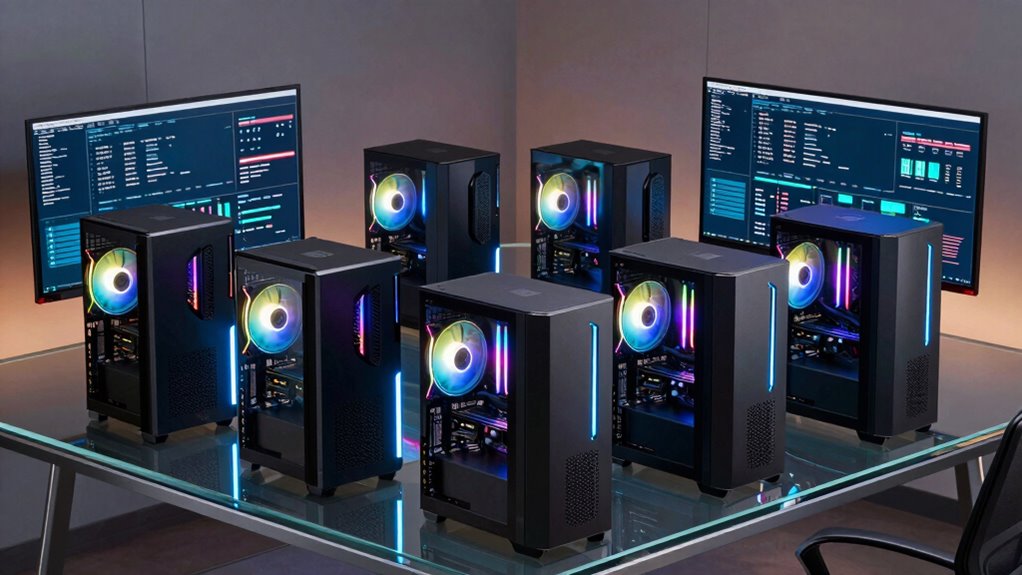

If you’re exploring EPYC workstations, you’re likely seeking powerful, scalable, and reliable systems for demanding workloads. The AMD EPYC 9965 stands out as the best overall choice due to its unmatched core count and high-end GPU support, ideal for intensive AI and data science tasks. The EPYC 9754 offers an excellent balance of performance and affordability for enterprise servers, while the Tyan S8050GM4NE-2T provides a robust motherboard option for custom builds. Each of these options highlights different priorities—whether raw power, value, or expandability—highlighting that the right pick depends on your specific use case. Keep reading for the full breakdown and help narrowing your decision.

Get the latest gadgets delivered free with Prime
- Fast, free delivery on millions of items
- Prime Video, Amazon Music and more included
- Member-only deals all year
Complete the kit

Key Takeaways
- High core counts, like in the EPYC 9965, are essential for parallel processing but come with increased costs and power consumption.
- Motherboards such as the Tyan S8050GM4NE-2T enable flexible customization but require technical expertise to assemble and configure.
- Workstations with integrated GPU options like the AMD EPYC 9965 with NVIDIA RTX PRO 6000 significantly boost AI and rendering performance.
- Choosing between server-grade CPUs and workstations involves balancing performance needs against budget and complexity.
- Scalability and future-proofing are major factors—look for systems that can upgrade RAM, storage, and GPUs as your workload grows.
| Tyan S8050GM4NE-2T Server Motherboard with SP5 Socket for AMD EPYC 9004 CPU |  | Best for Enterprise Server Applications | Processor Socket: SP5 | Memory Slots: 8 | Memory Speed: DDR5 4800 MHz | VIEW ON AMAZON | See Our Full Breakdown |
| AMD Epyc 9135 Processor 3.65 GHz 64 MB L3 Cache |  | Best for Reliable Enterprise Processing | Brand: AMD | Model Number: 100-000001150 | Processor Speed: 3.65 GHz | VIEW ON AMAZON | See Our Full Breakdown |
| ASRock Rack ROMED8-2T/BCM ATX Server Motherboard for AMD EPYC 7003 and 7002 Series Processors |  | Best for High-Performance, Flexible Server Building | Form Factor: ATX (12″ x 9.6″) | Socket: LGA 4094 (SP3) | Supported Processors: AMD EPYC 7003/7002 series | VIEW ON AMAZON | See Our Full Breakdown |
| Tyan FT65TB8030 B8030F65TV8E2H-G EPYC GPU Server 1S Professional Workstation with 8 LFF & 2 NVMe U.2 Bays |  | Best for GPU-Accelerated Workstation Tasks | Supported Motherboard: ATX | Case Type: Full Tower | Drive Bays: 8 LFF & 2 NVMe U.2 | VIEW ON AMAZON | See Our Full Breakdown |
| AMD EPYC 9754 128-Core Bergamo Processor, 2.25GHz, Socket SP5, 256MB L3 Cache, Unlocked Server CPU |  | Best for Massive Scalability and Heavy Multi-Core Workloads | Processor Series: AMD EPYC 9004 | Core Count: 128 cores | Thread Count: 256 threads | VIEW ON AMAZON | See Our Full Breakdown |
| AMD EPYC 9965 192-Core AI Workstation PC with Triple NVIDIA RTX PRO 6000 GPUs, 768GB RAM, 8x96GB DDR5-5600 ECC, 2x4TB Gen5 NVMe SSD, Windows 11 Pro |  | Best for AI and Deep Learning Professionals | Processor: AMD EPYC 9965 192-Core | Graphics: Triple NVIDIA RTX PRO 6000 96GB | Memory: 768GB DDR5-5600 ECC RDIMM | VIEW ON AMAZON | See Our Full Breakdown |
More Details on Our Top Picks
Tyan S8050GM4NE-2T Server Motherboard with SP5 Socket for AMD EPYC 9004 CPU
This motherboard stands out for its extensive high-speed connectivity tailored to large-scale server deployments, supporting AMD EPYC Genoa processors with a robust set of PCIe 5.0 slots and multiple LAN ports. Compared with the AMD EPYC 9754, it lacks integrated processing power but offers greater flexibility in building a customized server environment. The complex setup makes it less suitable for those without technical expertise, and its enterprise focus means it’s not ideal for smaller or less demanding workloads. Its support for DDR5 RAM and multiple SATA and NVMe ports makes it perfect for data centers needing scalability and extensive connectivity, though it comes with limited information on pricing and availability.
Pros:- Supports high-performance AMD EPYC Genoa processors
- Multiple DDR5 memory slots for large RAM capacity
- Numerous PCIe 5.0 and LAN ports for extensive connectivity
- Designed specifically for enterprise server environments
Cons:- Complex installation requiring specialized knowledge
- Limited consumer-level features or user-friendly design
- No integrated graphics or GPU support
Best for: IT professionals designing enterprise-grade server infrastructure with high connectivity needs
Not ideal for: Small businesses or individual users seeking a plug-and-play workstation setup
- Processor Socket:SP5
- Memory Slots:8
- Memory Speed:DDR5 4800 MHz
- Total SATA Ports:12
- Number of Ethernet Ports:5
- Form Factor:12″x10.5″
- Chipset:AMD 785E
- NVMe Slots:2
Our verdict“This motherboard makes the most sense for IT teams building scalable, high-performance server solutions rather than casual or small-scale use.”
AMD Epyc 9135 Processor 3.65 GHz 64 MB L3 Cache
The AMD Epyc 9135 shines with its high base clock speed of 3.65 GHz and large 64 MB L3 cache, making it a strong choice for enterprise workloads that demand consistent performance, especially compared with the AMD EPYC 9754, which offers more cores but at a higher power cost. Its focus on reliability and efficiency suits data centers and enterprise servers rather than desktop PCs, and it lacks integrated graphics or overclocking features. While it provides solid processing power, its high price tag and server-centric design mean it’s not ideal for casual workstation users. This processor excels in environments where stability and speed are more critical than raw core count or multitasking capacity.
Pros:- High base clock speed for responsive processing
- Large 64 MB L3 cache enhances performance
- Reputable AMD brand with proven reliability
- Designed specifically for server environments
Cons:- Limited to server use, not suitable for desktops
- No integrated graphics or overclocking options
- Potentially high cost for individual purchase
Best for: Data center operators and enterprise server administrators needing dependable, high-speed processing
Not ideal for: Small business owners or creatives requiring high core counts for multitasking or creative workloads
- Brand:AMD
- Model Number:100-000001150
- Processor Speed:3.65 GHz
- L3 Cache:64 MB
- Item Weight:9.6 ounces
- Warranty:See product page for details
Our verdict“This processor is ideal for enterprise environments prioritizing speed and reliability over core quantity or gaming capabilities.”
ASRock Rack ROMED8-2T/BCM ATX Server Motherboard for AMD EPYC 7003 and 7002 Series Processors
Compared to the Tyan S8050GM4NE-2T, this ASRock Rack motherboard provides a more accessible form factor and easier setup for those building high-performance servers with AMD EPYC 7003 or 7002 series processors. It supports AMD 3D V-Cache technology, boosting performance for cache-sensitive workloads. Its dual 10GbE ports cater to high-speed networking, and its PCIe 4.0 slots offer ample expansion options. However, its need for technical expertise and lack of integrated graphics make it less suitable for casual users or simple desktop setups. For organizations seeking a versatile, expandable server solution with advanced cache features, this motherboard offers a compelling balance of performance and flexibility.
Pros:- Supports AMD EPYC 7003/7002 with AMD 3D V-Cache
- Multiple PCIe 4.0 slots for expansion
- Dual 10GbE ports for fast networking
- Extensive storage options with M.2 and SATA ports
Cons:- Requires technical expertise for setup
- No integrated graphics support
- Limited to server and workstation applications
Best for: System builders and IT teams designing high-performance AMD EPYC-based servers
Not ideal for: End users looking for straightforward, consumer-friendly workstations
- Form Factor:ATX (12″ x 9.6″)
- Socket:LGA 4094 (SP3)
- Supported Processors:AMD EPYC 7003/7002 series
- Memory Slots:8
- Max Memory Speed:2133 MHz
- PCIe Slots:7 PCIe 4.0 x16
- Storage Support:2 M.2, 10 SATA
- Network Ports:2 x 10GbE
Our verdict“This motherboard is best suited for advanced users who need a flexible, high-performance platform for enterprise or high-end workstation builds.”
Tyan FT65TB8030 B8030F65TV8E2H-G EPYC GPU Server 1S Professional Workstation with 8 LFF & 2 NVMe U.2 Bays
This Tyan workstation excels in environments where high storage capacity and GPU acceleration are needed, offering support for AMD EPYC processors, multiple hot-swappable drive bays, and extensive PCIe slots. Unlike the ASRock Rack ROMED8-2T/BCM, it emphasizes GPU compatibility and storage flexibility, making it suitable for AI, rendering, or data analysis workloads. Its plastic case and professional-grade design suggest durability but may not appeal to casual users looking for sleek aesthetics. Its focus on professional use means it’s less suited for casual or small-scale setups, but for demanding computational tasks, the combination of multiple NVMe U.2 bays and GPU support makes this an appealing choice.
Pros:- Supports AMD EPYC processors and high-performance GPUs
- Multiple hot-swappable LFF and NVMe U.2 drive bays
- Extensive PCIe expansion slots for GPUs and accelerators
- Designed for high-end professional workloads
Cons:- Complex setup and maintenance
- Plastic enclosure may be less durable
- No integrated GPU or display options
Best for: AI researchers, data scientists, and GPU-accelerated workstation users needing extensive storage and GPU options
Not ideal for: Home users or small offices seeking a simple, compact workstation
- Supported Motherboard:ATX
- Case Type:Full Tower
- Drive Bays:8 LFF & 2 NVMe U.2
- Supported Processors:AMD EPYC
- Expansion Slots:Multiple PCIe 4.0
- Power Supply Mounting:Bottom
Our verdict“This workstation is tailored for users requiring maximum GPU and storage expansion capacity for demanding computational tasks.”
AMD EPYC 9754 128-Core Bergamo Processor, 2.25GHz, Socket SP5, 256MB L3 Cache, Unlocked Server CPU
The AMD EPYC 9754 is designed for the most demanding data center applications, with 128 cores and 256 threads, far surpassing the core count of other options like the AMD EPYC 9135. Its high core and thread counts enable exceptional scalability for virtualization, AI, and large-scale enterprise workloads. However, its 360W TDP demands a robust cooling solution, which can complicate system design, and its locked multiplier limits overclocking potential. For organizations prioritizing raw processing power and multi-threaded performance over power efficiency or consumer features, this CPU offers unmatched scalability, though at a high operational cost.
Pros:- Unmatched 128-core, 256-thread performance
- Supports latest DDR5 and PCIe 5.0 technologies
- Ideal for virtualized and multi-threaded workloads
- Built on advanced 5nm process technology
Cons:- Extremely high power consumption (TDP 360W)
- No integrated graphics, requiring additional GPU
- Locked multiplier limits overclocking
Best for: Large-scale data centers and high-performance compute clusters needing maximum core density
Not ideal for: Small enterprises or individual professionals seeking a balanced, energy-efficient workstation
- Processor Series:AMD EPYC 9004
- Core Count:128 cores
- Thread Count:256 threads
- Base Clock:2.25 GHz
- Boost Clock:up to 3.1 GHz
- L3 Cache:256MB
- Socket:SP5
- Process Technology:5 nm
Our verdict“This CPU is best suited for organizations scaling out massive multi-core, high-throughput computing environments rather than individual workstations.”
AMD EPYC 9965 192-Core AI Workstation PC with Triple NVIDIA RTX PRO 6000 GPUs, 768GB RAM, 8x96GB DDR5-5600 ECC, 2x4TB Gen5 NVMe SSD, Windows 11 Pro
This workstation stands out for its staggering 192-core AMD EPYC 9965 processor, which dwarfs most other options like the AMD EPYC 9135 in raw core count, making it ideal for intensive AI training and large-scale data processing. Its 768GB of DDR5 RAM allows handling massive datasets without bottlenecks, unlike typical workstations with 64GB or 128GB. The triple NVIDIA RTX PRO 6000 GPUs deliver unmatched graphics performance for rendering, 3D modeling, or AI acceleration, surpassing configurations with fewer GPUs. However, this power comes at a price—both financially and in operational complexity—requiring a 2800W titanium power supply and a dedicated 240V outlet, which limits flexibility. Its substantial weight (75 pounds) and high power draw make it less suited for mobility or small office environments. This pick is best for organizations running the most demanding AI or rendering workloads where top-tier performance justifies the cost and setup effort.
Pros:- Unmatched 192-core AMD EPYC CPU delivers extreme processing power
- Massive 768GB DDR5 RAM supports large-scale data workloads
- Triple NVIDIA RTX PRO 6000 GPUs excel at graphics-intensive tasks
- Pre-installed Windows 11 Pro ensures immediate productivity
Cons:- Extremely high power consumption requiring specialized electrical setup
- Heavy weight and size reduce portability and complicate relocation
- Premium components lead to very high purchase and maintenance costs
Best for: AI researchers, deep learning teams, and engineering firms needing maximum processing and graphics power.
Not ideal for: Small startups or individual professionals with limited budgets or space constraints, as the high cost and size are prohibitive.
- Processor:AMD EPYC 9965 192-Core
- Graphics:Triple NVIDIA RTX PRO 6000 96GB
- Memory:768GB DDR5-5600 ECC RDIMM
- Storage:2x4TB Gen5 NVMe SSD
- Operating System:Windows 11 Pro
- Power Supply:2800W Titanium PSU
- Chassis:EPC Pro 2 Server chassis
- Weight:75 pounds
Our verdict“This workstation makes the most sense for large organizations with critical, resource-intensive AI or rendering demands and the budget to match.”
How We Picked
Our selection process focused on identifying systems that leverage AMD EPYC processors to deliver exceptional performance in workstation environments. We prioritized hardware configurations that balance core count, scalability, and GPU support, ensuring suitability for demanding tasks like AI, rendering, or large-scale data analysis. Cost-effectiveness and expandability played key roles, alongside build quality and manufacturer support. The ranking reflects a combination of raw performance, value for money, and the versatility of each system to adapt to evolving professional needs.Factors to Consider When Choosing Epyc Workstation
Choosing an EPYC workstation involves more than just selecting the latest CPU. You’ll need to consider factors like core count, GPU compatibility, expandability, and system stability. Each of these impacts your workflow, future upgrades, and total cost of ownership. Understanding these broader considerations helps avoid common pitfalls, such as overpaying for unnecessary features or underestimating cooling and power requirements.Processor Core Count and Performance
While a high core count can dramatically improve multi-threaded workloads, it often comes with increased power consumption and heat generation. For tasks like AI training or large-scale rendering, more cores mean faster processing. However, if your workload is less parallel, investing in a mid-range EPYC processor can save costs without sacrificing performance. Balance your core needs with your cooling and power supply capabilities to avoid bottlenecks.
GPU Support and Compatibility
Many professional applications rely heavily on GPU acceleration. When choosing an EPYC workstation, consider systems that support multiple high-end GPUs, especially if you work with AI, deep learning, or 3D rendering. Compatibility with NVIDIA RTX PRO or AMD Radeon Instinct cards can make a significant difference. Be aware that adding GPUs may require enhanced power supplies and advanced cooling solutions, which can increase overall system cost.
Scalability and Upgradability
Look for systems that allow easy upgrades in RAM, storage, and GPU options. This flexibility extends the lifespan of your investment and helps adapt to increasing workload demands. Conversely, proprietary or closed systems can limit future expansion, forcing costly replacements. Prioritize motherboards and chassis that support multiple expansion slots, M.2 or U.2 storage, and sufficient RAM slots for your needs.
Build Quality and Reliability
Workstations often operate under heavy loads for extended periods, making durability and cooling essential. Choose systems from reputable manufacturers with good reviews for reliability. Features like redundant power supplies, advanced cooling solutions, and high-quality components reduce downtime and maintenance costs. Remember, higher initial costs can often translate into longer-lasting, more dependable systems.
Cost, Budget, and Total Value
While top-tier EPYC systems can be expensive, focusing solely on initial price might lead to overlooked expenses like increased power bills or frequent repairs. Balance your budget against the performance and scalability features you need. Sometimes, a mid-range CPU with a good motherboard and GPU support offers better value than the most expensive configuration. Consider long-term needs and potential upgrades when evaluating costs.
Frequently Asked Questions
Is an EPYC-based workstation worth it for small teams or individual professionals?
EPYC-based workstations are generally best suited for large-scale, multi-threaded workloads like AI, data analysis, and rendering. For small teams or individual professionals, a high-performance mainstream CPU may deliver comparable results at a lower cost and complexity. However, if your work involves intensive parallel processing or future scalability, investing in EPYC hardware can pay off over time.
Can I upgrade an EPYC workstation later if my needs grow?
Yes, many EPYC workstations are designed with scalability in mind, featuring multiple RAM slots, PCIe slots for GPUs, and storage options. Choosing a system with a modular design or a high-quality motherboard allows you to upgrade components like RAM, SSDs, and GPUs as your workload demands increase. Planning for future upgrades from the start can extend the lifespan and utility of your investment.
How important is GPU support in choosing an EPYC workstation?
GPU support is critical if your tasks involve rendering, AI training, or data science. Many EPYC systems now offer multiple PCIe slots and support for high-end NVIDIA or AMD GPUs, which can drastically accelerate workloads. Failing to consider GPU compatibility can limit your workstation’s effectiveness in professional environments that rely on GPU-accelerated applications.
Are enterprise server CPUs like EPYC compatible with standard workstation components?
While EPYC processors are primarily designed for servers, many motherboards and systems are tailored for workstation use, offering compatibility with standard RAM and PCIe components. However, EPYC CPUs often require specialized motherboards and cooling solutions, making assembly more complex. Ensuring compatibility before purchase helps avoid costly mismatches or performance issues.
When should I consider investing in a high-core-count EPYC processor?
High-core-count EPYC processors are ideal if your workloads are highly parallelizable, such as large-scale simulations, AI training, or massive rendering tasks. They provide significant performance benefits in multi-threaded environments but come with increased power use and costs. For less demanding tasks, a mid-range EPYC or even a high-end consumer CPU might deliver better value.
Conclusion
For large enterprises or professionals working with AI, data science, or heavy rendering, the AMD EPYC 9965 offers unmatched processing power and GPU support, making it the best overall choice. Budget-conscious buyers or those just starting with high-performance workloads will find the EPYC 9135 or Tyan S8050GM4NE-2T to be solid options. If you need maximum scalability and future-proofing, systems built around the EPYC 9754 provide a balanced investment. For AI and deep learning specialists, the AMD EPYC 9965 with NVIDIA GPUs is the premium pick for raw performance. Your ideal choice depends on your specific workload, budget, and upgrade plans.
As an affiliate, we earn on qualifying purchases.Halloween Picks
halloween