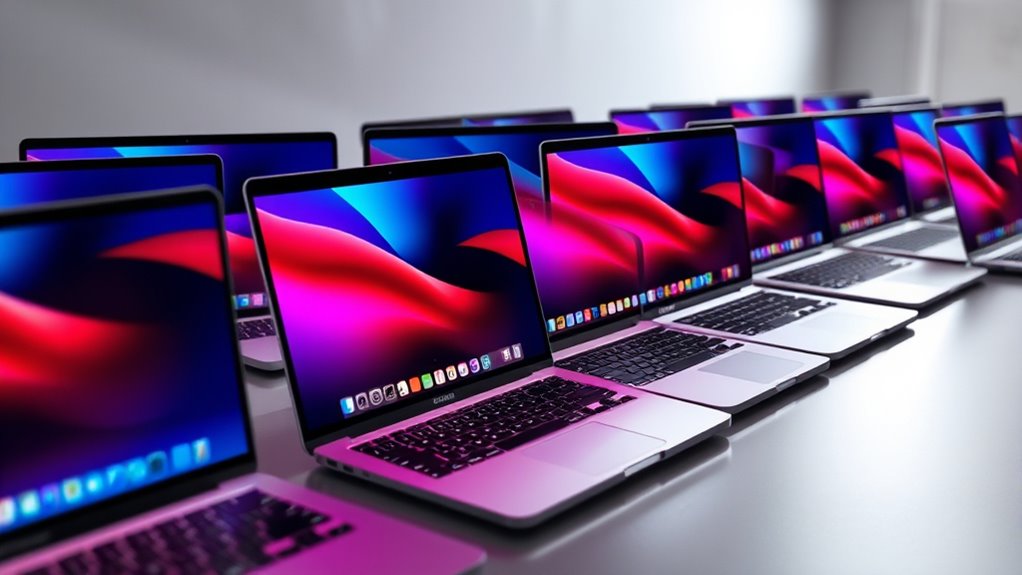

For most buyers seeking a MacBook Pro with 64GB unified memory, I’d put the 16-inch M5 Max with 2TB SSD first: it pairs the lineup’s strongest graphics configuration with ample built-in storage. The 14-inch M5 Pro is a better fit when portability and a lower-power workflow matter more, while the renewed M1 Max 14-inch may suit buyers who want a previous-generation Max configuration. The central tradeoff is whether your work benefits from Max-class graphics and extra storage enough to justify a larger or newer configuration. I also compare screen size, chip generation, SSD capacity, and renewed status across all 10 options. Read on for the full breakdown and a buyer-focused guide.

Get the latest gadgets delivered free with Prime
- Fast, free delivery on millions of items
- Prime Video, Amazon Music and more included
- Member-only deals all year
Complete the kit



Key Takeaways
- M5 Max is the graphics-first choice: its 40-core GPU separates it from the M5 Pro models’ 20-core GPU, making it the clearest fit for graphics-heavy professional workloads.
- 64GB memory does not make every configuration equivalent: the M5 Pro and M5 Max options share the memory capacity but differ in GPU resources and intended workload.
- Screen size and portability create a real split: 14-inch models are easier to carry, while 16-inch versions offer more workspace for long editing or coding sessions.
- Storage capacity changes the buying decision: the M5 Max models listed here include 2TB SSDs, while most M5 Pro options have 1TB; the 14-inch M5 Pro with 2TB is the storage-focused exception.
- Older and renewed models need a different value calculation: the renewed M1 Max and M3 Max can appeal to buyers seeking earlier Max hardware, but condition, support, and remaining useful life matter alongside specifications.


| macbook pro with 64gb unified memory | Processor | Memory | Storage | Display |
|---|---|---|---|---|
| Apple MacBook Pro 16.2-inch La | Apple M5 Max, 18-core CPU, 40-core GPU | 64GB unified memory | 2TB SSD | 16.2-inch Liquid Retina XDR, up to 1600 nits peak brightness |
| Apple 2021 MacBook Pro with M1 | Apple M1 Max, 10-core CPU | 64GB RAM | 2TB | 14-inch Retina LED, 2560 x 1600 pixels |
| Apple MacBook Pro 14-inch | Apple M5 Max, 18-core CPU, 40-core GPU | 64GB unified memory | 2TB SSD | 14.2-inch Liquid Retina XDR, up to 1600 nits peak brightness |
| Apple MacBook Pro 16.2-inch | Apple M3 Max, 16-core CPU, 40-core GPU | 64GB unified memory | 1TB SSD | 16.2-inch Liquid Retina XDR |
| Apple 2026 MacBook Pro Laptop | Apple M5 Pro, 18-core CPU, 20-core GPU | 48GB unified memory | 1TB SSD | 16.2-inch Liquid Retina XDR |
| Apple MacBook Pro 16" M5 Pro 1 | Apple M5 Pro, 18-core CPU | 64GB unified memory | 1TB SSD | 16.2-inch Liquid Retina XDR, 3456 x 2234, 120Hz |
| Apple MacBook Pro 16.2-inch wi | Apple M5 Pro, 18-core CPU | 64GB | 1TB SSD | 16.2-inch Liquid Retina XDR |
| Apple 14-inch MacBook Pro with | Apple M5 Pro, 18-core CPU | 64GB | 1TB SSD | 14.2-inch Liquid Retina XDR, 3024 x 1964, 120Hz |
| Apple MacBook Pro 16.2-inch | Apple M5 Max, 18-core CPU | 64GB unified memory | 2TB SSD | 16.2-inch Liquid Retina XDR with Nano-Texture Glass |
| Apple 14-inch MacBook Pro with | Apple M5 Pro, 18-core CPU | 64GB unified memory | 2TB SSD | 14.2-inch Liquid Retina XDR, 3024 x 1964, 120Hz |
More Details on Our Top Picks
Apple MacBook Pro 16.2-inch Laptop with M5 Max Chip, 18-Core CPU, 40-Core GPU, 64GB Unified Memory, 2TB SSD, Space Black
For buyers who specifically need 64GB of unified memory, this 16.2-inch M5 Max configuration pairs that capacity with an 18-core CPU, 40-core GPU, and 2TB SSD. That combination suits demanding AI and creative workflows that need substantial memory alongside strong graphics performance and room for large project files. Compared with the 14-inch M5 Max in this roundup, this model gives you a larger display, but its listed 8.5-pound weight makes it the less convenient choice to carry. Thunderbolt 5, HDMI, and SDXC also reduce the need for adapters at a desk or studio. The tradeoff is size and heft, and buyers handling unusually large enterprise workloads may need more than 64GB. I rank it first for people who value performance and workspace over portability.
Pros:- M5 Max combines an 18-core CPU and 40-core GPU for demanding professional tasks
- 64GB unified memory supports large creative projects and memory-intensive workflows
- 2TB SSD provides substantial room for media and project files
- 16.2-inch Liquid Retina XDR display and broad port selection suit desk and studio work
Cons:- Listed weight of 8.5 pounds makes it a cumbersome travel laptop
- 64GB may not cover the largest enterprise workloads
- The M5 Max configuration is more capability than buyers with mainly everyday workloads need
Best for: Video editors, 3D artists, and AI practitioners who need 64GB of memory, strong GPU capacity, and a large built-in display.
Not ideal for: Frequent travelers or buyers running memory-heavy enterprise workloads beyond 64GB; it is heavy, and this configuration cannot meet needs above its listed memory capacity.
- Processor:Apple M5 Max, 18-core CPU, 40-core GPU
- Memory:64GB unified memory
- Storage:2TB SSD
- Display:16.2-inch Liquid Retina XDR, up to 1600 nits peak brightness
- Ports:3x Thunderbolt 5, HDMI, SDXC, MagSafe 3
- Wireless:Wi-Fi 7, Bluetooth 6
- Weight:8.5 pounds
- Camera and audio:12MP Center Stage camera; six speakers with Spatial Audio and Dolby Atmos
Our verdict“Choose this model if you want a large-screen MacBook Pro with 64GB memory and M5 Max graphics, and can accept its weight.”
Apple 2021 MacBook Pro with M1 Max Chip, 14-inch, 64GB RAM, 2TB SSD, Silver (Renewed)
This renewed 14-inch MacBook Pro is the lineup’s older-generation alternative for buyers who want 64GB RAM and a 2TB SSD without choosing a current M5 Max machine. Its M1 Max chip has a 10-core CPU and 24-core GPU, so it is a different performance tier from the 18-core CPU, 40-core GPU M5 Max models featured here. That gap matters most for buyers doing newer, GPU-heavy creative or AI work; it matters less if the priority is memory capacity and local storage on a MacBook Pro. The renewed condition adds uncertainty: the battery is listed above 80% capacity, but cosmetic condition and included compatible accessories can vary. I would choose it for a budget-conscious legacy workflow, not as a like-for-like substitute for the newer M5 Max systems.
Pros:- 64GB RAM paired with a 2TB SSD
- M1 Max chip remains a capable option for compatible professional workflows
- 14-inch form factor is smaller than the 16.2-inch M5 Max models
- Renewed listing specifies battery capacity above 80%
Cons:- Older M1 Max generation trails the M5 Max models in this roundup
- Renewed condition may include cosmetic imperfections and non-original accessories
- Battery capacity varies, with only a limited warranty listed
Best for: Mac users with established M1-era workflows who need 64GB RAM and 2TB storage and are comfortable buying a renewed laptop.
Not ideal for: Professionals seeking the latest CPU and GPU capability, original accessories, or a predictable new-device condition.
- Processor:Apple M1 Max, 10-core CPU
- Graphics:24-core GPU
- Memory:64GB RAM
- Storage:2TB
- Display:14-inch Retina LED, 2560 x 1600 pixels
- Condition:Renewed; battery capacity above 80%
- Weight:6.9 pounds
- Warranty:Limited
Our verdict“Consider it if 64GB and 2TB matter more than having a current-generation chip and you accept renewed-device variability.”
Apple MacBook Pro 14-inch (M5 Max, 18-Core CPU, 40-Core GPU, 64GB RAM, 2TB SSD, Silver)
This 14-inch model keeps the key performance ingredients of the larger 16.2-inch M5 Max: an 18-core CPU, 40-core GPU, 64GB of memory, and a 2TB SSD. Its role is clear: buyers get the same listed chip and memory capacity in a smaller-display format. That makes it a better fit for professionals who move between locations but still need serious GPU capability and space for large files. The compromise is workspace: the 14.2-inch Liquid Retina XDR display offers less room for timelines, code, or side-by-side windows than the 16.2-inch option. Its listed 5.5-pound weight is also substantial for a compact laptop, though lower than the larger model’s 8.5 pounds. I rank it ahead of the renewed M1 Max when current-generation performance matters more than legacy-device savings.
Pros:- M5 Max pairs an 18-core CPU with a 40-core GPU
- 64GB unified memory and 2TB SSD support demanding workflows and large projects
- Smaller 14.2-inch display format than the 16.2-inch M5 Max alternative
- Thunderbolt 5, HDMI, SDXC, and MagSafe 3 provide broad connectivity
Cons:- Smaller display offers less working area than the 16.2-inch M5 Max model
- Listed 5.5-pound weight is still substantial for a 14-inch laptop
- High-end chip and memory may be unnecessary for everyday or light creative use
Best for: Mobile video editors, developers, and AI professionals who want M5 Max performance and 64GB memory in a smaller screen size.
Not ideal for: Buyers who prioritize a large editing canvas or an especially light travel computer; the 14-inch display and listed 5.5-pound weight may not suit them.
- Processor:Apple M5 Max, 18-core CPU, 40-core GPU
- Memory:64GB unified memory
- Storage:2TB SSD
- Display:14.2-inch Liquid Retina XDR, up to 1600 nits peak brightness
- Ports:3x Thunderbolt 5, MagSafe 3, SDXC, HDMI, headphone jack
- Wireless:Wi-Fi 7, Bluetooth 6
- Camera:12MP Center Stage
- Weight:5.5 pounds
Our verdict“Pick this 14-inch M5 Max if you need the lineup’s high-end chip and 64GB memory but prefer a smaller screen than the 16.2-inch model.”
Apple MacBook Pro 16.2-inch (2023) with M3 Max, 16-Core CPU, 40-Core GPU, 64GB RAM, 1TB SSD, Space Black (Renewed)
This renewed 2023 configuration offers 64GB unified memory and a 40-core GPU in a 16.2-inch MacBook Pro, giving it a workstation-style role without the newest M5 Max generation. Its M3 Max has a 16-core CPU, compared with the 18-core CPU in the M5 Max models elsewhere in this roundup, and storage is 1TB rather than 2TB. Those differences make the M3 Max a more restrained fit for buyers whose workloads do not require the latest chip or as much built-in file space. The large Liquid Retina XDR screen and stated battery life of up to 22 hours suit a desk-based creative workflow, but its listed 8.4-pound weight limits portability. Renewed condition and a 90-day limited warranty are further tradeoffs.
Pros:- 64GB unified memory paired with a 40-core GPU
- 16.2-inch Liquid Retina XDR display suits detailed creative work
- Stated battery life of up to 22 hours
- Includes 1TB SSD storage for local projects
Cons:- M3 Max generation is older than the M5 Max configurations in this roundup
- 1TB SSD offers less built-in capacity than the 2TB M5 Max options
- Renewed condition, 8.4-pound weight, and 90-day limited warranty are notable compromises
Best for: Creative professionals who want a large-screen MacBook Pro with 64GB memory and are open to a renewed previous-generation model.
Not ideal for: Buyers who need the newest M5 Max generation, 2TB of storage, a lighter carry, or the reassurance of a new device.
- Model year:2023
- Processor:Apple M3 Max, 16-core CPU, 40-core GPU
- Memory:64GB unified memory
- Storage:1TB SSD
- Display:16.2-inch Liquid Retina XDR
- Battery life:Up to 22 hours stated
- Condition and warranty:Renewed; 90-day limited warranty
- Weight:8.4 pounds
Our verdict“Choose this renewed model for a large 64GB workstation setup if you can trade newer-generation performance and 2TB storage for the M3 Max configuration.”
Apple 2026 MacBook Pro Laptop with M5 Pro Chip, 16.2-inch Liquid Retina XDR Display, 48GB RAM, 1TB SSD, Wi-Fi 7, Space Black
This 16.2-inch M5 Pro is the roundup’s deliberate near-match rather than a true 64GB unified memory pick: it has 48GB. That remains a substantial capacity for many professional workloads, while the 18-core CPU and 20-core GPU make it less graphics-focused than the M5 Max models with 40-core GPUs. The result may suit creators who want a current-generation chip and large display but do not need the full 64GB or Max-tier graphics. Its 1TB SSD also provides less project space than the 2TB M5 Max configurations. At a listed 4.71 pounds, it is lighter than the 16.2-inch M5 Max option, which improves carry comfort. Choose it only if 48GB meets your workload; buyers who require 64GB should look to the other listed configurations.
Pros:- M5 Pro chip with an 18-core CPU and 20-core GPU
- Large 16.2-inch Liquid Retina XDR display
- Listed weight of 4.71 pounds is lower than the 16.2-inch M5 Max option
- Wi-Fi 7 and three Thunderbolt 5 ports
Cons:- 48GB memory does not meet a strict 64GB requirement
- 20-core GPU is below the 40-core GPU in the M5 Max models
- 1TB SSD provides less storage than the 2TB configurations
Best for: Creative professionals who want a 16.2-inch M5 Pro MacBook Pro and can comfortably work with 48GB rather than requiring 64GB.
Not ideal for: Buyers whose software, projects, or workflow specifically require 64GB unified memory, or who need M5 Max graphics capacity.
- Processor:Apple M5 Pro, 18-core CPU, 20-core GPU
- Memory:48GB unified memory
- Storage:1TB SSD
- Display:16.2-inch Liquid Retina XDR
- Connectivity:Wi-Fi 7, Bluetooth 6
- Ports:3x Thunderbolt 5, MagSafe 3, SDXC, HDMI, headphone jack
- Weight:4.71 pounds
Our verdict“Choose this M5 Pro only if 48GB is enough for your work; if 64GB is non-negotiable, select one of the actual 64GB models instead.”
Apple MacBook Pro 16″ M5 Pro 18-Core CPU, 20-Core GPU, 64GB RAM, 1TB SSD
For buyers who want 64GB unified memory and a large screen without moving up to an M5 Max, this 16-inch M5 Pro configuration is the most balanced pick in this group. Its 18-core CPU and 20-core GPU suit demanding editing, development, and multitasking, while the 1TB SSD leaves room for active projects. Compared with the 16-inch M5 Max model with 2TB, it gives up graphics headroom and storage, but those upgrades may be wasted if your work is not GPU-heavy. The 16.2-inch 120Hz XDR display is useful for detailed timelines and sustained desk work; the tradeoff is a larger machine than the 14-inch M5 Pro options. I would skip it for basic office tasks, where 64GB and this performance tier add capability you may not use.
Pros:- 64GB unified memory supports demanding multitasking and memory-intensive creative applications.
- M5 Pro 18-core CPU and 20-core GPU provide a strong performance tier without the M5 Max configuration.
- 16.2-inch 120Hz Liquid Retina XDR display gives detailed work more screen space.
- 1TB SSD provides room for active applications and project files.
Cons:- The 1TB SSD is half the capacity of the 2TB M5 Max model in this roundup.
- The 16-inch chassis is less convenient to carry than the 14-inch M5 Pro alternatives.
- Its performance and memory configuration are excessive for routine browsing and office work.
Best for: Video editors, developers, and creative professionals who want 64GB memory with a spacious 16-inch display but do not need M5 Max graphics.
Not ideal for: Frequent travelers who prioritize a smaller laptop, and everyday users whose workloads do not benefit from 64GB memory or an M5 Pro chip.
- Processor:Apple M5 Pro, 18-core CPU
- Graphics:20-core GPU
- Memory:64GB unified memory
- Storage:1TB SSD
- Display:16.2-inch Liquid Retina XDR, 3456 x 2234, 120Hz
- Camera:12MP Center Stage
- Color:Space Black
- Power adapter:140W USB-C
Our verdict“Choose this for a large-screen M5 Pro MacBook Pro with 64GB memory when M5 Max graphics and 2TB storage are not requirements.”
Apple MacBook Pro 16.2-inch with M5 Pro, 18-core CPU, 20-core GPU, 64GB Memory, 1TB SSD, Space Black
This 16.2-inch M5 Pro shares the core setup of the other 16-inch M5 Pro entry, but its clearest buyer advantage is a well-rounded connection set: Thunderbolt 5, HDMI, SDXC, MagSafe 3, and a headphone jack. That helps photographers and video teams connect common gear without making adapters central to the workflow. Like the B0H7Z68CLL, it pairs 64GB memory with a 1TB SSD, so it suits heavy applications but offers less built-in project space than the 2TB models. Its XDR display and 20-core GPU make it a capable professional workstation, though the listing’s stated 9.1-pound weight is a serious portability drawback and should be checked against the actual configuration. I would favor the 14-inch M5 Pro choices for regular commuting unless the larger screen and ports matter more.
Pros:- Includes Thunderbolt 5, HDMI, SDXC, MagSafe 3, and a headphone jack.
- 64GB memory and M5 Pro processing support demanding creative and technical workloads.
- 16.2-inch Liquid Retina XDR display provides ample space for detailed work.
- Wi-Fi 7 and Bluetooth 6 are specified.
Cons:- The listed 9.1-pound weight would make it cumbersome for regular travel.
- 1TB SSD offers less project storage than the 2TB options in this roundup.
- The listing does not specify a battery-runtime figure.
Best for: Photographers and video professionals who need 64GB memory, a 16-inch display, and direct access to HDMI, SDXC, and Thunderbolt 5 connections.
Not ideal for: Commuters and mobile professionals who carry a laptop daily, especially given the unusually high listed weight.
- Processor:Apple M5 Pro, 18-core CPU
- Graphics:20-core integrated GPU
- Memory:64GB
- Storage:1TB SSD
- Display:16.2-inch Liquid Retina XDR
- Ports:Three Thunderbolt 5, MagSafe 3, SDXC, HDMI, headphone jack
- Wireless:Wi-Fi 7, Bluetooth 6
- Listed weight:9.1 pounds
Our verdict“Pick this 16-inch M5 Pro if built-in ports and a large workspace matter more than carrying weight or 2TB storage.”
Apple 14-inch MacBook Pro with M5 Pro, 18-core CPU, 20-core GPU, 64GB RAM, 1TB SSD, Space Black
This is the straightforward choice for someone who wants 64GB unified memory in a 14-inch MacBook Pro rather than the larger 16-inch machines. The M5 Pro’s 18-core CPU and 20-core GPU match the larger M5 Pro configurations here, so downsizing the screen does not mean choosing a lower chip tier. The 14.2-inch 120Hz XDR display remains sharp and bright, while the listed battery life of up to 24 hours supports long stretches away from an outlet. Compared with the 14-inch B0HFKYRTZ8, this model has half the SSD capacity; its appeal is keeping the same memory and processor while avoiding the larger-screen format. The 1TB drive may pinch if you keep large media libraries locally, and the stated 8.5-pound weight makes the portability advantage less clear, so verify the configuration details before buying.
Pros:- 14.2-inch format is smaller than the 16-inch M5 Pro alternatives.
- 64GB memory pairs with the same M5 Pro CPU and GPU tier as the larger models.
- 120Hz Liquid Retina XDR display with up to 1600 nits peak brightness.
- Advertised battery life is up to 24 hours.
Cons:- The 1TB SSD provides less local storage than the 2TB 14-inch M5 Pro option.
- The listed 8.5-pound weight appears unusually high for this size and may undermine portability.
- The smaller screen offers less workspace than either 16-inch model.
Best for: Mobile developers and creative professionals who need 64GB memory and M5 Pro performance in a 14-inch display size.
Not ideal for: People who need 2TB of internal project storage or buyers who rely on the listed weight as evidence of easy portability without checking it.
- Processor:Apple M5 Pro, 18-core CPU
- Graphics:20-core GPU
- Memory:64GB
- Storage:1TB SSD
- Display:14.2-inch Liquid Retina XDR, 3024 x 1964, 120Hz
- Peak brightness:Up to 1600 nits
- Battery life:Up to 24 hours
- Listed weight:8.5 pounds
Our verdict“Choose this when you need 64GB memory and M5 Pro performance in a 14-inch configuration and 1TB storage is enough.”
Apple MacBook Pro 16.2-inch (M5 Max, 18-Core CPU, 40-Core GPU, 64GB RAM, 2TB SSD, Space Black)
Among these 64GB models, this is the clear pick when the work depends on graphics throughput: the M5 Max 40-core GPU is a substantial step beyond the 20-core GPU in the M5 Pro laptops. It also doubles the 1TB capacity found in the 16-inch M5 Pro choices, giving large creative projects more room before external storage enters the picture. The Nano-Texture Glass display is specified to reduce reflections, a useful distinction for bright studios or changing work locations. Compared with the M5 Pro models, though, the extra GPU capability is only valuable if your applications can use it; CPU core counts are the same in the supplied specs. The 16.2-inch chassis and listed 7.4-pound weight make this a less convenient carry, and its premium configuration is difficult to justify for general productivity.
Pros:- M5 Max 40-core GPU is better suited to GPU-heavy tasks than the 20-core M5 Pro options.
- 2TB SSD offers twice the storage of the 1TB M5 Pro models listed here.
- Nano-Texture Glass is designed to reduce reflections on the XDR display.
- Includes Thunderbolt 5, HDMI, SDXC, MagSafe 3, and a headphone jack.
Cons:- M5 Max graphics capability is unnecessary for many everyday and CPU-focused workflows.
- The listed 7.4-pound weight makes it less appealing for frequent travel.
- The high-end configuration carries a substantial premium over M5 Pro alternatives.
Best for: 3D artists, AI practitioners, and video professionals whose GPU-intensive workloads can use the M5 Max and who need 2TB of internal storage.
Not ideal for: General office users, frequent travelers, or buyers whose software workloads do not benefit from the 40-core GPU.
- Processor:Apple M5 Max, 18-core CPU
- Graphics:40-core GPU
- Memory:64GB unified memory
- Storage:2TB SSD
- Display:16.2-inch Liquid Retina XDR with Nano-Texture Glass
- Ports:Three Thunderbolt 5, MagSafe 3, SDXC, HDMI, headphone jack
- Wireless:Wi-Fi 7, Bluetooth 6
- Listed weight:7.4 pounds
Our verdict“Choose this 16-inch M5 Max when your GPU-heavy work justifies the added graphics capability and 2TB storage.”
Apple 14-inch MacBook Pro with M5 Pro Chip (18-Core CPU, 20-Core GPU), 64GB RAM, 2TB SSD, Space Black
This 14-inch M5 Pro configuration is the strongest fit for buyers who want 64GB unified memory and 2TB of internal storage without moving to the M5 Max. Its 18-core CPU and 20-core GPU match the 1TB 14-inch B0GYZKZ2WX, while the larger SSD gives video editors, developers, and researchers more space for active files and applications. The 14.2-inch 120Hz XDR display and advertised battery life of up to 24 hours retain the compact model’s main advantages. Compared with the 16-inch M5 Max, it gives up a 40-core GPU and a larger screen, so it is not the right choice for GPU-bound work or those who need more workspace. The high-spec memory and storage configuration is also more than routine office tasks call for.
Pros:- 2TB SSD provides more local workspace than the 1TB 14-inch M5 Pro alternative.
- 64GB unified memory supports demanding multitasking and professional applications.
- M5 Pro chip combines an 18-core CPU with a 20-core GPU.
- Advertised battery life is up to 24 hours.
Cons:- The 20-core GPU is less suited to GPU-heavy workloads than the 40-core M5 Max model.
- 14.2-inch display provides less workspace than the 16-inch options.
- The 64GB and 2TB configuration is excessive for basic computing needs.
Best for: Mobile creative professionals and developers who need 64GB memory, 2TB local storage, and M5 Pro performance in a 14-inch MacBook Pro.
Not ideal for: GPU-heavy 3D and AI workers who would benefit from the M5 Max, or buyers who only need a laptop for everyday productivity.
- Processor:Apple M5 Pro, 18-core CPU
- Graphics:20-core GPU
- Memory:64GB unified memory
- Storage:2TB SSD
- Display:14.2-inch Liquid Retina XDR, 3024 x 1964, 120Hz
- Battery life:Up to 24 hours
- Dimensions:12.31 x 8.71 x 0.61 inches
- Color:Space Black
Our verdict“Pick this 14-inch M5 Pro if you want 64GB memory and 2TB storage in a smaller-screen configuration without needing M5 Max graphics.”

How We Picked
I ranked these configurations around the needs that make 64GB unified memory worthwhile: sustained professional multitasking, large creative projects, demanding development work, and graphics-intensive tasks. I compared chip generation and GPU configuration first, then weighed screen size, SSD capacity, and the practical portability tradeoff. A higher GPU count can matter more than the shared memory figure for some creative workloads, while a larger SSD may reduce dependence on external storage.
The order favors current-generation options with a clear fit for demanding work, while distinguishing M5 Pro models from M5 Max models rather than treating 64GB as the only meaningful specification. I also account for renewed status: older hardware can still fit a buyer’s workload, but it warrants more scrutiny than a new configuration. The 48GB M5 Pro is included as a nearby alternative, not as a 64GB match, so readers can judge whether their actual workload needs the full memory capacity.
| macbook pro with 64gb unified memory | Processor |
|---|---|
| Apple MacBook Pro 16.2-inch La | Apple M5 Max, 18-core CPU, 40-core GPU |
| Apple 2021 MacBook Pro with M1 | Apple M1 Max, 10-core CPU |
| Apple MacBook Pro 14-inch | Apple M5 Max, 18-core CPU, 40-core GPU |
| Apple MacBook Pro 16.2-inch | Apple M3 Max, 16-core CPU, 40-core GPU |
| Apple 2026 MacBook Pro Laptop | Apple M5 Pro, 18-core CPU, 20-core GPU |
| Apple MacBook Pro 16" M5 Pro 1 | Apple M5 Pro, 18-core CPU |
| Apple MacBook Pro 16.2-inch wi | Apple M5 Pro, 18-core CPU |
| Apple 14-inch MacBook Pro with | Apple M5 Pro, 18-core CPU |
| Apple MacBook Pro 16.2-inch | Apple M5 Max, 18-core CPU |
| Apple 14-inch MacBook Pro with | Apple M5 Pro, 18-core CPU |
Factors to Consider When Choosing Macbook Pro With 64gb Unified Memory
Before choosing a configuration, I’d start with the tasks that actually stress memory, graphics, storage, and portability. The shared 64GB figure narrows the field, but it does not settle which MacBook Pro is right for you.
Decide Whether 64GB Is a Workload Need
Memory capacity matters most when your work keeps large projects or many demanding apps active at once. Video timelines, sizable codebases, virtual machines, and complex creative sessions can benefit from more memory headroom. A common mistake is buying 64GB just because it sounds more future-proof without identifying a workload that uses it. If your everyday work is browsing, office tasks, and modest editing, a lower-memory configuration may leave budget and power unused. Choose based on the heaviest work you regularly perform, not the rarest task you might attempt.
Match M5 Pro or M5 Max to the Work
The chip family matters even when memory capacity is identical. In this lineup, M5 Max models offer a 40-core GPU, compared with 20 cores on the M5 Pro options, so the distinction is most relevant to graphics-heavy production and parallel visual workloads. More GPU resources do not automatically improve every programming, writing, or general multitasking task. Buyers can overpay for graphics capacity they rarely use, while creators who rely on GPU-accelerated tools may find a Pro configuration limiting sooner. Check which parts of your software use the GPU before choosing between the two families.
Choose Screen Size Around Your Workday
A 16-inch MacBook Pro gives you more room for timelines, code panes, and side-by-side windows, but its larger footprint can be a burden on a daily commute. A 14-inch model is easier to carry and may suit people who work between locations or use an external monitor at a desk. The screen-size decision is not just about preference: it changes how often you need extra displays and how comfortable long sessions may feel. Buyers who mostly dock at a fixed workspace may prefer the larger built-in panel. Those who travel often should weigh that convenience against the value of more on-screen space.
Budget for Storage Alongside Memory
64GB unified memory cannot substitute for SSD capacity: memory supports active work, while storage holds apps, source files, and completed projects. A 1TB drive can be adequate for code, documents, and projects kept on external or network storage. Large video libraries and creative assets can fill it quickly, creating extra file-management work. The 2TB options in this roundup are a better fit for buyers who want more project space on the laptop itself. Before choosing a drive size, estimate how much data needs to stay available offline and account for backups.
Treat Renewed Models as a Separate Purchase Decision
A renewed MacBook Pro can offer an earlier Max-class chip and 64GB memory, but its value depends on more than the listed specifications. Check the seller’s condition description, return terms, battery information, and included accessories before deciding. A previous-generation chip may still suit a stable workload, yet newer hardware can be a better match for buyers who plan to keep the laptop for many years. Do not assume that a renewed model is a bargain solely because it has a Max label. Compare its condition and remaining support expectations with the practical benefits of a current-generation Pro or Max.
Do Not Confuse Nearby Memory Configurations
One listed option has 48GB rather than 64GB, so it is an adjacent alternative, not a match for the target configuration. That difference may not affect every workflow, but buyers with a firm 64GB requirement should verify the exact configuration before ordering. Product listings can use similar names for machines with different memory, storage, or chip options. Confirm the memory capacity, screen size, chip family, and SSD on the specific item page rather than relying on a broad model name. This check is especially useful when comparing retailer listings or renewed units.
Frequently Asked Questions
Is an M5 Pro MacBook Pro with 64GB enough, or should I choose an M5 Max?
I would choose M5 Pro when your main need is memory headroom for development, multitasking, or creative work that does not lean heavily on GPU performance. M5 Max is the stronger fit when your software makes sustained use of graphics resources, since the listed Max configurations have twice the GPU core count of the M5 Pro models. The 64GB capacity is shared, so the decision is about the work each chip handles, not a memory upgrade. Check your software’s GPU requirements and the size of your typical projects before paying for the Max configuration.
Should I choose a 14-inch or 16-inch MacBook Pro for demanding work?
Choose the 14-inch model if carrying the laptop regularly is a priority or you often connect to a larger monitor. The 16-inch version gives more room for complex timelines, multiple windows, and long sessions away from a desk monitor. Both sizes appear with powerful configurations in this roundup, so the choice does not have to mean giving up the memory capacity you want. Think about where you spend most of your workday and whether a lighter carry or larger built-in display will help more often.
Is the 48GB M5 Pro option a suitable substitute for a 64GB model?
It can be a reasonable alternative if your workload is unlikely to use the extra memory and you are flexible about the exact specification. It is not a 64GB configuration, so it does not meet a strict requirement for that capacity. Buyers who run memory-intensive workloads should avoid treating the 48GB listing as interchangeable just because its chip generation is current. Confirm your software’s actual memory demands and verify the configuration on the listing before buying.
Does a 2TB SSD matter more than choosing M5 Max?
That depends on whether your bottleneck is keeping files close at hand or completing GPU-heavy work. The 2TB drive is useful for large libraries and projects you need offline, while M5 Max targets workloads that benefit from its larger GPU configuration. If you already use external storage and your apps are GPU intensive, the chip family may matter more. If you spend more time managing full drives than waiting on graphics tasks, the larger SSD may improve your day-to-day workflow more. Consider both your active project sizes and your software’s hardware demands.
What should I check before buying a renewed M1 Max or M3 Max MacBook Pro?
Check the exact memory and storage configuration, the seller’s condition details, return policy, battery information, and whether the included charger and accessories meet your needs. Renewed status makes the condition and purchase protections part of the decision, not an afterthought. Compare the older chip’s capabilities with the apps you use now and the length of time you expect to keep the laptop. An earlier Max model may still be appropriate for a known workload, but a current-generation machine may suit buyers who want a longer runway before replacing it.
Conclusion
For the best overall balance of current-generation performance, graphics capacity, and built-in storage, I’d choose the 16-inch M5 Max with 64GB memory and a 2TB SSD. The best value by workload is an M5 Pro 64GB model if you need memory headroom but do not need the Max GPU; pick 14 inches for portability or 16 inches for a larger workspace. For a premium graphics-focused setup, choose an M5 Max configuration, while the 14-inch M5 Pro is my best beginner fit for someone stepping into demanding professional work who values a more portable machine. The renewed M1 Max or M3 Max suits buyers who specifically want an earlier Max configuration and are comfortable checking condition and seller terms closely. If your requirement is strictly 64GB, skip the 48GB alternative and confirm the exact memory listing before purchase.