
TL;DR

Get the latest gadgets delivered free with Prime
- Fast, free delivery on millions of items
- Prime Video, Amazon Music and more included
- Member-only deals all year
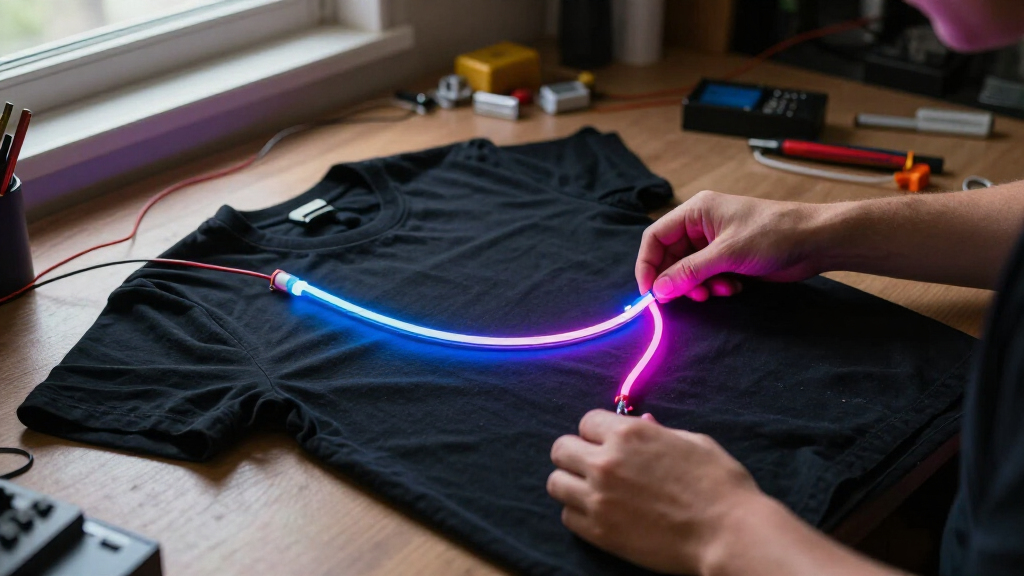
A maker has published a project report describing how he built a wearable “neon” T-shirt from flexible LED filaments, a black shirt and craft materials. The design used sewn-in light strips and electronics assembled on a tight deadline; the account does not establish how the shirt performed after extended wear or washing.
A maker has published an account of building a wearable LED-filament T-shirt in a few days for a neon-themed work event, describing how he sewed flexible light strips into a black shirt and improvised the electronics from parts on hand. The project offers a practical example of combining textile craft, custom design and low-voltage lighting, though the report does not document long-term durability or washability.
In a post on his personal blog shared as a Show HN project, Scott Bezek said the event was announced less than a week ahead, prompting him to use flexible LED filaments he had kept in an “interesting parts” collection. He describes the filaments as strips containing many tiny LEDs, covered by a silicone diffuser about 1.8 millimeters in diameter. They are sold for decorative lighting, including Edison-style bulbs, and come in different lengths and voltages.
Bezek’s shirt design combined a red llama on the back with cursive lettering and warm-white borders on the front. Because the filaments could not be cut to shorten them, he drew paths to match the lengths he had available: one 1,200 mm red filament for the back, three 300 mm red filaments for the front text and two 600 mm warm-white filaments for the border. He used Inkscape to measure and scale the paths before transferring them to the shirt.
For sewing, he traced the design onto tissue paper and stitched the filaments to the shirt through a layer of stiff cross-stitch fabric, which he said helped keep the cotton from bunching. A small piece of black heat-shrink tubing hid a glowing connection between two letters. To join three shorter filaments along the lettering, he soldered them in series; he reported that the joins left small unlit gaps, positioned between letters.
A Wearable Lighting Build
The report is useful as a hands-on account of adapting lighting components for clothing, rather than as a commercial product announcement or a controlled test. It shows how design constraints—in particular, fixed filament lengths—shaped the artwork, and how a stabilizing fabric layer and temporary paper templates helped make the sewing manageable.
It also highlights the difference between a decorative prototype and a garment suitable for regular use. Sewing lights onto fabric introduces practical issues around flexing, wiring, heat, comfort and cleaning. Bezek’s account describes a wearable made for a specific event, but does not establish that it can be washed, worn safely for long periods or reproduced without additional testing.
As an affiliate, we earn on qualifying purchases.
Designing Around Fixed Filament Lengths
The project began with basic tests to see whether the filament could be sewn into curved shapes without the unsupported T-shirt fabric puckering. Bezek first tried attaching a short sample with loop stitches, using an embroidery hoop to keep the fabric tensioned. He placed tissue paper over the design as a guide and tore it away after stitching.
Since the filaments had fixed positive and negative ends and could not be shortened, the design had to fit the available pieces. Bezek used vector-drawing software to measure continuous paths and adjust their scale. For the front lettering, he chose a font, manually traced a path and used three 300 mm strips to approach the desired length. He says he used the lengths and parts already available because there was no time to order different components.
The electronics list in the report includes a USB battery bank, an ESP32, voltage-conversion and LED-control components, and wiring. Bezek says he used a TPS61169 constant-current LED driver for the front text after he could not obtain the drivers he had wanted in time. The supplied report excerpt does not provide a complete account of the final circuit, operating time or measured electrical performance.
flexible LED filament lighting strips
As an affiliate, we earn on qualifying purchases.
As an affiliate, we earn on qualifying purchases.
Durability and Wear Remain Untested
The blog account focuses on the design and assembly, but does not report how the shirt performed after repeated wear, bending or washing. It also does not provide runtime, battery capacity, temperatures, circuit measurements or a full safety assessment. Those details matter for judging whether this approach is suitable beyond a one-off event garment.
The source describes soldered connections, magnet wire and ribbon cables routed inside the shirt, but does not say whether the electronics or battery were removable, how the garment was cleaned, or whether the finished wiring was tested under extended movement. The project should not be treated as evidence that any similar build is automatically safe or washable.
As an affiliate, we earn on qualifying purchases.
Further Testing Would Clarify Use
The published report documents a completed event garment, but does not announce a product launch or a follow-up testing plan. Readers looking to reproduce the idea would need to consult the full project account and verify component ratings, wiring and battery arrangements for their own materials.
Any next evaluation would need to establish whether the stitched filaments and connections withstand movement, how long the battery powers the lights, and what cleaning method the shirt can tolerate. No such results are included in the supplied report, so the current record remains a description of a rapid custom build rather than a tested wearable design.
As an affiliate, we earn on qualifying purchases.
Key Questions
What did the maker build?
Scott Bezek built a black T-shirt with sewn-in LED filaments, featuring a red llama design on the back and cursive lettering with lighted borders on the front.
Why did the design use several filament lengths?
Bezek said the filaments could not be cut shorter without breaking them. He shaped the artwork to fit the pieces he had, including joining three 300 mm red filaments for the front lettering.
How were the lights attached to the shirt?
He stitched the filaments to the shirt with a stiff cross-stitch fabric backing. Tissue paper served as a tracing template and was removed after sewing.
Is the shirt proven safe to wash or wear regularly?
The report does not establish that. It does not provide results for washing, extended wear, battery runtime or heat testing, and describes a one-off build for an event.
Source: hn
Fall Picks
fall essentials
As an affiliate, we earn on qualifying purchases.