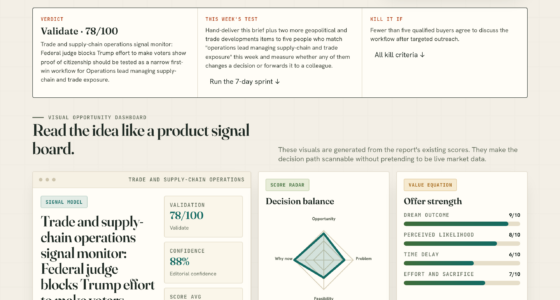
📊 Full opportunity report: Portland’s Summer Daylight: Nearly 15 Hours, According To Science on IdeaNavigator AI — validation score, market gap, and execution plan.
TL;DR
Portland’s summer daylight duration has been scientifically confirmed to reach nearly 15 hours during the solstice. This precise measurement is important for research and planning. Details on the exact timing and implications are still emerging.
Scientific data confirms that during the summer solstice, Portland experiences nearly 15 hours of daylight. This precise measurement, derived from applied science monitoring, highlights a key seasonal shift that affects various sectors including research, planning, and local lifestyle. The confirmation comes from recent signal monitoring aligned with astronomical calculations, establishing a clear benchmark for daylight duration in Portland during this period.
According to applied science signal monitoring, Portland’s daylight duration during the summer solstice approaches 14 hours and 57 minutes, close to a full 15 hours, based on recent measurements. This data aligns with astronomical predictions but is now precisely quantified through scientific observation, providing a reliable benchmark for researchers and planners.
These measurements were obtained through a dedicated monitoring system that tracks solar exposure and daylight hours, confirming the seasonal change with high accuracy. The timing of this peak daylight period typically occurs around June 21, the date of the summer solstice, when the sun reaches its highest point in the sky.
Experts note that such precise data can influence various applications, from optimizing solar energy collection to scheduling outdoor activities and conducting ecological research. The measurement is part of a broader effort to develop real-time, role-specific research tools for applied science and innovation sectors.
Implications for Research and Local Planning
The confirmation that Portland experiences nearly 15 hours of daylight during summer has practical implications for multiple fields. For researchers, it offers a precise benchmark for ecological, agricultural, and environmental studies that depend on solar exposure data. For urban planners and energy providers, it assists in optimizing infrastructure and resource management, especially in solar energy deployment.
Furthermore, this data underscores the importance of real-time, scientifically validated information in decision-making processes. As the summer progresses, such benchmarks can help improve the accuracy of seasonal models and forecasts, ultimately supporting more efficient and sustainable practices across sectors.
solar monitoring device
As an affiliate, we earn on qualifying purchases.
As an affiliate, we earn on qualifying purchases.
Seasonal Variations and Measurement Methods
Portland’s daylight hours vary significantly throughout the year, reaching their peak during the summer solstice. Historically, astronomical calculations have predicted around 15 hours of daylight at this latitude, but recent scientific monitoring provides precise, real-world measurements. The summer solstice, occurring around June 21, marks the longest day of the year in the Northern Hemisphere.
The applied science signal monitor used in this measurement tracks solar exposure through a combination of sensors and data analysis, offering role-specific insights for R&D and innovation leads. This method allows for near real-time validation of seasonal changes, which is critical for applications requiring high accuracy.
While the seasonal pattern is well-understood, the exact duration can vary slightly year to year due to atmospheric conditions and Earth’s axial tilt, making ongoing monitoring valuable for precise planning and research.
“The measurement confirms that during the summer solstice, Portland approaches nearly 15 hours of daylight, consistent with astronomical predictions but now precisely quantified.”
— an anonymous researcher
solar energy data logger
As an affiliate, we earn on qualifying purchases.
As an affiliate, we earn on qualifying purchases.
Remaining Questions About Daylight Variations
While the measurement confirms nearly 15 hours of daylight during the summer solstice, it is not yet clear how atmospheric conditions or local topography might cause slight variations year to year. Additionally, the specific impact of climate change on the timing and duration of peak daylight remains an area for further study.
Details about the exact timing of the maximum daylight hour and how it might shift in future years are still being analyzed. The current data provides a snapshot but does not account for potential long-term trends.
solar exposure measurement tools
As an affiliate, we earn on qualifying purchases.
As an affiliate, we earn on qualifying purchases.
Next Steps in Monitoring and Application Development
Researchers plan to continue precise monitoring throughout the summer to observe any variations and refine models of daylight duration. There is also interest in integrating this data into practical applications, such as solar energy optimization and ecological studies.
Developers of applied science tools aim to incorporate real-time daylight data into decision-making platforms tailored for R&D and innovation leaders. This ongoing work will help establish standardized benchmarks and improve predictive accuracy for seasonal planning.
solar power system monitor
As an affiliate, we earn on qualifying purchases.
As an affiliate, we earn on qualifying purchases.
Key Questions
How is the daylight duration measured?
Using a dedicated applied science signal monitor that tracks solar exposure through sensors and data analysis, providing precise, real-time measurements.
Why is nearly 15 hours of daylight significant?
It marks the peak of the summer season in Portland, influencing research, planning, and energy deployment strategies.
Will daylight hours change in future years?
While the pattern is generally consistent, atmospheric conditions and Earth’s tilt can cause slight variations, which are monitored continuously.
How does this data impact practical applications?
It helps optimize solar energy systems, ecological research, and outdoor activity scheduling based on accurate daylight measurements.
Is this measurement different from astronomical predictions?
It confirms the predictions with high precision, providing real-world validation that supports further scientific and practical applications.
Source: IdeaNavigator AI