📊 Full opportunity report: Apple Silicon’s Quiet Memory Advantage on ThorstenMeyerAI.com — validation score, market gap, and execution plan.

Get the latest gadgets delivered free — and shop member deals
- Fast, free delivery on millions of items
- Access to Prime Big Deal Days deals on October 6–7
- Prime Video, Amazon Music and more included
TL;DR
Apple Silicon chips have a significant memory capacity advantage for AI workloads due to unified memory architecture. While slower than NVIDIA GPUs, this allows running larger models locally at lower cost and power. The development highlights Apple’s niche in large-model AI processing but also its limitations.
Apple Silicon chips have demonstrated a significant memory capacity advantage for AI workloads, allowing users to run larger models locally than is possible with traditional discrete GPUs. This development is confirmed by recent industry analyses and Apple’s product configurations, highlighting a key benefit for AI developers and enthusiasts seeking capacity over raw speed.
Unlike traditional PCs with separate system RAM and GPU VRAM, Apple Silicon shares a single pool of physical memory across CPU and GPU, enabling models to utilize the entire memory available on a device. For more on memory costs, see Apple raises prices of MacBooks, iPads as memory costs skyrocket. For example, a Mac with 64GB of RAM can run models up to 70 billion parameters, surpassing the capacity of high-end NVIDIA GPUs which are limited by VRAM size, typically 24GB or 32GB.
This unified approach effectively removes the VRAM bottleneck, making large AI models accessible on consumer devices. For security implications, see First public macOS kernel memory corruption exploit on Apple M5.
Despite slower inference, the design offers benefits in power efficiency, operating silently at 25–90 watts, and lower operating costs, with annual electricity savings estimated at up to 10× compared to high-end discrete GPU rigs. These factors make Apple Silicon appealing for continuous, large-scale AI inference at a personal or small-team level.
Apple Silicon’s quiet memory advantage
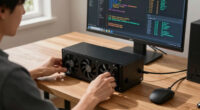
While the discrete-GPU world fought over 24GB of brutally expensive VRAM, a Mac quietly offered to run the big model on one silent, low-watt box. Not magic — but the rare place an architecture beats the squeeze.
Mac Studio 256GB holds a 70B at near-lossless Q8, or 200B+ at Q4 — no single GPU reaches that at any price. Win zone: 32–200B models at 10–30 tok/s for personal/dev use.
M5 Max ~614 GB/s vs RTX 4090’s 1,008. A 70B runs ~12–18 tok/s on M5 Max vs 40–50 on a 5090. You buy capacity, not raw throughput. Bandwidth & capacity matter — not FLOPs.
Apple turned a laptop-efficiency design — one shared memory pool — into the most elegant answer to the part of the squeeze that hurts most: capacity. Bonus: 25–90W vs a GPU rig’s 600–1,200, ~$35–55/yr to run 24/7 vs $300–400, and silent. Right for large models, privacy, low-power always-on; wrong for max speed on small models or heavy training. Next: Build, Rent, or Quantize.
Implications for Large-Model AI Processing
This development matters because it shifts the landscape of local AI processing, making large models more accessible to consumers and small organizations. The ability to run models exceeding 100GB of effective memory without multi-GPU setups reduces cost, complexity, and power consumption. It also emphasizes the importance of memory capacity and bandwidth over raw GPU FLOPs for certain AI workloads, influencing future hardware choices and AI deployment strategies.
Apple Silicon MacBook with 64GB RAM
As an affiliate, we earn on qualifying purchases.
As an affiliate, we earn on qualifying purchases.
Industry-Wide Memory and GPU Limitations
The industry has faced a memory squeeze in 2026, with GPU VRAM often capped at 24–32GB, forcing models larger than that to spill over into slower system RAM, drastically reducing performance. Apple’s unified memory architecture, originally designed for efficiency in laptops, inadvertently offers a solution for large AI models by consolidating memory pools. This approach contrasts with traditional discrete GPU setups, which are constrained by VRAM size and PCIe bandwidth, limiting accessible model size and increasing costs.
Recent product updates, such as the discontinuation of the 512GB Mac Studio and price hikes across Apple’s lineup, reflect the industry-wide impact of the RAM shortage. Apple’s long-term memory contracts eventually ran out, affecting their ability to maintain the previous configurations, but the core architectural advantage remains.
“Our chips are optimized for efficiency and large memory pools, enabling powerful AI processing at lower power and cost.”
— Apple spokesperson
large AI model development MacBook
As an affiliate, we earn on qualifying purchases.
As an affiliate, we earn on qualifying purchases.
Remaining Questions About Performance and Scalability
It is not yet clear how Apple Silicon’s slower bandwidth will impact real-world AI tasks beyond inference speed, such as training or multi-model workloads. Additionally, the long-term effects of the RAM shortage on Apple’s supply chain and product offerings remain uncertain, especially as Apple’s memory prices and availability fluctuate in 2026.
Apple Silicon compatible external GPU
As an affiliate, we earn on qualifying purchases.
As an affiliate, we earn on qualifying purchases.
Future Developments and Industry Impact
Upcoming Apple Silicon updates and new Mac models are likely to refine this memory advantage, possibly increasing bandwidth or expanding memory options. Industry trends suggest a continued focus on unified memory architectures for AI, potentially influencing hardware design choices across the industry. Monitoring Apple’s product launches and third-party software optimizations will clarify the practical limits and benefits of this approach.
As an affiliate, we earn on qualifying purchases.
Key Questions
How does Apple Silicon’s unified memory compare to discrete GPUs for AI?
Apple Silicon’s shared memory pool enables larger models to run on consumer devices, surpassing VRAM limits of discrete GPUs, but at the cost of lower inference speed due to bandwidth constraints.
Can I run large AI models faster on Apple Silicon?
No, Apple Silicon is slower per token than NVIDIA GPUs because of lower memory bandwidth, but it offers capacity advantages for large models at personal or small-team scale.
Will Apple increase memory bandwidth in future chips?
It is not confirmed, but future updates may improve bandwidth, which could narrow the speed gap while maintaining large memory capacity benefits.
Is Apple Silicon suitable for training large models?
No, current Apple Silicon chips are primarily optimized for inference and not suitable for training large AI models, which require higher bandwidth and compute power.
How does the power efficiency of Apple Silicon impact ongoing AI workloads?
Apple Silicon’s lower power consumption and silent operation make it ideal for continuous, large-scale AI inference in personal or low-power environments, reducing operational costs.
Source: ThorstenMeyerAI.com
Fall Picks
fall essentials
As an affiliate, we earn on qualifying purchases.