
📊 Full opportunity report: What To Log When Tracking Symptoms And Labs On TRT on IdeaNavigator AI — validation score, market gap, and execution plan.

Get the latest gadgets delivered free — and shop member deals
- Fast, free delivery on millions of items
- Access to Prime Big Deal Days deals on October 6–7
- Prime Video, Amazon Music and more included
TL;DR
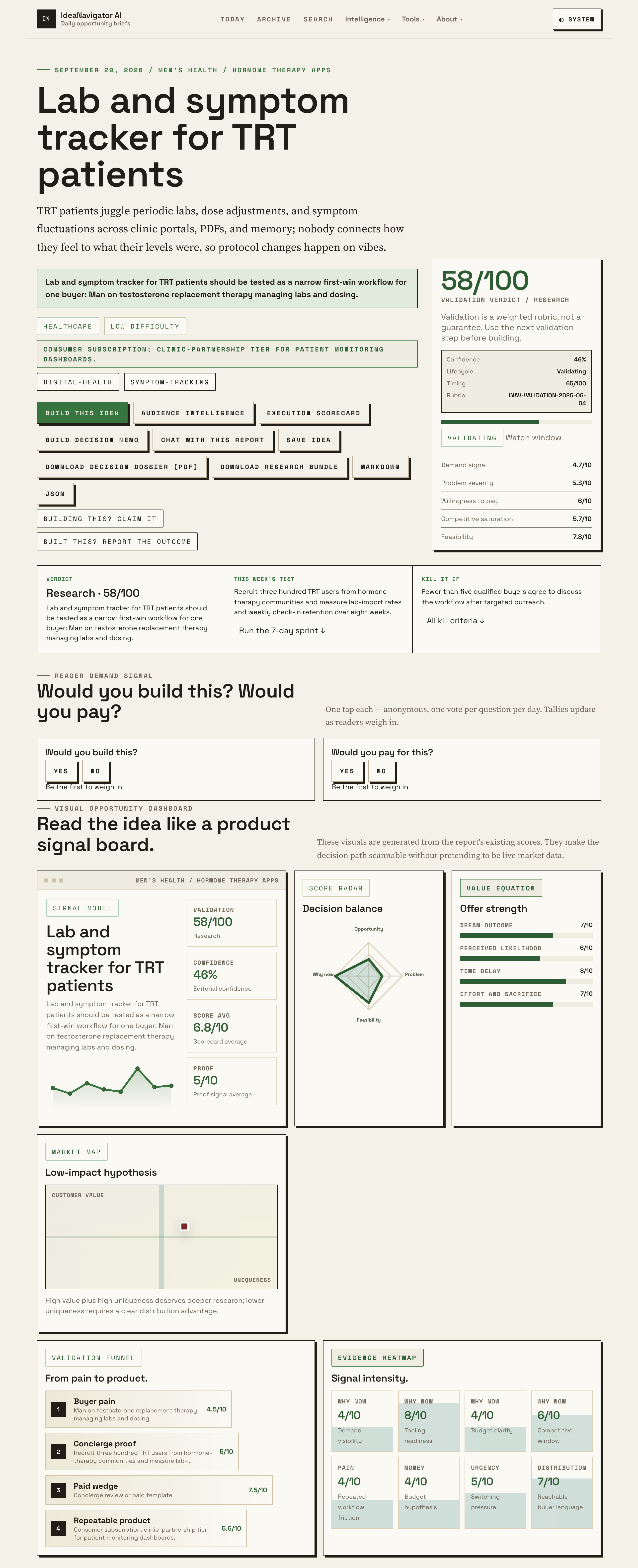
IdeaNavigator AI has proposed testing a narrow app for men on testosterone replacement therapy that links lab results and dose changes with daily symptom reports. The concept is still an idea: IdeaNavigator AI reports no product, trial results, or evidence of patient benefit.
IdeaNavigator AI has proposed testing a lab and symptom tracker for men receiving testosterone replacement therapy (TRT). In its proposal, the app would connect imported lab results and dose changes with daily symptom check-ins. IdeaNavigator AI describes a possible product and a way to test whether patients use it; it does not report that an app has launched or that the approach improves care.
According to IdeaNavigator AI, the proposed minimum viable product would let users import lab reports as PDFs, chart hormone results over time, record dosing changes and log symptoms each day. The proposal also says the app would create trend summaries for clinic visits and flag readings outside target ranges. It does not specify which lab markers or target ranges the app would use, or who would set and review them.
IdeaNavigator AI describes the intended user as a man on TRT managing labs and dosing. It says patients may have to piece together information from clinic portals, PDFs and memory, making it hard to compare how they feel with their hormone levels. That is the proposal’s account of the problem; IdeaNavigator AI provides no patient interviews, usage data or clinical findings to establish how common the difficulty is.
For validation, IdeaNavigator AI proposes recruiting 300 TRT users through hormone-therapy communities and tracking lab-import rates and weekly check-in retention over eight weeks. These are proposed measures, not completed results. The proposal describes a business model combining a consumer subscription with a clinic-partnership tier offering patient-monitoring dashboards, but reports no pricing or clinic interest.
Testing Whether Patients Keep Useful Records
If patients do have trouble bringing together results, dose history and symptoms, a tracker could give them a clearer record to discuss with their clinicians. Linking entries over time may help users and care teams review what changed around a particular lab result or dose adjustment. IdeaNavigator AI’s proposal does not establish that the charts would explain cause and effect, or that they would improve treatment decisions.
The distinction matters because tracking is not medical guidance. A flag based on a target range could prompt a patient to ask a clinician about a result, but IdeaNavigator AI’s proposal gives no clinical rules, safety process or plan for handling urgent findings. Any usefulness would depend on accurate records and on clinicians interpreting them within the patient’s care.
A Proposed Response to Fragmented Records
IdeaNavigator AI frames the idea around patients whose TRT care may involve periodic laboratory testing, dose adjustments and changing symptoms. Its proposal describes a setting in which records sit across provider portals and personal files, but offers no evidence about how often this occurs or whether current clinic tools already address it.
IdeaNavigator AI proposes an intentionally narrow first step: test a workflow for people already managing TRT, rather than build a broad men’s health platform. The plan names lab-import rates and weekly check-in retention as early indicators of use. Those measures could show whether participants enter information and return to the tracker, but by themselves would not demonstrate clinical accuracy, better health outcomes or demand for a paid service.
Demand, Safety and Clinical Value
IdeaNavigator AI reports no app, recruitment effort or user study, so it remains unclear whether 300 participants can be recruited or whether they would keep using the tracker for eight weeks. Its proposal provides no results on lab-import rates or retention and no evidence that users want to pay or clinics would adopt a dashboard.
The proposal also leaves open how the app would extract data from PDFs, account for different laboratories and units, define target ranges, protect sensitive health information or respond when a result appears out of range. IdeaNavigator AI reports no clinician review, regulatory assessment or comparison with existing tools. The proposed links between symptoms, hormone levels and dosing should be treated as records for discussion, not as proof that one caused another.
An Eight-Week Pilot Is Proposed
IdeaNavigator AI’s proposed next step is recruiting 300 TRT users and following lab-import behavior and weekly check-ins over eight weeks. The proposal gives no start date, participating clinics or recruitment commitments. Results from such a test could indicate whether users engage with the core workflow, while questions about data accuracy, safety and clinical value would require further evaluation.
Until a pilot is conducted and its findings are reported, the tracker remains a product proposal from IdeaNavigator AI. Subsequent reporting on a launch, clinical safeguards, user retention or clinic partnerships would clarify whether the concept has moved beyond its initial test plan.
Key Questions
Has a TRT lab and symptom tracker launched?
No launch is reported. IdeaNavigator AI describes a proposed product and validation plan.
What would the proposed app track?
In IdeaNavigator AI’s proposal, it would combine lab PDFs, dose changes and daily symptom check-ins, then chart trends and prepare summaries for clinic visits.
Would the app recommend TRT dose changes?
IdeaNavigator AI’s proposal does not say that it would recommend doses. It describes tracking information and flagging results outside target ranges, without specifying clinical rules or clinician oversight.
How would the idea be tested?
IdeaNavigator AI proposes an eight-week test with 300 TRT users, measuring lab-import rates and weekly check-in retention. No test results are available.
Source: IdeaNavigator AI
Fall Picks
fall essentials
As an affiliate, we earn on qualifying purchases.