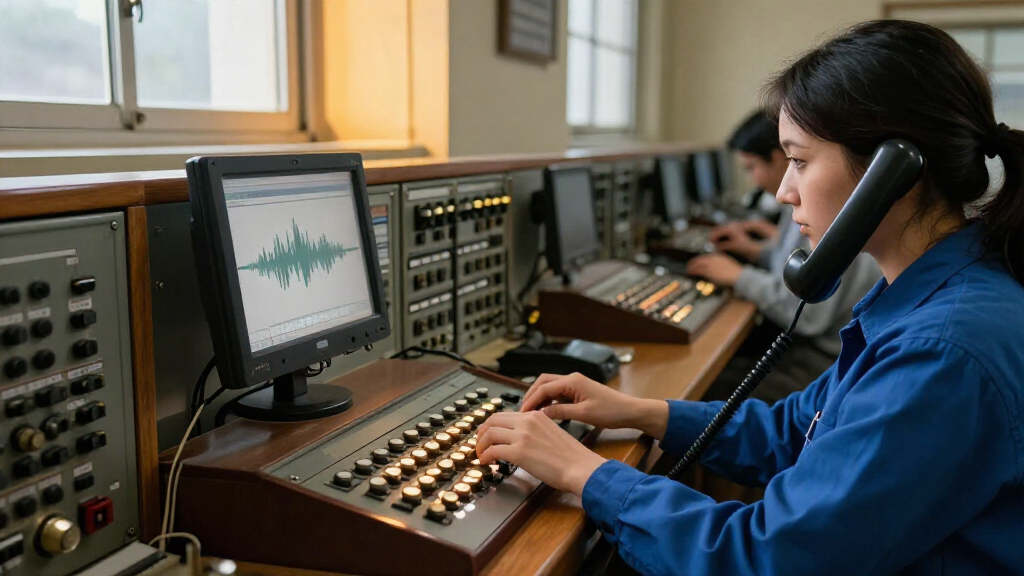
🔍 Read the full analysis: The Telephone Operator's Journey Into The Age Of AI on ThorstenMeyerAI.com

Get the latest gadgets delivered free with Prime
- Fast, free delivery on millions of items
- Prime Video, Amazon Music and more included
- Member-only deals all year
TL;DR
A November 19 account from ThorstenMeyerAI.com examines how automatic telephone exchanges replaced manual operators over several decades. It reports that younger women found other kinds of work, while operators already in the job faced greater employment losses and lower-paid work. The history offers context for concerns about AI exposure, but it does not establish what current AI adoption will do to jobs.
A November 19 report from ThorstenMeyerAI.com recounts how automatic telephone exchanges displaced many U.S. switchboard operators, a job held by about 2% of working women in 1920. Drawing on historical research cited by the publication, the account says incumbent operators were more likely to leave work or move into lower-paid jobs, while younger women entered other occupations—a history offered as context for current concerns about AI and women’s employment.
The change happened over decades, not in a single national cutover. Almon Strowger received a patent for an automatic telephone exchange in 1891, but large-scale conversion by the Bell System began only after engineers recommended mechanical switching for large cities in 1917. The Bell System began converting exchanges in 1919. Preparing a city took two to three years; the final transfer of wires from a manual switchboard to a machine could take minutes.
The publication reports that 32% of Bell telephones were on dial service by 1930 and 60% by 1940. Wartime copper rationing slowed conversions, and the last Bell network conversion came in 1978. Census figures cited in the account put the telephone-industry operator workforce at about 182,000 in 1930, with another 23,000 operators at private switchboards in hotels, hospitals and large businesses.
Economists James Feigenbaum and Daniel Gross estimate that about 13.7%—roughly one in seven—of white, U.S.-born women born around 1900 worked as an operator at some point from 1910 to 1940. The report says young operators’ numbers fell by 50% to 80% after a city adopted dial service. It also says incumbent operators were less likely to be working a decade later, and those still employed more often held lower-paid jobs. These are historical findings as presented by the source, not a forecast of AI’s effects.
Infographic 01 · Rise and fall
The switchboard job: 70 years up, half a century down
The dial arrived city by city from 1919. Yet the number of telephone operators kept growing until 1970, because calls, long distance and office switchboards grew too.
All telephone operators in the US census · thousands
Share of Bell System telephones on dial
Census counts: persons 14 and over, economically active (1950 in the 1950 classification); they include operators at private switchboards. After 1970: −75,000 telephone operator jobs in 1972-1980 (BLS), all of them held by women. 2025: wage and salary jobs (BLS survey), split into telephone operators (3,430) and switchboard operators incl. answering services (34,280). Definitions differ: compare orders of magnitude only.
Sources: US Census Bureau, Historical Statistics of the United States (1975), series D 351; J. Feigenbaum & D. P. Gross, Quarterly Journal of Economics 139(3), 2024 (AT&T archive data, 1930 count, 1 in 7 estimate); C. B. Leon, Monthly Labor Review (June 1982); BLS, Occupational Employment and Wage Statistics, May 2025.
Powered by Thorsten Meyer AI
The Cost of Switching to Automation
The history separates two outcomes that can be blurred in discussions of automation: what happens to people already doing a job, and what happens to the next generation of workers. According to the account, younger women did not experience an overall fall in employment; many took jobs as typists, secretaries and food-service workers. That does not mean the change was painless or that the new jobs matched the pay, conditions or prospects of operator work.
For workers already at the switchboard, the evidence described is less reassuring: lower likelihood of employment later and a greater chance of moving into lower-paid work. The distinction matters to readers weighing claims that new technology will create enough work to offset jobs it replaces. A transition in the total number of employed people can conceal substantial losses for particular workers and groups.
The report connects the history to generative AI, citing the International Labour Organization’s ranking of clerical work as the occupational category most exposed to the technology. It says that exposure in high-income countries falls more heavily on women’s jobs than on men’s. Exposure is not the same as confirmed job loss: the source presents this as a reason to examine who faces change, not proof that AI will repeat the telephone industry’s trajectory.
Products Worth Considering

LG UltraGear 27-inch QHD OLED Gaming Monitor, 240Hz, 0.03ms, G-SYNC Compatible, FreeSync Premium Pro, HDR True Black 400

Apple AirPods Pro 3 Wireless Earbuds with Active Noise Cancellation

Amazon Kindle Scribe Colorsoft 64GB with Premium Pen
As an affiliate, we earn on qualifying purchases.
From Manual Switchboards to Dial Phones
The Bell telephone company was founded in 1877, and its first exchange opened in New Haven, Connecticut, in 1878. Under manual switching, an operator connected a caller by plugging a cord into the correct jack. The work grew with the network because each new subscriber added possible connections that had to be handled by people.
Operators were initially mostly boys and young men. The company later recruited young women, and by 1910 operators were almost all women. A 1946 U.S. Women’s Bureau report listed employers’ expectations, including a high-school education, good hearing and eyesight, a pleasing voice, and a temperament suited to handling irritable customers. The source describes the position as relatively well-paid and social compared with factory work, while also noting high turnover: internal AT&T memoranda described rates of up to 40% a year.
Strowger’s 1891 patent described a dial and exchange switches that could connect calls without an operator. The source cautions that the familiar story that Strowger invented the system because an operator diverted his customers to a competitor could not be confirmed in a primary source. It should be treated as a legend, rather than established motive.
“About one in seven white, American-born women born around 1900 were telephone operators at some point.”
— ThorstenMeyerAI.com, summarizing estimates by economists James Feigenbaum and Daniel Gross
What the Historical Comparison Cannot Show
The account does not provide the underlying tables or full methods for every employment result in the excerpt, so readers cannot independently assess the estimates from this material alone. The one-in-seven figure applies specifically to white, U.S.-born women born around 1900; it should not be generalized to all women. The source says AT&T did not hire Black operators until after 1940, underscoring the limits of the estimate’s population coverage.
The reported decline of 50% to 80% concerns young operator numbers after a city switched to dial service. It is not a national job-loss rate, and the supplied account does not specify the cities, exact time windows or calculation details for that range. Nor does it establish how many displaced workers secured equivalent pay or conditions elsewhere.
The source points to AI exposure in clerical occupations but gives no specific forecast of employment losses, timeline or worker outcomes. Whether AI will reduce headcounts, change tasks, or create other jobs remains unresolved here. The story of telephone automation supplies historical evidence, not a direct prediction.
Tracking AI’s Effects on Clerical Work
The historical account gives no new policy announcement or scheduled follow-up. The next evidence relevant to its AI comparison will come from research and labor-market data that distinguish tasks exposed to generative AI from jobs actually eliminated or changed. Tracking pay, hours, hiring and job transitions by occupation and gender would help show who bears the costs and who gains from adoption.
For the telephone story itself, the source traces the Bell network’s conversion through 1978 but does not set out a new historical research milestone. Its immediate takeaway is a question for current technology decisions: whether employers and policymakers will account for incumbent workers as well as the opportunities available to people entering the labor market.
Key Questions
How many women worked as telephone operators?
The account cites an estimate by economists James Feigenbaum and Daniel Gross that about 13.7%, or roughly one in seven, white, U.S.-born women born around 1900 worked as operators at some point between 1910 and 1940. This is a lifetime-through-that-period estimate, not the share working in the job in a single year.
When did automatic switching replace manual operators?
The change took place gradually. The Bell System began converting exchanges in 1919, with 32% of Bell telephones on dial service by 1930 and 60% by 1940. The source says the final Bell network conversion occurred in 1978.
What happened to operators who lost their jobs?
The report says younger women moved into occupations such as typing, secretarial work and food service. It also cites evidence that incumbent operators were less likely to be working ten years later and that those still employed more often had lower-paid jobs. The supplied material does not quantify all their later employment outcomes.
Does this history prove AI will eliminate women’s jobs?
No. The account cites the International Labour Organization’s assessment that clerical jobs are highly exposed to generative AI, especially in high-income countries and more often among women’s jobs than men’s. Exposure does not prove job loss, and the historical case does not establish what AI adoption will do.
Source: ThorstenMeyerAI.com