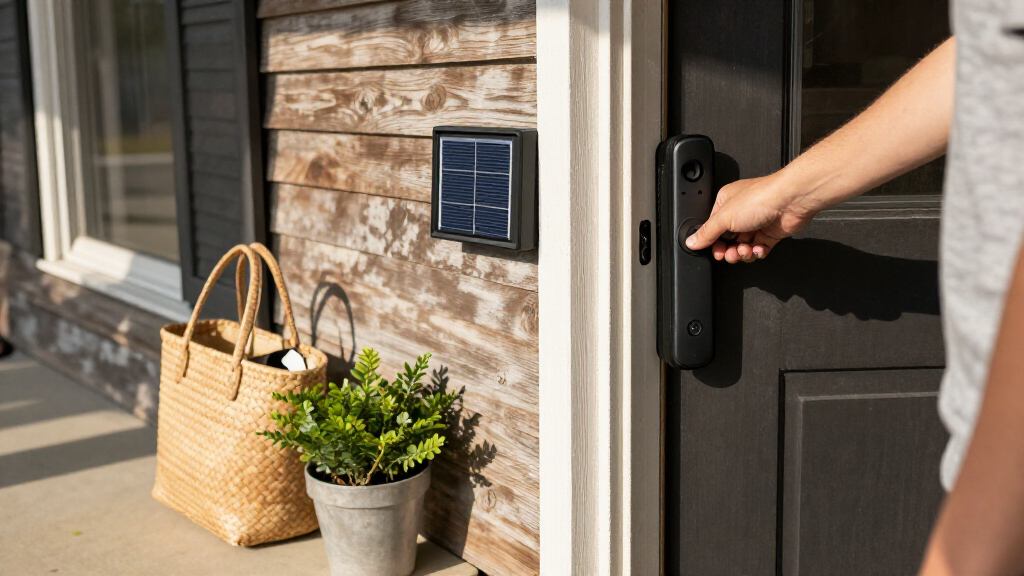

Choosing among the best solar smart locks means weighing more than how much sunlight a panel can collect. I’d start with the DESLOC V150 Plus if outdoor weather resistance and face recognition matter most, the Lockin Veno with Handle for broad smart-home support and several entry methods, or the Lockin Veno deadbolt if you want the same solar and Matter platform without the included handle. Each uses solar to support a rechargeable battery, not as a guarantee that you will never need backup charging.

Get the latest gadgets delivered free with Prime
- Fast, free delivery on millions of items
- Prime Video, Amazon Music and more included
- Member-only deals all year
The central tradeoff is clear: DESLOC offers IP65 protection and 3D face recognition, while the two Lockin versions share a 37 Wh battery, USB-C backup, Wi-Fi, and Matter. The Lockin models are closely related rather than wholly different systems, so the useful distinction is their included hardware and how each fits your door project. I rank the Veno with Handle first for its combination of access choices and ecosystem flexibility, DESLOC second for its stronger weather rating and distinctive biometrics, and the standalone Veno third as the leaner deadbolt configuration. Before choosing any of them, I would check door measurements and the light reaching the solar panel.
Complete the kit



Key Takeaways
- The Lockin Veno with Handle is my best overall choice for buyers seeking fingerprint, PIN, app, voice, and key access alongside Wi-Fi and Matter.
- DESLOC V150 Plus is the strongest fit for exposed entrances: its IP65 rating exceeds the Lockin models’ IP53 rating, and it adds 3D face recognition.
- The two Lockin Veno products share a 37 Wh battery, perovskite solar charging, USB-C backup, and BHMA Grade 3 construction; choose between them by included handle and configuration.
- Solar charging depends on usable light: the Lockin charging condition specifies 1000 lux or more when its battery is below 90%, so a shaded doorway can still require USB-C backup.
- DESLOC lists specific door-fit measurements, including a 2-1/8-inch bore hole; verify those dimensions before buying, just as you should confirm compatibility for either Lockin model.
| Lockin Veno Solar Fingerprint Smart Deadbolt with Handle |  | Best Overall — broad entry choices and Matter support | Model: LKMSD650BL; Veno Solar Fingerprint | Power: Built-in perovskite solar panel; 37 Wh battery; USB-C backup charging | Unlock methods: Fingerprint, PIN, app, voice control, mechanical key | VIEW LATEST PRICE | See Our Full Breakdown |
| DESLOC V150 Plus Solar Smart Lock with Wi-Fi and 3D Face Recognition |  | Best for exposed doors — higher weather protection and face recognition | Model: V150 Plus | Power: Perovskite solar technology and 10,000 mAh lithium battery | Unlock methods: 3D face recognition, fingerprint, app, Alexa or Google Assistant voice control, mechanical key | VIEW LATEST PRICE | See Our Full Breakdown |
| Lockin Veno Solar Fingerprint Smart Deadbolt |  | Best Deadbolt-Only Configuration — Lockin solar and Matter without the listed handle | Model: Veno Solar Fingerprint LKMSD650B | Power: Built-in perovskite solar panel and 37 Wh battery | Backup charging: USB-C | VIEW LATEST PRICE | See Our Full Breakdown |
| solar smart lock | Model | Power | Unlock methods | Connectivity |
|---|---|---|---|---|
| Lockin Veno Solar Fingerprint | LKMSD650BL; Veno Solar Fingerprint | Built-in perovskite solar panel; 37 Wh battery; USB-C backup charging | Fingerprint, PIN, app, voice control, mechanical key | Wi-Fi and Matter; no separate hub required |
| DESLOC V150 Plus Solar Smart L | V150 Plus | Perovskite solar technology and 10,000 mAh lithium battery | 3D face recognition, fingerprint, app, Alexa or Google Assistant voice control, mechanical key | — |
| Lockin Veno Solar Fingerprint | Veno Solar Fingerprint LKMSD650B | Built-in perovskite solar panel and 37 Wh battery | Fingerprint and four additional methods | Wi-Fi and Matter; no hub required |
More Details on Our Top Picks
Lockin Veno Solar Fingerprint Smart Deadbolt with Handle
The Lockin Veno with Handle earns my top spot because it balances solar-assisted power with the widest clearly stated smart-home and access combination in this group. A built-in perovskite panel supports its 37 Wh battery, while USB-C charging gives you another way to recover power when available light is not enough. Fingerprint, PIN, app, voice, and mechanical-key entry also give a household several ways to get inside. That range makes this more adaptable than a lock selected around only one biometric method.
Its Wi-Fi and Matter connectivity are another reason I rank it ahead of the standard Veno configuration for most buyers. The listing names Apple Home, Alexa, and Google Home compatibility and says no separate hub is needed. That gives it a broader stated smart-home role than the DESLOC, which specifies Wi-Fi and Alexa or Google Assistant voice control but does not list Matter. The Lockin also includes remote access, temporary passcodes, entry alerts, access logs, and countdown auto-lock, giving owners options for guests and routine entry rather than only a way to unlock the door.
There are meaningful limits. Its solar charging condition is specified for 1000 lux or more when the battery is below 90%, so a covered or deeply shaded entry may not get the benefit you expect. USB-C is a backup, not a reason to ignore battery status. And while IP53 suits everyday outdoor exposure, it is less protective than DESLOC’s IP65 rating. For a door exposed to driving rain or harsher conditions, the V150 Plus is the more defensible pick on the specifications provided.
The handle is the practical distinction between this model and the Lockin Veno deadbolt reviewed below. I would choose this version when the included handle matches the job, rather than assuming it is automatically a better retrofit for every door. Its BHMA Grade 3 rating and mechanical key add useful everyday reassurance, but buyers should still check the supplied hardware and door compatibility before replacing existing pieces. For someone who wants one solar-assisted lock with several entry paths and a connected-home feature set, this is the most balanced option here.
Pros:- Five stated entry methods provide alternatives if a fingerprint or phone is unavailable.
- Wi-Fi and Matter support connect with Apple Home, Alexa, and Google Home without a separate hub.
- A 37 Wh battery pairs solar input with USB-C backup charging.
- Temporary passcodes, alerts, access logs, and countdown auto-lock support guest access and routine security.
Cons:- Solar charging is specified at 1000 lux or more when the battery is below 90%, so shaded entries may need USB-C charging.
- IP53 offers less weather protection than DESLOC’s IP65 rating.
- The handle configuration may not suit buyers replacing only a deadbolt.
Best for: Households that want fingerprint, PIN, app, voice, and key access, plus Wi-Fi and Matter support in a solar-assisted lock with an included handle.
Not ideal for: Buyers with a heavily exposed entrance, a shaded door where solar charging is unlikely to help, or a project that needs only a deadbolt and not the included handle.
- Model:LKMSD650BL; Veno Solar Fingerprint
- Power:Built-in perovskite solar panel; 37 Wh battery; USB-C backup charging
- Unlock methods:Fingerprint, PIN, app, voice control, mechanical key
- Connectivity:Wi-Fi and Matter; no separate hub required
- Smart-home compatibility:Apple Home, Alexa, Google Home
- Weather protection:IP53
- Included configuration:Solar fingerprint lock with handle
Our verdict“I recommend the Veno with Handle for buyers who want the broadest stated access and smart-home mix, provided the entry gets useful light and the IP53 rating suits its exposure.”
DESLOC V150 Plus Solar Smart Lock with Wi-Fi and 3D Face Recognition
The DESLOC V150 Plus is my pick for buyers who put weather resistance and hands-free biometric access ahead of Matter support. Its IP65 rating is the strongest stated protection in this roundup, well above the IP53 rating on both Lockin Veno models. It also lists an operating range from -22°F to 158°F, making its stated environmental tolerance an advantage for a door that sees wide temperature changes. Those specifications make it the clearest choice for a more exposed entrance, though the rating does not remove the need to follow installation guidance.
Its headline feature is 3D face recognition, joined by fingerprint, app, voice-assistant, and mechanical-key entry. The lock supports up to 50 face profiles and 50 fingerprints, and the listing specifies local storage for biometric data plus liveness detection. That is a different emphasis from Lockin: the Veno models lead with Matter, a 37 Wh battery, and their five listed entry methods, while DESLOC adds face recognition and a larger stated fingerprint capacity. If people often arrive with hands full, face access could be the deciding feature, but buyers who prefer PIN entry should note that a PIN method is not listed in the supplied specifications.
Power comes from perovskite solar technology and a 10,000 mAh lithium battery. The solar input can help reduce manual charging, but the product information does not specify a lux threshold or promise that every installation will stay charged from sunlight alone. I would treat solar as assistance, not a substitute for monitoring battery status. Unlike the Lockin models, the supplied description does not list USB-C as a backup charging method, so I would check the current product instructions for the battery-recovery procedure before relying on it at a remote entry.
Fit is the main reason to pause before ordering. DESLOC specifies a 2-1/8-inch bore hole, a backset of 2-3/8 or 2-3/4 inches, and a door thickness from 1-3/8 to 2 inches. It includes a door sensor, keys, battery, and mounting hardware, and automatic door handing is listed as an installation aid. That detail is helpful, but it does not make the lock universal. Compared with the Lockin entries, DESLOC offers stronger weather protection and a distinctive face-based route in, while asking buyers to pay closer attention to exact door measurements and the available charging backup.
Pros:- IP65 weather resistance and a stated operating range of -22°F to 158°F suit more demanding outdoor conditions than the Lockin models’ listed IP53 rating.
- 3D face recognition, fingerprints, app, voice, and mechanical keys offer varied access methods.
- Biometric data is stored locally, with liveness detection listed.
- Solar technology is paired with a 10,000 mAh battery; the package lists keys, mounting hardware, a door sensor, and spare parts.
Cons:- The 2-1/8-inch bore hole and stated backset and door-thickness ranges require careful fit checks.
- Solar charging still depends on light, and no specific lux condition is supplied.
- The provided specifications do not list Matter or USB-C backup charging.
Best for: Buyers with a more exposed entry who want 3D face recognition, local biometric storage, fingerprint access, and a stated IP65 rating.
Not ideal for: Anyone whose door misses the listed bore-hole, backset, or thickness dimensions, or who specifically wants Matter integration or a listed USB-C charging backup.
- Model:V150 Plus
- Power:Perovskite solar technology and 10,000 mAh lithium battery
- Unlock methods:3D face recognition, fingerprint, app, Alexa or Google Assistant voice control, mechanical key
- Biometric capacity:Up to 50 face profiles and 50 fingerprints
- Connectivity and data:Built-in Wi-Fi; biometric data stored locally
- Weather and temperature:IP65; -22°F to 158°F (-30°C to 70°C)
- Door fit:1-3/8 to 2 inches thick; 2-1/8-inch bore hole; 2-3/8 or 2-3/4-inch backset
- Included components:Two mechanical keys, locks, deadbolt, lithium-ion battery, mounting hardware, door sensor, and spare parts
Our verdict“I would choose the V150 Plus for a compatible, weather-exposed door where face recognition and IP65 protection matter more than Matter or a stated USB-C backup.”
Lockin Veno Solar Fingerprint Smart Deadbolt
Best Deadbolt-Only Configuration — Lockin solar and Matter without the listed handle
View Latest PriceThe standalone Lockin Veno Solar Fingerprint Deadbolt is the most straightforward choice when you want the Veno platform in a deadbolt configuration and do not need the handle included with the first-ranked version. It shares the core power and connection story: a 37 Wh battery**, built-in perovskite solar panel, USB-C backup, Wi-Fi, and Matter. The product listing also says no hub is required and describes app control. That makes its day-to-day smart-home profile close to the Veno with Handle, rather than a less capable solar system.
Compared with DESLOC, this Veno prioritizes Matter and flexible smart-home integration over face recognition and a stronger weather rating. It lists fingerprint access and four additional methods, but the supplied detail does not name all four as clearly as the Veno-with-Handle description does. I would verify the exact entry methods in current product documentation if PIN or voice access is a must-have. DESLOC is the more compelling pick for facial access and IP65; this Veno makes more sense for someone already choosing the Lockin ecosystem and replacing a deadbolt alone.
The same solar caveat applies here as to the handle version: the stated charging condition is 1000 lux or more when the battery is below 90%. A bright entrance may let solar input help maintain the integrated battery, while a dark porch may leave USB-C charging as the practical recovery method. Its IP53 protection is described for everyday outdoor exposure, not unrestricted weather, so I would not choose it over the DESLOC for a door that takes persistent wind-driven rain. The BHMA Grade 3 rating provides a useful construction reference, but it does not erase the environmental difference between these models.
What keeps this third is not a major flaw in its stated feature set; it is the narrow gap between it and the first-ranked Lockin. Buyers considering both should focus on the hardware configuration and the exact included components. The handle model provides a clearer all-in-one choice for someone replacing a broader set of entry hardware, while this product listing describes one lock and a deadbolt-focused setup. If that is the format your door needs, this may be the cleaner fit. If you want a more weather-hardened lock or face recognition, DESLOC has the stronger case.
Pros:- Shares the 37 Wh battery, perovskite solar panel, and USB-C backup approach of the Veno with Handle.
- Wi-Fi and Matter support operate without a separate hub, according to the listing.
- Fingerprint access and app control provide keyless entry and remote management.
- BHMA Grade 3 construction and IP53 protection are specified for everyday home use.
Cons:- Its IP53 rating is below DESLOC’s IP65 protection for more exposed doors.
- Solar input has a stated light condition of at least 1000 lux when the battery is below 90%.
- The listing does not name all five unlocking methods individually as clearly as the handle version does.
Best for: Buyers who want a solar-assisted Lockin deadbolt with a 37 Wh battery, USB-C backup, Wi-Fi, and Matter, without selecting the listed handle configuration.
Not ideal for: Buyers who need IP65 protection, 3D face recognition, or a clearly specified complete set of entry methods without checking the detailed product documentation.
- Model:Veno Solar Fingerprint LKMSD650B
- Power:Built-in perovskite solar panel and 37 Wh battery
- Backup charging:USB-C
- Unlock methods:Fingerprint and four additional methods
- Connectivity:Wi-Fi and Matter; no hub required
- Weather protection:IP53
- Size and weight:10.42 × 3 × 4 inches; 3.1 pounds
- Material and finish:Aluminum; black
Our verdict“I recommend this Veno when a deadbolt-only Lockin setup is the right hardware fit; choose the handle version for the more clearly specified all-in-one access package or DESLOC for harsher exposure.”
How We Picked
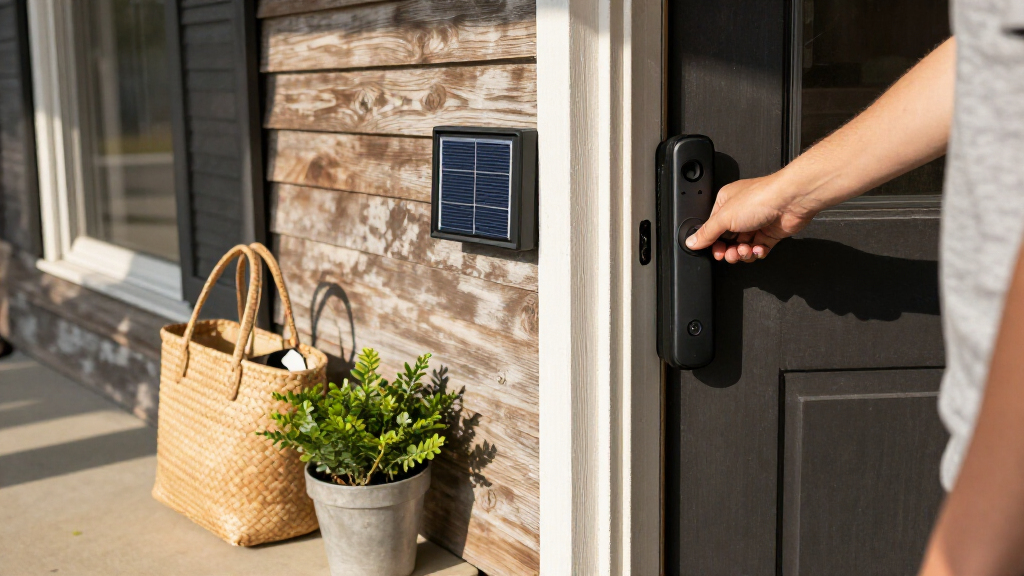
I ranked these locks around the practical question behind a solar-lock purchase: how well does solar support daily access without creating a new reliability or installation problem? I compared the stated power systems, backup options, entry methods, weather protection, smart-home connections, and door-fit information. I did not treat a solar panel as proof of maintenance-free operation. The listed charging conditions and the availability of wired backup matter because light varies by doorway and season.
My top position goes to the Lockin Veno with Handle because it combines several ways to enter with Wi-Fi, Matter, remote access, and a mechanical-key fallback. DESLOC ranks close behind: its face recognition, local biometric storage, liveness detection, and IP65 rating create a compelling outdoor-focused package, but its listed bore-hole requirement makes fit verification particularly important. The Lockin Veno deadbolt remains a capable choice, but it shares much of the first model’s core platform and has fewer supplied hardware details in the listing. Its place reflects a narrower configuration, not a claim that its solar system is inferior.
I also considered whether each model gives a buyer a clear reason to choose it over the others. Handle inclusion can matter when replacing or refreshing door hardware; a weather rating can matter more at an exposed entry; Matter support can matter to a household building around multiple smart-home platforms. Finally, I considered the drawbacks alongside the benefits: solar still needs light, outdoor ratings have limits, and smart-lock compatibility depends on the actual door and the way the household uses it. The descriptions supplied the specifications used here; I make no claim of hands-on testing.
| solar smart lock | Model | Power | Connectivity |
|---|---|---|---|
| Lockin Veno Solar Fingerprint | LKMSD650BL; Veno Solar Fingerprint | Built-in perovskite solar panel; 37 Wh battery; USB-C backup charging | Wi-Fi and Matter; no separate hub required |
| DESLOC V150 Plus Solar Smart L | V150 Plus | Perovskite solar technology and 10,000 mAh lithium battery | — |
| Lockin Veno Solar Fingerprint | Veno Solar Fingerprint LKMSD650B | Built-in perovskite solar panel and 37 Wh battery | Wi-Fi and Matter; no hub required |
Factors to Consider When Choosing Best Solar Smart Locks
I would choose a solar smart lock by checking the door, the light, and the access habits in that order. A feature list only helps after the lock can fit the door and its panel can receive useful light. From there, compare backup power, weather exposure, and the smart-home features you will actually use.
Treat solar as battery support, not a no-maintenance promise
Solar-assisted locks still depend on a rechargeable battery and the light available at their installation point. The Lockin Veno models specify a 37 Wh battery, perovskite solar panel, and USB-C backup; the listed charging condition calls for at least 1000 lux when the battery is below 90%. That detail matters if a porch roof, storm door, nearby wall, or north-facing entrance limits daylight. DESLOC lists solar technology with a 10,000 mAh battery but does not provide the same lux threshold in the supplied information. I would compare the panel’s placement and read the manufacturer’s charging guidance before treating solar as a substitute for battery checks.
Backup access and backup power solve different problems. A mechanical key can let you enter when electronic access fails, but it does not recharge the battery. USB-C backup on the Lockin models addresses charging; DESLOC lists mechanical keys, but the supplied specifications do not state USB-C charging. If you are choosing DESLOC, confirm how its battery is charged or recovered when solar input is insufficient. Whichever lock you pick, make a habit of checking its battery warnings and keeping the listed fallback method available.
Match the weather rating to the actual doorway
IP65 versus IP53 is the clearest outdoor distinction in this group. DESLOC’s IP65 rating is the stronger stated protection and makes it the leading candidate for a more exposed entrance. Both Lockin Veno versions list IP53, which is described for everyday outdoor exposure rather than unrestricted weather. Neither number tells you every detail about how a particular installation will fare, so consider the direction of rain, shelter, temperature, and manufacturer instructions rather than relying on the label alone.
DESLOC also gives a stated operating range of -22°F to 158°F, which is useful information for buyers dealing with large temperature swings. No equivalent temperature range is included in the provided Lockin specifications, so I would not infer that the two systems have the same rated tolerance. If the lock will sit under a deep overhang in a moderate climate, the Lockin feature mix may matter more. At an exposed door, DESLOC’s stated weather advantage deserves more weight.
Check measurements before comparing app features
A smart lock that does not fit is not a useful upgrade. DESLOC specifies a 1-3/8- to 2-inch door thickness**, a 2-1/8-inch bore hole, and a backset of 2-3/8 or 2-3/4 inches. Measure your door and existing preparation against those figures before ordering. The package includes hardware and automatic door handing is listed, but buyers should not assume that feature makes every door compatible.
The product information supplied for the Lockin models does not spell out the same complete set of door measurements. I would check the current fit guide for the exact version, especially because one listing includes a handle and another describes a deadbolt-only configuration. Decide whether you are replacing only the deadbolt or changing more of the door hardware; then confirm the included components match that plan. This practical check can outweigh small differences in access features.
Pick entry methods that match the people using the door
The Lockin Veno with Handle has the clearest stated selection: fingerprint, PIN, app, voice control, and mechanical key. That variety helps households that want alternatives for family, guests, and times when a phone or fingerprint is inconvenient. It also lists temporary passcodes, entry alerts, access logs, and countdown auto-lock. The standalone Veno lists fingerprint and four additional methods, but the supplied description does not name all four individually; verify the exact methods if a particular one is a requirement.
DESLOC’s point of difference is 3D face recognition, along with fingerprint, app, voice-assistant control, and mechanical keys. It supports up to 50 face profiles and 50 fingerprints, and its biometric data stays on the lock according to the listing. A PIN method is not included in the supplied details, so do not assume one is available. I would pick based on the least convenient access problem in your household, not the longest feature list: face access may help when hands are full, while a PIN may be more useful for visitors who should not enroll a biometric.
Choose the smart-home system you already use
Both Lockin models list Wi-Fi and Matter, with no separate hub required, and the handle version specifies compatibility with Apple Home, Alexa, and Google Home. The DESLOC lists built-in Wi-Fi and Alexa or Google Assistant voice control, but Matter is not specified in the information provided. If Matter compatibility is a firm requirement in your connected home, the Lockin models have the clearer stated fit. If face recognition and weather resistance matter more, DESLOC may still be the better functional choice.
Remote access, alerts, and logs can be useful for letting someone in or checking entry activity, but check which functions the app supports in your region and whether your home network reaches the door. Smart-home compatibility is not the same thing as every feature being available through every assistant. I would treat the listed ecosystem support as a starting point and confirm the specific routines or voice commands you expect to use.
Compare the Lockin versions by hardware configuration
These two Lockin products share much of the same core: solar-assisted 37 Wh power, USB-C backup, Wi-Fi, Matter, IP53, and BHMA Grade 3. The handle model is the better-defined all-in-one pick and names five entry methods plus additional access-management functions. The standalone Veno is a deadbolt-focused option, with one lock listed among its included components. For a buyer who needs only a deadbolt, that configuration may be the more natural match; for a buyer replacing or coordinating a handle as well, the first model is more relevant.
I would not rank one Lockin as having a better solar system based on the provided descriptions. The practical distinction is what is included and how completely the access features are specified. Compare the exact package, fit instructions, and door hardware before choosing between them. If neither suits the exposure of your entry, DESLOC’s IP65 rating is the more important difference to weigh.
Frequently Asked Questions
Do solar smart locks work without direct sunlight?
They may receive useful light without direct sun, but charging depends on the particular panel and the light level at the door. The Lockin Veno descriptions state that charging applies at 1000 lux or more when the battery is below 90%; that is a condition to check against your entrance, not a promise that every shaded spot will maintain the battery. DESLOC also depends on available light, though its supplied specifications do not give a lux threshold. I would plan for battery monitoring and use the listed backup method when solar input is limited.
Which of these locks is best for an exposed front door?
Based on the stated weather ratings, I would choose the DESLOC V150 Plus for a more exposed door because it lists IP65 protection, compared with IP53 for both Lockin Veno models. DESLOC also lists an operating range from -22°F to 158°F. That does not make installation conditions irrelevant: follow the manufacturer’s guidance and consider the direction of rain and shelter. For a sheltered entry, the Lockin options may be preferable if Matter or their specified access features matter more.
Do the Lockin Veno models require a hub?
The standalone Lockin Veno listing says Wi-Fi and Matter connectivity with no hub required, and the handle version describes Wi-Fi and Matter along with Apple Home, Alexa, and Google Home compatibility. That is the clearest stated hub-free smart-home option in this comparison. DESLOC lists built-in Wi-Fi and voice control for Alexa or Google Assistant, but the supplied description does not list Matter. I would check the current compatibility details for the exact features and ecosystem you plan to use.
Is the DESLOC V150 Plus compatible with every standard door?
No. DESLOC gives specific fit dimensions: a door thickness from 1-3/8 to 2 inches, a 2-1/8-inch bore hole, and a 2-3/8- or 2-3/4-inch backset. Check each measurement on your door before choosing it. The listing’s automatic door handing and included mounting hardware may help with setup, but they do not remove those fit requirements. I would also verify the current installation guide rather than relying only on the word “standard.”
Which lock should I choose if I do not want biometric entry?
The Lockin Veno with Handle is the clearest choice if you want to avoid relying on biometrics because it explicitly lists a PIN code, app, voice control, and mechanical key as alternatives to fingerprint access. DESLOC emphasizes face and fingerprint recognition, and its supplied specification list does not state a PIN method. The standalone Lockin Veno lists fingerprint plus four additional methods without naming each one in the supplied detail, so I would verify that model’s exact options before buying if PIN access is essential.
Conclusion
My best overall recommendation is the Lockin Veno with Handle for households that want multiple ways to enter, named Apple Home, Alexa, and Google Home compatibility, Matter, and useful access-management features. Choose it only if the included handle suits your door and the IP53 rating matches its exposure. For an entrance that faces tougher weather, or for someone who specifically wants 3D face recognition, I would move to the DESLOC V150 Plus after checking its bore hole, backset, and door thickness.
If your project calls for a deadbolt-only Lockin configuration, the Lockin Veno Solar Fingerprint Deadbolt keeps the 37 Wh battery, solar panel, USB-C backup, Wi-Fi, and Matter without the listed handle package. Across all three, I would make the final choice by matching door measurements, realistic light, and backup access to the entry—not by assuming solar eliminates charging. Buyers with a shaded door should pay particular attention to the Lockin lux condition and confirm DESLOC’s battery-recovery instructions before relying on its solar input.