
🔍 Read the full analysis: Leading Studio Condenser Microphones For AI In 2026 on ThorstenMeyerAI.com

Get the latest gadgets delivered free — and shop member deals
- Fast, free delivery on millions of items
- Access to Prime Big Deal Days deals on October 6–7
- Prime Video, Amazon Music and more included
TL;DR
In 2026, industry leaders have introduced advanced studio condenser microphones optimized for AI integration. These models prioritize sound clarity, durability, and connectivity, shaping professional and consumer AI audio applications. This development signals a shift toward higher-quality AI audio input devices, impacting creators and tech developers alike.
In 2026, several major audio equipment companies have launched new studio condenser microphones explicitly optimized for AI integration, marking a significant shift in professional and consumer AI audio input technology. These microphones aim to deliver unprecedented clarity, reliability, and connectivity, enabling more sophisticated AI-driven audio processing and recognition applications. The development underscores the growing importance of high-quality input devices in the expanding AI ecosystem, affecting content creators, developers, and enterprise users.
Leading brands such as RØDE, Audio-Technica, and Neumann have introduced new condenser microphone models tailored for AI applications, emphasizing features like enhanced frequency response, low self-noise, and advanced connectivity options. For instance, the RØDE NT1 5th Gen now includes USB-C connectivity, facilitating seamless integration with modern AI hardware and software setups. These microphones are designed to meet the needs of high-fidelity voice recording, data collection, and real-time AI processing, which require pristine audio input.
Industry experts note that durability and versatility are important considerations, as AI applications often require continuous, reliable operation in various environments. The new models also incorporate improved noise rejection and multiple pickup patterns, catering to both studio and field use. While the core technology remains rooted in traditional condenser design, these models incorporate innovations aimed at optimizing AI data input, such as integrated digital interfaces and enhanced sensitivity.
Market analysts predict that these developments will support increased adoption of AI in media production, virtual assistants, and automated transcription services, where audio quality can influence AI performance. The new microphones are likely to be adopted across professional studios, research labs, and consumer devices, reflecting a broader industry trend toward integrating high-quality audio hardware with AI systems.
The 10 picks
- 1
 RØDE NT1 5th Gen Studio Condenser Microphone, XLR + USB-C, SilverView on Amazon →
 - 2
 RØDE NT1 Signature Series Studio Condenser Microphone, BlackView on Amazon →
 - 3
 Audio-Technica AT2020 Cardioid Condenser Studio XLR Microphone, BlackView on Amazon →
 - 4
 AKG Pro Audio P120 – Affordable 2/3-Inch Diaphragm Condenser Microphone for C…View on Amazon →
 - 5
 Melon Audio MA-87 Studio Condenser Microphone with AccessoriesView on Amazon →
 - 6
 MAONO A04 Gen2 XLR/USB Condenser Microphone Kit for PC Podcast RecordingView on Amazon →
 - 7
 Maono PM320S Condenser PC Microphone with XLR Cable, Boom Arm, Pop FilterView on Amazon →
 - 8
 Mackie EM-Series Large-Diaphragm Condenser Microphone (EM-91C)View on Amazon →
 - 9
 FIFINE T669 Studio Condenser USB Microphone for Recording and PodcastingView on Amazon →
 - 10
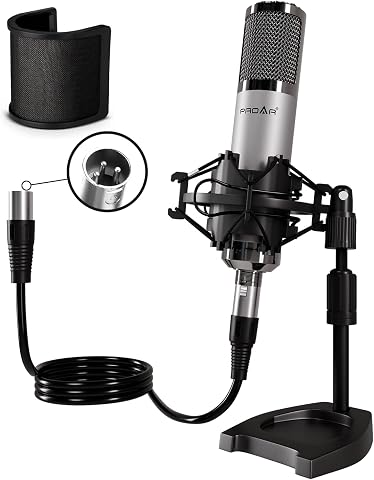 XLR Condenser Microphone with Desktop Stand for Vocals and PodcastingView on Amazon →
Implications for AI-Driven Audio Applications
The introduction of advanced studio condenser microphones in 2026 tailored for AI signifies a step toward improving the quality and reliability of audio input in AI systems. High-fidelity microphones can enhance speech recognition accuracy, reduce background noise interference, and support more natural interactions between humans and AI. For content creators and developers, this may lead to more precise voice commands, clearer virtual meetings, and better data for machine learning models. The trend also indicates a growing demand for specialized hardware to support complex AI workflows, which could influence future product design and industry standards.
Evolution of Studio Microphones and AI Integration
Over the past decade, studio condenser microphones have evolved from basic recording tools into highly sophisticated devices capable of capturing nuanced sound with minimal noise. Historically, models like the RØDE NT1 and Audio-Technica AT2020 have established benchmarks for affordability and performance. In recent years, the integration of digital connectivity options, such as USB-C, has simplified setups for creators and professionals. As AI applications expanded, the need for microphones that can provide clean, detailed audio input became more urgent, prompting manufacturers to innovate with features like low self-noise, multiple pickup patterns, and digital interfaces.
Prior to 2026, most AI-focused microphone development was incremental, often adding digital output or improved noise rejection. The current wave of new models, however, explicitly targets AI workflows, with features designed to optimize data quality for machine learning, speech recognition, and real-time processing. This represents a strategic shift in the industry, emphasizing hardware that directly supports AI applications rather than solely traditional recording or broadcasting use.
Remaining Questions on Industry Adoption and Standards
While new models are being introduced, questions remain regarding the speed of adoption across different sectors. Factors such as cost, compatibility with existing AI systems, and the development of standardized specifications will influence how quickly these microphones become widely used. Additionally, the long-term durability and real-world performance in diverse environments require further assessment.
Future Developments and Industry Adoption Milestones
Manufacturers are expected to release updated models with additional digital features and AI-specific optimizations in the coming months. Industry groups may also work toward establishing standards for AI-compatible microphones, which could facilitate broader adoption. Ongoing testing and case studies will help evaluate the impact of these microphones on AI system performance, guiding future product development and purchasing decisions. Stakeholders should monitor these developments to understand how high-quality audio hardware can support AI workflows effectively.
Key Questions
What makes these microphones suitable for AI applications?
They feature enhanced digital connectivity, low self-noise, high sensitivity, and noise rejection, all designed to optimize audio input for AI processing and recognition.
Are these new models compatible with existing AI hardware?
Most are designed with standard digital interfaces like USB-C, ensuring compatibility with current AI platforms, but specific integration depends on the system architecture.
Will higher prices reflect better AI performance?
Generally, higher-end models offer features like improved noise rejection and digital interfaces that can enhance AI data quality, but performance also depends on system integration and use case.
When will these microphones become industry standards?
It is uncertain; widespread adoption depends on industry acceptance, cost considerations, and the development of formal standards, which are still in progress.
Source: ThorstenMeyerAI.com
Fall Picks
fall essentials
As an affiliate, we earn on qualifying purchases.