
As an audiophile, you care about DACs because they directly impact your listening experience by accurately converting digital music into rich, detailed analog signals. A high-quality DAC helps preserve subtle nuances, spatial cues, and tonal balance, making your music sound closer to the artist’s original intent. It reduces distortions, noise, and jitter, revealing hidden details in your favorite tracks. Keep exploring to discover how choosing the right DAC can transform your sound system into an authentic audio haven.
Key Takeaways
- DACs directly influence sound clarity, fidelity, and detail, which are crucial for an authentic listening experience.
- High-quality DACs reduce distortion, jitter, and noise, ensuring cleaner and more precise audio output.
- They preserve subtle nuances like reverb, breath, and spatial cues, enhancing musical realism.
- Upgrading DACs can significantly improve sound quality, turning standard audio into professional-grade listening.
- Audiophiles prioritize DAC components and design to maximize system performance and achieve true sound reproduction.
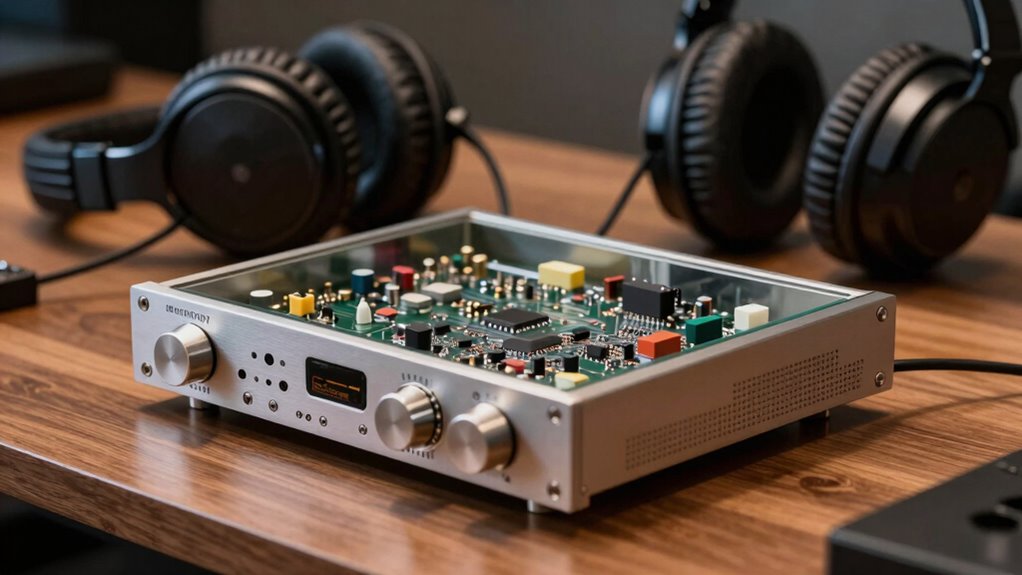
Digital-to-analog converters, or DACs, might seem like technical components tucked away inside your audio gear, but for audiophiles, they’re essential to sound quality. You might not notice their presence, but they play a vital role in how your music translates from digital files to the rich, detailed audio you crave. When you press play, it’s the DAC that takes your digital music—be it from a streaming service, a computer, or a smartphone—and transforms it into an analog signal your speakers or headphones can reproduce. This process, called digital conversion, is at the heart of sound quality. If that conversion isn’t done precisely, your listening experience suffers, filled with distortions, noise, or a lack of clarity.
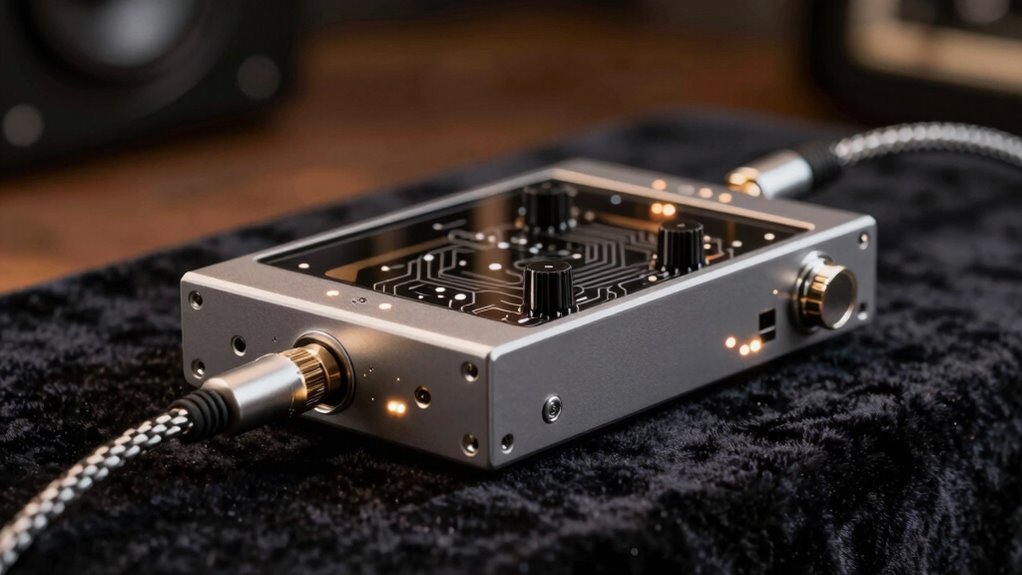
DACs are essential for translating digital music into rich, detailed sound, ensuring clarity and accuracy in every note.
As an audiophile, you understand that the quality of the DAC directly impacts how true-to-life your music sounds. A high-end DAC provides a cleaner, more accurate conversion, preserving the nuances, spatial cues, and tonal balance of the original recording. Low-quality DACs, on the other hand, might introduce jitter, distortion, or unwanted noise, muddying the sound. That’s why many enthusiasts invest in dedicated DAC units—these are designed to optimize digital conversion, offering better components, improved circuitry, and more refined power management. You want your music to be as close to the artist’s intent as possible, and a superior DAC helps make that happen.
Your focus on sound quality isn’t just about volume or bass; it’s about capturing the subtleties and depth in every track. A good DAC can reveal details you never noticed before—like the faint breath of a vocalist or the subtle reverb of a distant guitar. These details are often lost in lower-quality conversions. By choosing a high-quality DAC, you’re ensuring that every note, every instrument, and every breath is faithfully reproduced, giving you a more immersive experience. It’s like upgrading from a standard camera to a professional-grade one—you see the difference in clarity and richness. Additionally, understanding the circuit layout of a DAC can significantly influence how well it preserves the original sound, especially when paired with high-quality components and proper landscaping techniques in the circuit layout. Advances in digital conversion technology continue to push the boundaries of what’s achievable in sound fidelity, making it even more crucial to select a well-designed DAC.
Furthermore, the power supply quality within a DAC can greatly affect its ability to deliver a clean, stable signal, reducing noise and distortion. Investing in a DAC with a robust power management system can further enhance your listening experience by minimizing electrical interference. Ultimately, understanding the importance of digital conversion and sound quality helps you make informed choices about your audio setup. You realize that the DAC isn’t just a piece of hardware; it’s the bridge that connects your digital library to the soulful, detailed sound you crave. When you prioritize quality, you’re investing in a listening experience that’s authentic, detailed, and true to the music’s original essence. That’s why, as an audiophile, you care so deeply about your DACs—they’re the key to accessing the full potential of your sound system.

PROZOR 192KHz Digital to Analog Audio Converter DAC Digital SPDIF Optical to Analog L/R RCA Converter, Toslink Optical to 3.5mm Jack Adapter for PS3 HD DVD PS4 Amp Apple TV Home Cinema -Aluminum Alloy
PROZOR 192KHz Digital to Analog Audio Converter: Converts coaxial or toslink digital PCM audio signals to analog L/R…
As an affiliate, we earn on qualifying purchases.
As an affiliate, we earn on qualifying purchases.
Frequently Asked Questions
How Do Different DAC Designs Affect Sound Quality?
Different DAC designs impact sound quality through circuit topology and noise shaping techniques. A well-designed circuit topology minimizes signal distortion and reduces noise, resulting in clearer, more accurate audio. Noise shaping algorithms help push quantization noise out of the audible range, enhancing detail and depth. You’ll notice that DACs with optimized topology and noise shaping deliver richer, more immersive sound, making your listening experience more enjoyable and true to the original recording.
Can a Portable DAC Outperform a Desktop One?
Yes, a portable DAC can outperform a desktop one, especially with advancements in wireless connectivity and headphone compatibility. Imagine slipping a sleek device into your pocket that rivals or surpasses your desktop’s audio quality. Portable DACs now feature high-end components and innovative designs, offering surprising clarity and detail. You might find that portability doesn’t mean sacrificing sound—sometimes, it elevates your listening experience beyond what a bulky desktop can deliver.
What’s the Difference Between PCM and DSD DACS?
PCM DACs process digital audio using pulse-code modulation, handling standard bit depths and sample rates, which makes them suitable for most music formats. DSD DACs, however, convert digital signals into Direct Stream Digital, offering a different approach with higher sample rates and unique sound characteristics. The main difference lies in how each handles bit depth and sample rate, influencing the overall sound quality and fidelity you experience.
How Does Jitter Impact DAC Performance?
Jitter can totally ruin your sound quality, making music sound muddy or disjointed. It happens when clock accuracy falters, throwing off signal integrity during digital-to-analog conversion. Even tiny timing errors create audible distortions, so high-quality DACs minimize jitter to preserve pristine sound. When jitter is controlled, your music remains crisp, precise, and vibrant—like the artist is right there in your room.
Are Expensive DACS Worth the Investment?
Yes, expensive DACs are worth the investment if you care about sound quality. Higher-end models typically feature advanced digital filters that refine audio playback and superior power supplies that reduce noise, resulting in clearer, more detailed sound. You’ll notice the difference in your listening experience, especially with high-resolution files. While they cost more, the improved accuracy and richness make premium DACs a worthwhile upgrade for true audiophiles.

SMSL D200 Audiophile Desktop Audio decoder ROHMBD34352EKV DAC Chip Hi-Res Audio with MQA-CD Support, 32bit/768kHz DSD512 CK-03 Clock Circuit HiFi Audio Support USB, Optical, coaxial, Bluetooth Decode
High-Resolution Audio Mastery: Supports PCM playback up to 32bit/768kHz and DSD up to DSD512. Also features full MQA-CD…
As an affiliate, we earn on qualifying purchases.
As an affiliate, we earn on qualifying purchases.
Conclusion
Think of a DAC as the translator between your music and your ears. I once sat with a friend who upgraded his DAC, and suddenly, every note felt like a secret being whispered directly into his soul. That’s the power of a good DAC—it transforms your listening experience from static to storytelling. When you care about the details, investing in quality isn’t just about sound; it’s about reconnecting with the music on a deeper level.

blafili B3 Professional XLR Bluetooth v5.1 Music Receiver, LDAC & aptX HD Streamer, Built-in ESS DAC, Analog RCA, Digital Optical and COAXIAL Outputs, for Audio Mixer, DJ Speakers & PA System
Enjoy High Quality Bluetooth Audio On Your Powered Speakers – blafili B3 Bluetooth Receiver lets you stream music…
As an affiliate, we earn on qualifying purchases.
As an affiliate, we earn on qualifying purchases.

UGREEN USB to 3.5mm Jack Audio Adapter Sound Card Support Mic TRRS Headphone DAC 24bit 96kHz Nylon Braided USB to Aux Jack Compatible with Windows Mac Linux PC PS5 PS4 Switch 2 Speaker, 9.8 Inch
2 in 1 USB Audio Adapter: UGREEN USB to 3.5mm jack audio adapter supports both listening and talking….
As an affiliate, we earn on qualifying purchases.
As an affiliate, we earn on qualifying purchases.