
🔍 Read the full analysis: Inside The AI Process Behind “Luciole” on ThorstenMeyerAI.com

Get the latest gadgets delivered free with Prime
- Fast, free delivery on millions of items
- Prime Video, Amazon Music and more included
- Member-only deals all year
TL;DR
“Luciole — The Synchronous Fireflies of Vallon Creux” is an AI-built interactive exhibit in the FABLE/175 series. Its 96 simulated fireflies use a Kuramoto-style oscillator model to show flashes moving from separate rhythms toward synchronization; the fictional setting and the site’s disclosed creative brief are part of the presentation.
Room 155 of the FABLE/175 exhibition presents “Luciole — The Synchronous Fireflies of Vallon Creux,” an AI-built interactive website that models fireflies gradually synchronizing their flashes, as described in the original analysis. The exhibit includes a link to its art-direction prompt and identifies Vallon Creux and its fireflies as fictional, rather than as a real place or field study.
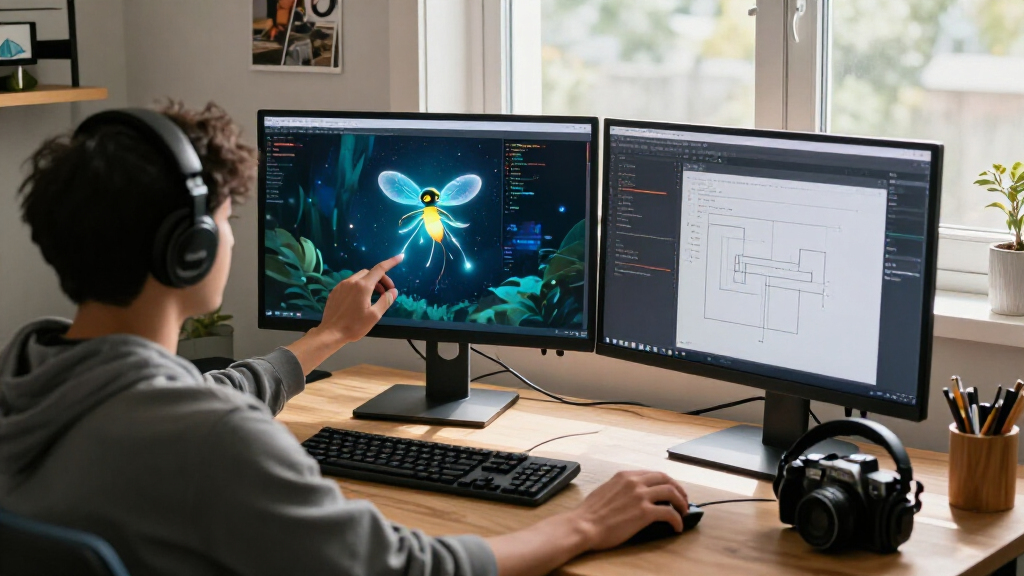
The interactive field notebook begins with 96 simulated fireflies flashing out of step. Each is represented as an oscillator with its own phase and tempo, influenced by signals from nearby neighbors. Visitors can adjust a coupling control to change how strongly those neighbors affect one another, and watch the flashes move toward—or away from—a shared rhythm. The exhibit describes this behavior through the Kuramoto synchronization model.
Other controls make the process visible rather than leaving it as an animation alone. A live coherence measure summarizes how closely the simulated lights agree; a trace records a disruption and recovery, and a phase diagram draws on the simulation. Pointer interaction can scatter the phases, after which the same local rules drive the field toward coherence again. The supplied description says a separate brief called for hundreds of fireflies and synchronization in about 20 seconds, but that is a design specification, not a reported measurement of the live site.
The exhibit’s disclosed brief calls for a dark forest palette, chartreuse flashes, dusk-mauve observer notes, and a naturalist’s notebook style. According to the source description, the site’s visuals are made with HTML, CSS, SVG and canvas, without downloaded image assets or a prerecorded firefly sequence. It also describes reduced-motion handling, focus styling, announced state changes, a mobile field map and pausing the simulation when relevant views are offscreen or the page is hidden.
Making the Simulation’s Rules Visible
“Luciole” presents synchronization through an interactive demonstration of how a local rule can produce collective behavior. Visitors can alter the influence between neighboring oscillators, interrupt their shared rhythm and observe the simulated response. The coherence reading and phase trace display the simulation’s changing state alongside its visual presentation.
The site’s disclosure of its prompt allows readers to compare the stated direction—including the notebook aesthetic, interaction design and accessibility requirements—with the delivered experience. The exhibit is an example of AI-assisted creative web production, but it does not establish how much work was automated, how the result was reviewed, or whether the process would generalize to other projects.
interactive firefly simulation website
As an affiliate, we earn on qualifying purchases.
As an affiliate, we earn on qualifying purchases.
A Fictional Field Notebook
The exhibit is identified as Room 155 of 175 in the FABLE/175 series. Its title uses a naturalist’s field-guide format, but the source explicitly says that both Luciole and Vallon Creux are invented for the work. The fireflies are simulated, and the page is not a report of biological observation or a study conducted at a real site.
The source material includes a verbatim art-direction brief attributed to Claude Fable 5 and says the prompt is available through a “Prompt” link in the room’s footer. It describes a three-pass process: build the site and critique it, seek and fix external critique, then refine the art direction. The material does not supply records of those review stages, screenshots from each pass, or independent verification of the stated process.
““A night sky that learns to keep time.””
— The exhibit’s art-direction brief
Kuramoto oscillator model educational kit
As an affiliate, we earn on qualifying purchases.
As an affiliate, we earn on qualifying purchases.
What the Source Does Not Verify
The source describes the exhibit’s mechanics and implementation, but it does not provide independent testing of the live website, its performance across devices, or its accessibility features. The brief’s targets—including 60 frames per second, three responsive screenshot widths and a roughly 20-second synchronization—are requirements in the prompt, not verified results in the supplied account. The source describes 96 fireflies in the room, while the brief asks for hundreds; it does not explain whether that difference reflects a later implementation choice, a particular view, or a change in the project.
It is also unclear which AI tools or models generated the website, how much code was written or revised by people, and who carried out the stated external critique. No independent evaluator or technical documentation is included. The account should therefore be read as a description of the exhibit and its disclosed prompt, not as independently audited evidence about its production or performance.
digital science notebook for naturalist style
As an affiliate, we earn on qualifying purchases.
As an affiliate, we earn on qualifying purchases.
The Live Room and Its Prompt
The source directs readers to the live Luciole room and says its “Prompt” link in the footer reveals the art-direction brief. Visitors can use the running simulation to examine the controls and observe how the field responds. No publication date, planned update, or next room release is specified in the supplied material, so further changes to the exhibit remain unconfirmed.
As an affiliate, we earn on qualifying purchases.
Key Questions
What is “Luciole”?
“Luciole — The Synchronous Fireflies of Vallon Creux” is Room 155 in the FABLE/175 exhibition: an AI-built interactive website about simulated fireflies moving toward synchronized flashes.
Is Vallon Creux a real place?
No. The source says Vallon Creux is fictional, as are Luciole and the fireflies in the exhibit. The page is not a real field study.
How does the firefly simulation work?
Each simulated firefly is an oscillator with its own phase and tempo. Nearby signals influence its rhythm; visitors can adjust that coupling and disturb the phases, while the model continues to update them.
What does the exhibit say about how the site was made?
The source describes an implementation using HTML, CSS, SVG and canvas, with no downloaded image assets or prerecorded firefly sequence. It also exposes an art-direction prompt and describes a three-pass design process, though those production claims are not independently verified in the supplied material.
Source: ThorstenMeyerAI.com
Halloween Picks
halloween
As an affiliate, we earn on qualifying purchases.