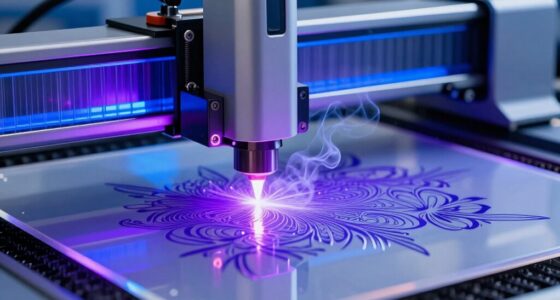
Resin printing differs from FDM mainly in detail, surface finish, and color accuracy. Resin printers produce highly detailed, smooth surfaces with vibrant colors, ideal for intricate designs. FDM, on the other hand, relies on filament layering, making it faster and more cost-effective for larger, simpler projects. If you want to understand how these differences impact your projects and which suits your needs best, you’ll find the full explanation enlightening.
Key Takeaways
- Resin printing produces highly detailed, smooth surfaces with precise color reproduction, unlike FDM’s layer lines and limited color accuracy.
- Resin printing involves longer curing times and post-processing, whereas FDM offers faster, simpler printing for larger, less detailed objects.
- Resin printers handle intricate designs better, providing finer details and surface quality compared to FDM’s visible layer lines.
- FDM printers are generally more affordable, easier to operate, and require less maintenance than resin printers.
- The choice depends on project needs: resin for precision and surface finish, FDM for quick, larger prototypes.

When choosing between resin printing and FDM (Fused Deposition Modeling), understanding their key differences can help you make an informed decision. One of the main distinctions lies in color accuracy. Resin printers produce highly detailed and smooth surfaces, which allows for precise color reproduction, especially when using colored resins or post-processing techniques. If you need intricate designs with vibrant, true-to-life colors, resin printing offers a significant advantage. FDM printers, on the other hand, typically rely on filament colors and layering, which can result in visible layer lines and less accurate color blending. While FDM can handle multi-color prints with advanced setups, it generally doesn’t match the color fidelity that resin printers provide.
Print speed is another critical factor that sets these technologies apart. FDM printing tends to be faster for larger, less detailed objects, as it extrudes filament layer by layer relatively quickly. However, the speed drops when producing highly detailed or small parts due to the need for finer layer resolution. Resin printing, although capable of producing incredibly detailed models, often involves longer curing times per layer and a more complex post-processing process, which can slow down overall production. If you’re looking for rapid prototyping of larger, less detailed objects, FDM might be more practical. But if your priority is creating highly detailed, smooth models with excellent surface finishes, resin printing’s slightly longer print times are often justified.
The choice between resin and FDM also hinges on other factors like ease of use, cost, and maintenance. Resin printers demand careful handling of liquid resins, proper ventilation, and post-curing processes, which can be more involved than FDM’s straightforward filament loading and printing. Conversely, FDM printers are generally more accessible, with lower initial costs and simpler maintenance routines. This makes FDM a popular choice for hobbyists and beginners. However, if your projects require precision, fine details, and superior surface quality, investing in resin printing can be worthwhile despite the added complexity.

ELEGOO Saturn 4 Ultra 16K Resin 3D Printer with 10" 16K Mono LCD and Flip-up Lid, Smart Tank Heating at 30 °C, 150mm/h High Speed Printing, Large Printing Size of 8.33 × 4.66 × 8.66 Inches
【16K Magic, Precision Redefined】Designed to capture the finest details for exquisite models, ELEGOO Saturn 4 Ultra 16K Resin…
As an affiliate, we earn on qualifying purchases.
As an affiliate, we earn on qualifying purchases.
Frequently Asked Questions
Which Printing Method Offers Better Surface Finish?
Resin printing offers a better surface finish and higher detail resolution compared to FDM. You’ll notice smoother surfaces with fewer layer lines, making resin ideal for intricate models. The fine details are captured more precisely, giving your prints a professional look. If you prioritize surface quality and sharp detail, resin printing is the superior choice, providing a refined, polished appearance that FDM struggles to match.
How Do Resin Printers Compare in Printing Speed?
Resin printers typically print slower than FDM printers due to their layer-by-layer curing process, which emphasizes precision over speed. However, they excel in color accuracy, capturing fine details and subtle shades better. Keep in mind, resin printing has a higher environmental impact because of resin waste and curing chemicals, so proper disposal is essential. If you prioritize detailed, colorful models and are mindful of environmental concerns, resin printers are a great choice despite the slower speed.
What Safety Precautions Are Needed for Resin Printing?
Did you know that improper handling of resin can cause skin irritation or respiratory issues? When resin printing, you need to take safety precautions seriously. Always wear safety gear like gloves, goggles, and masks to protect against resin toxicity. Work in a well-ventilated area, and avoid skin contact or inhaling fumes. Proper disposal of excess resin and cleaning materials is essential to stay safe and prevent health risks.
Can Resin Printers Produce Larger Models?
Yes, resin printers can produce larger models, but their size is typically limited by the build volume of the machine. You’ll need to take into account layer adhesion and the curing process, as larger models require careful support and longer curing times to guarantee strength and detail. While resin printing excels at high detail, printing larger objects may demand more patience and precise calibration to attain ideal results.
How Does Material Cost Differ Between FDM and Resin?
You’ll find that resin material costs are typically higher than FDM filament costs, but resin offers better material durability for detailed prints. Resin printing also has a different environmental impact, as it produces less waste but involves potentially hazardous chemicals. While FDM uses cheaper, more environmentally friendly filaments, resin’s superior detail and durability can justify the higher material costs depending on your project needs.

FLASHFORGE AD5X Multi-Color 3D Printer, CoreXY 600mm/s High-Speed, 1-Click Auto Leveling, 300°C Direct Drive Extruder, 220x220x220mm Build Volume, Ideal for Precision and Efficiency
Vivid Multi-Color Printing: Bring your creations to life with vibrant, multi-color prints. This printer supports up to 4…
As an affiliate, we earn on qualifying purchases.
As an affiliate, we earn on qualifying purchases.
Conclusion
Ultimately, choosing between resin printing and FDM is like selecting between a finely woven tapestry and a broad brushstroke—each offers its own elegance and precision. As Da Vinci mastered the delicate details of his sketches, resin printing allows you to craft intricate designs with exceptional clarity. Meanwhile, FDM’s robustness echoes the bold strokes of a painter’s vision. Your choice reflects your creative soul—whether you seek delicate artistry or sturdy innovation.

ELEGOO Upgraded 8K Standard Photopolymer 3D Printer Resin 405nm UV-Curing Resin Best for 8K/12K/14K/16K Saturn MSLA DLP LCD 3D Printing Space Grey 1000G
【Low Shrinkage and High Precision】ELEGOO photopolymer resin is specially designed for reducing volume shrinkage during the Photocuring process…
As an affiliate, we earn on qualifying purchases.
As an affiliate, we earn on qualifying purchases.

AMOLEN Silk PLA 3D Printer Filament Bundle, Shiny Dual Color Filament 1.75mm Pack, Multi Color Change 3D Printing Filament for Most FDM 3D Printer, 4 Spools 200g Each
Colorful Variety 4 Pack: Each color weighs 200 g, providing a total of 800 g. Dive into the…
As an affiliate, we earn on qualifying purchases.
As an affiliate, we earn on qualifying purchases.