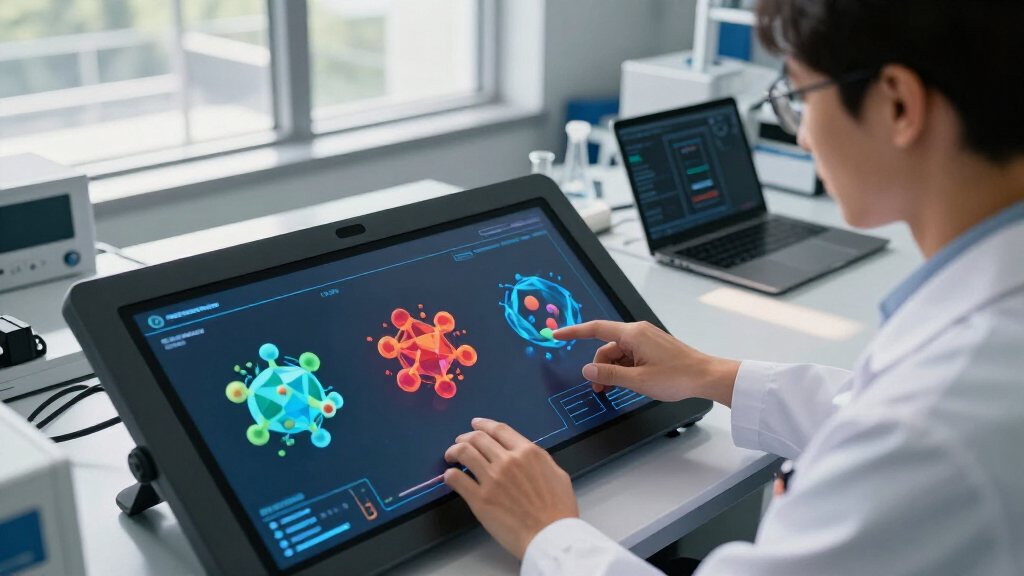

📊 Full opportunity report: The Role Of Particle Geometry Mapping In AI Innovation: 'SINGULARITY' Case Study on ThorstenMeyerAI.com — validation score, market gap, and execution plan.

Get the latest gadgets delivered free with Prime
- Fast, free delivery on millions of items
- Prime Video, Amazon Music and more included
- Member-only deals all year
TL;DR
The ‘SINGULARITY’ project demonstrates how Particle Geometry Mapping advances AI-driven environment design. This technique creates immersive, data-rich spaces that challenge traditional concepts of form and function. The case study highlights technical achievements and potential applications, marking a significant step in AI innovation.
The ‘SINGULARITY’ project demonstrates how Particle Geometry Mapping is used to craft immersive AI environments, transforming abstract data into tangible spatial experiences. This development is confirmed through a detailed case study published on ThorstenMeyerAI.com, highlighting technical innovations that push the boundaries of design and AI integration.
The case study details how Particle Geometry Mapping enables precise control over complex data structures, translating them into spatial forms that engage users visually and functionally. The project involved transforming a stark black room into a dynamic visual environment, where data points are mapped into geometrical forms that respond to AI algorithms in real time.
According to Thorsten Meyer, the design process navigated significant technical challenges, including maintaining aesthetic coherence while integrating high-volume data streams. The result is an environment that not only visualizes data but also serves as a blueprint for future AI-driven spatial design, with potential applications in virtual reality, data visualization, and intelligent interfaces.
Implications of Particle Geometry Mapping for AI-Driven Design
This development matters because it demonstrates a novel method for visualizing and interacting with complex data through spatial design, opening new avenues for AI applications in architecture, virtual environments, and data analysis. By translating data into tangible forms, it enhances user engagement and understanding, which is crucial for advancing AI tools and interfaces.
Experts suggest that this technique could revolutionize how AI systems communicate information, making data more accessible and intuitive. It also signals a shift toward more integrated art and technology collaborations, where design principles directly influence AI functionality and vice versa.
virtual reality data visualization headset
As an affiliate, we earn on qualifying purchases.
As an affiliate, we earn on qualifying purchases.
Technical Foundations and Prior Developments in Data-Driven Environments
Particle Geometry Mapping is an emerging technique that builds on prior advances in data visualization and spatial computing. Previous projects have explored virtual environments and immersive data displays, but the ‘SINGULARITY’ case study is among the first to integrate this approach into a cohesive design process that balances technical complexity with aesthetic appeal.
The project follows a broader trend of leveraging AI algorithms to generate and manipulate spatial forms, aiming to create environments that are both functional and artistically compelling. This evolution reflects ongoing efforts to merge data science with creative design, pushing the boundaries of what is possible in AI-enabled environments.
“Particle Geometry Mapping allows us to translate complex data structures into tangible spatial forms, enabling new modes of interaction and visualization.”
— an anonymous researcher
As an affiliate, we earn on qualifying purchases.
Unresolved Questions About Practical Applications and Scalability
It is still unclear how widely applicable Particle Geometry Mapping will be beyond experimental environments like ‘SINGULARITY’. Details about scalability, integration with existing AI systems, and real-world deployment remain under development. Further testing is needed to confirm its effectiveness across different contexts and industries.
AI-driven environment design software
As an affiliate, we earn on qualifying purchases.
As an affiliate, we earn on qualifying purchases.
Next Steps in Research and Potential Industry Adoption
Future efforts will likely focus on refining the technical process, exploring scalability, and testing applications in virtual reality, architecture, and data analysis. Industry stakeholders may begin pilot projects based on this approach, aiming to incorporate Particle Geometry Mapping into commercial AI tools and environments.
As an affiliate, we earn on qualifying purchases.
Key Questions
What is Particle Geometry Mapping?
Particle Geometry Mapping is a technique that translates complex data structures into spatial geometrical forms, enabling immersive visualization and interaction within AI environments.
How does ‘SINGULARITY’ demonstrate this technique?
The ‘SINGULARITY’ project visualizes data points as geometrical particles that respond dynamically to AI algorithms, creating an immersive spatial experience.
Why is this development important for AI design?
It offers a new way to visualize and interact with data, potentially improving understanding, engagement, and interface design in AI applications.
Are there practical applications beyond experimental environments?
While promising, the scalability and integration of Particle Geometry Mapping into real-world applications are still under investigation.
What are the next steps for this technology?
Further research will focus on refining the technique, testing in diverse settings, and exploring commercial adoption in virtual environments and data visualization tools.
Source: ThorstenMeyerAI.com
Halloween Picks
halloween
As an affiliate, we earn on qualifying purchases.