🔍 Read the full analysis: Advanced External GPUs For AI Powerhouses In 2026 on ThorstenMeyerAI.com

Get the latest gadgets delivered free with Prime
- Fast, free delivery on millions of items
- Prime Video, Amazon Music and more included
- Member-only deals all year
TL;DR
In 2026, advanced external GPUs are transforming AI processing by offering higher performance and compatibility. Leading models like Razer Core X V2 are setting new standards, impacting AI research and enterprise applications.
In 2026, external GPU (eGPU) technology has advanced significantly, with new models delivering increased performance tailored for AI workloads. Leading manufacturers like Razer, ASUS, and MINISFORUM have introduced high-end enclosures that support the latest graphics cards, enabling AI researchers and enterprises to accelerate processing without replacing existing hardware. This development broadens access to powerful AI computing, especially for organizations relying on portable or cost-effective solutions.
Several new eGPU models launched in early 2026 are designed specifically to meet the demands of AI applications, which require high computational power, efficient cooling, and reliable connectivity. The Razer Core X V2 remains a top choice due to its compatibility with a wide range of graphics cards and robust power delivery, supporting GPUs up to 600W. ASUS’s ROG XG Mobile continues to appeal to high-end gamers and AI developers with its support for flagship graphics cards and Thunderbolt 4 connectivity. Meanwhile, the MINISFORUM DEG1 offers a more affordable option with support for flagship GPUs and enhanced thermal management.
Industry sources confirm that these models feature improved cooling systems, higher wattage support, and faster data transfer standards, notably Thunderbolt 4 and USB4, which are critical for maximizing AI workload efficiency. The market shift toward AI-optimized eGPUs reflects growing demand from research labs, startups, and large corporations seeking portable yet powerful solutions. Pricing varies, with premium models exceeding $1,000, while more affordable options are available under $500, depending on features and build quality.
The 10 picks
- 1
 ASUS ROG XG Mobile (2025) External Graphics Card with NVIDIA GeForce RTX 5090View on Amazon →
 - 2ASUS ROG XG Mobile (2025) External Graphics Card with NVIDIA GeForce RTX 5070 TiView on Amazon →
- 3
 Razer Core X V2 External Graphics Enclosure (eGPU)View on Amazon →
 - 4
 AOOSTAR AG02 OCuLink eGPU Dock with 800W PSU and USB4 Port, External GPU Dock…View on Amazon →
 - 5
 External GPU Dock Station, Mini eGPU Enclosure Compatible with Thunderbolt 3/…View on Amazon →
 - 6
 MINISFORUM DEG1 eGPU Dock, External GPU Docking Station for RTX 4090, AMD RX…View on Amazon →
 - 7
 OwlTree PCIe 5.0 x4 128Gbps eGPU Dock for 50 Series Graphics Cards, M.2 NVMe…View on Amazon →
 - 8
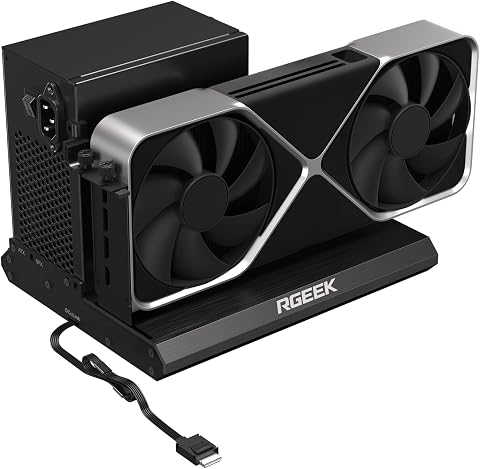 RGEEK OCuLink eGPU Dock PCIe 5.0 x4 for External Graphics CardView on Amazon →
 - 9
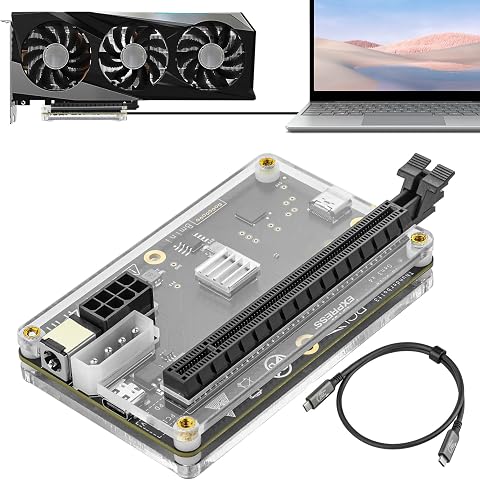 PCIe 3.0 x16 22Gbps eGPU Dock with Thunderbolt 4 Cable for Windows/LinuxView on Amazon →
 - 10
 OCuLink eGPU Dock, PCIe 4.0 x4 64Gbps, 19.7-inch SFF-8611 Cable, External GPU…View on Amazon →
Impact of High-Performance eGPUs on AI Development
The advent of advanced external GPUs in 2026 influences AI development by providing more accessible and flexible high-performance computing options. These eGPUs enable organizations to upgrade existing hardware setups without significant capital expenditure, supporting faster training and inference of AI models. Improvements in power delivery, cooling, and data transfer standards facilitate the handling of larger and more complex models, which can reduce bottlenecks and support more rapid experimentation. This technological progression has the potential to broaden participation in AI research, lower costs for startups, and expand the capabilities of enterprise AI systems, contributing to ongoing innovation across various sectors.
Evolution of External GPUs and AI Hardware in 2026
External GPU technology has seen rapid development in recent years, evolving from specialized accessories to integral components for AI and high-performance computing. In 2024, models like the Razer Core X V2 gained recognition for their reliability and broad compatibility. By 2025, manufacturers incorporated AI-specific features such as optimized cooling and increased wattage support to meet the demands of machine learning workloads. The 2026 market reflects a convergence of hardware innovation and AI requirements, with new enclosures supporting the latest graphics cards, faster data transfer standards, and improved thermal management. This trend supports the growth of portable, scalable AI infrastructure, enabling smaller labs and remote teams to access enterprise-grade computing power.
Unanswered Questions About Long-Term Compatibility and Scalability
While the new eGPU models introduced in 2026 demonstrate promising performance, questions remain regarding their long-term scalability with future GPU architectures and compatibility as standards evolve. Additionally, the durability and thermal management of these devices under sustained AI workloads are still under evaluation. Industry experts note that rapid hardware obsolescence could impact the long-term value of investments. The adoption of emerging data transfer standards beyond Thunderbolt 4 and USB4 also presents uncertainties, as industry-wide support varies.
Upcoming Developments and Market Adoption in 2026
Manufacturers are expected to continue releasing firmware updates and new models throughout 2026, aiming to improve performance and compatibility. Industry analysts anticipate increased adoption of high-performance eGPUs in AI research, enterprise data centers, and portable workstations. Monitoring their performance in real-world AI applications will be important, along with ongoing assessments of reliability and compatibility. As standards evolve, support for newer interfaces and thermal management solutions are likely to improve, shaping the future of portable AI hardware.
Key Questions
Are external GPUs suitable for AI workloads in 2026?
Yes, the latest external GPUs in 2026 are designed to support AI workloads, offering high power, advanced cooling, and fast connectivity to handle complex models efficiently.
Can I upgrade my existing eGPU for AI tasks?
Many new models support a range of graphics cards and are compatible with current standards like Thunderbolt 4, allowing upgrades for AI and high-performance tasks.
What should I consider when choosing an eGPU for AI applications?
Key factors include power delivery capacity, cooling efficiency, connectivity standards (Thunderbolt 4 or USB4), and support for high-end GPUs to ensure optimal AI performance.
Will these external GPUs support future GPU architectures?
While current models are compatible with the latest GPUs, future support depends on standard updates and manufacturer support. Compatibility for upcoming architectures remains to be seen.
Source: ThorstenMeyerAI.com
Halloween Picks
halloween
As an affiliate, we earn on qualifying purchases.