Portable external SSDs have replaced hard drives as the sensible way to carry files, and the difference between a good one and a great one comes down to sustained speeds, durability, and price per gigabyte. My top pick is the Samsung T9 1TB, which is the only drive here with USB 3.2 Gen 2×2 support, pushing close to 2,000MB/s on compatible ports. The Samsung T7 remains the safest all-around choice for most people, while the SanDisk Extreme line wins on ruggedness with its IP65-rated rubberized shell. The main tradeoff you’ll face: paying extra for Gen 2×2 speed you may never use, versus saving money on a Gen 2 drive that still hits 1,000MB/s. Capacity pricing also varies wildly — the 2TB models here offer far better value per gigabyte than the 250GB–500GB options. Keep reading for the full breakdown.

Get the latest gadgets delivered free — and shop member deals
- Fast, free delivery on millions of items
- Access to Prime Big Deal Days deals on October 6–7
- Prime Video, Amazon Music and more included
Complete the kit



Key Takeaways
- The Samsung T9 is the only Gen 2×2 drive in this lineup, roughly doubling real-world transfer speeds over the T7 — but only if your computer has a matching USB port; otherwise it performs identically to cheaper drives.
- The SSK drives match Samsung and SanDisk on paper speed at 1,050MB/s for noticeably less money, making them the value play — though their enclosures feel less rugged than the SanDisk Extreme’s IP65-rated shell.
- SanDisk‘s older 800MB/s rugged model is now the weakest value here, since its own sibling, the 500GB Extreme, is faster at a similar price.
- Price per gigabyte drops sharply with capacity across every brand: the 2TB Samsung T7 and SanDisk Extreme cost roughly half as much per gigabyte as their 500GB siblings.
- Within each family, performance is identical across capacities — a 500GB Samsung T7 transfers files just as fast as the 2TB version, so the only real decision is how much storage you need.




| portable external SSD | Capacity | Interface |
|---|---|---|
| SSK Portable SSD 250GB Externa | 250 GB | USB 3.2 Gen 2 |
| SanDisk 500GB Portable SSD | 500 GB | — |
| Samsung T7 Portable SSD 1TB Ti | 1 TB | USB 3.2 Gen 2 |
| SanDisk 2TB Extreme Portable S | 2 TB | — |
| SanDisk 500GB Extreme Portable | 500 GB | — |
| Samsung T9 Portable SSD 1TB US | 1TB | USB 3.2 Gen 2×2 |
| SanDisk 1TB Extreme Portable S | 1TB | — |
| SSK Portable SSD 1TB External | 1TB | USB-C, USB-A |
| SSK Portable SSD 500GB Externa | 500 GB | USB 3.2 Gen 2 |
| Lexar ES3 1TB Portable SSD Sil | — | USB 3.2 Gen 2 |
| SanDisk 1TB Portable SSD | 1TB | USB 3.2 Gen 2, USB Type-C |
| Samsung T7 Portable SSD 2TB Ti | 2TB | USB 3.2 Gen 2 |
More Details on Our Top Picks
SSK Portable SSD 250GB External Solid State Drive USB-C Up to 1050MB/s
For anyone who just needs a small, affordable fast drive without paying for capacity they won’t use, this SSK model fills a niche the bigger drives here ignore. Its 1050MB/s read speed matches what the Samsung T7 delivers, at a fraction of the storage cost — you’re giving up space, not speed. The aluminum case keeps it cool during sustained transfers, and the USB-C plus USB-A connectivity is a genuine advantage over the SanDisk 500GB Portable SSD, which is USB-C only. Compared with the SanDisk Extreme line, though, it lacks any ruggedness rating or hardware encryption, so it belongs in a laptop bag, not a backpack. Windows users should also expect roughly 232GB of usable space — fine for documents and a few projects, tight for video work.
Pros:- Read speeds up to 1050MB/s rival drives costing much more
- Includes both USB-C and USB-A connectivity
- Lightweight aluminum body dissipates heat well
- Works across PC, Mac, phones, and consoles
Cons:- Only 250GB of capacity, and less usable space after formatting
- No encryption or bundled backup software
- No drop, water, or dust resistance rating
Best for: Students and casual users who want a fast, cheap drive for documents, photos, and light project files
Not ideal for: Videographers or anyone working with large media libraries — 250GB fills up after a couple of projects
- Capacity:250 GB
- Interface:USB 3.2 Gen 2
- Read Speed:1050 MB/s
- Write Speed:1000 MB/s
- Enclosure:Aluminum
- Weight:36.6 g
- Compatibility:PC, Mac, Linux, smartphones, consoles
Our verdict“A smart entry point if you want flagship speeds on a shoestring budget and don’t need much space.”
SanDisk 500GB Portable SSD, Up to 1000MB/s Read Speeds, Black
This drive’s main appeal is zero friction: no drivers, no software download, no setup — plug it in and it works. That contrasts with the SanDisk 500GB Extreme, which requires a software download just to enable its encryption features. Speeds are solid at up to 1000MB/s read, though write speeds trail noticeably, so it’s better suited to backing up files than moving them constantly between machines. The 2-meter drop protection is decent but falls short of the 3-meter rating on the Extreme models, and there’s no IP-rated water or dust resistance here. Think of it as the sensible middle choice between the bargain SSK 250GB and the pricier rugged options — more capacity than one, less armor than the other.
Pros:- True plug-and-play operation with no drivers or setup
- 2-meter drop protection for everyday mishaps
- Compact enough to live in a pocket or bag
- 500GB hits a practical capacity sweet spot for most users
Cons:- Write speeds noticeably lag read speeds
- No IP water or dust resistance rating
- USB-C only, with no USB-A cable option
Best for: Everyday users who want a straightforward backup drive for a laptop with no software hassle
Not ideal for: Outdoor shooters and travelers — the lack of water and dust resistance makes the Extreme line a safer bet
- Capacity:500 GB
- Read Speed:Up to 1000 MB/s
- Connectivity:USB-C
- Drop Protection:Up to 2 meters
- Color:Black
Our verdict“The pick for buyers who value simplicity and fair pricing over rugged specs and encryption.”
Samsung T7 Portable SSD 1TB Titan Gray, USB 3.2 Gen 2, Up to 1,050MB/s
This is the drive I’d point most people toward, because it balances speed, capacity, and build quality without tipping into any single extreme. The 1050MB/s ceiling matches the SSK and SanDisk Extreme drives, but Samsung pairs it with a rigid aluminum unibody that feels more premium than the rubberized SanDisk designs, plus shock resistance rated to 6 feet. Unlike the bargain SSK 250GB, there’s real room here — 1TB handles photo libraries, game installs, and video projects comfortably. It works with PCs, Android phones, and iPhone 15 Pro directly. The tradeoff is price: it sits above the SanDisk 500GB models, and it lacks the IP65 water resistance of the Extreme line, so it’s tough but not weatherproof. On an older USB 3.0 port, speeds drop substantially — the drive is only as fast as your connection.
Pros:- 1050MB/s speeds with a proven, consistent track record
- 1TB capacity suits media workloads and game storage
- Solid aluminum unibody with 6-foot drop resistance
- Broad compatibility including iPhone 15 Pro and Android
Cons:- Premium pricing versus同等-capacity competitors
- No water or dust resistance rating
- Older USB ports bottleneck real-world speeds
Best for: Professionals and enthusiasts who want a dependable 1TB drive for editing, backups, and cross-device use
Not ideal for: Budget-focused buyers or anyone working in wet, dusty field conditions — the SanDisk Extreme 2TB covers both cases better
- Capacity:1 TB
- Interface:USB 3.2 Gen 2
- Max Speed:1050 MB/s
- Shock Resistance:Up to 6 feet
- Body:Aluminum unibody
- Compatibility:PC, Mac, Android, iPhone 15 Pro
Our verdict“If you want one drive that does everything reasonably well and lasts, this is the default choice.”
SanDisk 2TB Extreme Portable SSD
When the job involves capacity and survivability, this is the workhorse of the lineup. The 2TB of storage doubles what the Samsung T7 1TB offers, and the ruggedness specs outclass everything else here: 3-meter drop protection and IP65 water and dust resistance, plus operation from -20°C to 85°C. Add hardware 256-bit AES encryption and a carabiner loop, and it’s built for photographers and field crews, not desk jockeys. Compared with the SanDisk 500GB Extreme, the formula is identical — you’re paying for four times the space. The catches are real, though: it costs noticeably more than every drive above, and hitting 1050MB/s requires a USB 3.2 Gen 2 port. It’s also heavier on the wallet than the plug-and-play SanDisk 500GB for users who don’t need the armor.
Pros:- 2TB capacity for large photo and video libraries
- IP65 water and dust resistance with 3-meter drop protection
- Hardware 256-bit AES password encryption
- Carabiner loop and wide operating temperature range
Cons:- Among the most expensive options per purchase
- Requires USB 3.2 Gen 2 ports to reach rated speeds
- Overbuilt for indoor, everyday use
Best for: Photographers, videographers, and outdoor professionals who need large capacity that survives weather and drops
Not ideal for: Office-bound users with modest storage needs — the rugged premium is wasted money compared to the Samsung T7
- Capacity:2 TB
- Read Speed:1050 MB/s
- Write Speed:1000 MB/s
- Drop Protection:3 meters
- Water/Dust Rating:IP65
- Encryption:256-bit AES
- Operating Temperature:-20°C to 85°C
Our verdict“The drive to buy when failure in the field isn’t an option and you need serious space.”
SanDisk 500GB Extreme Portable SSD
This model takes the Extreme formula and adds a speed jump — up to 2000MB/s, nearly double the 1050MB/s ceiling of the 2TB Extreme and the Samsung T7. That headroom matters if your machine has a USB 3.2 Gen 2×2 port; on standard Gen 2 ports you’ll see the same ~1000MB/s as everything else, so don’t pay the premium unless your hardware can use it. You still get the full rugged package — IP65 rating, 3-meter drop protection, and 256-bit AES encryption — in a 500GB size that keeps the price below the 2TB Extreme. Compared with the black SanDisk 500GB, the tradeoffs are clear: more speed and armor here, but you must download software to enable encryption, and the extra speed is wasted on older laptops.
Pros:- Up to 2000MB/s transfer speeds with compatible hardware
- IP65 water and dust resistance plus 3-meter drop protection
- 256-bit AES encryption for sensitive files
- Rugged features at a lower price than the 2TB Extreme
Cons:- Full speed requires USB 3.2 Gen 2×2, which many PCs lack
- Encryption requires a separate software download
- 500GB fills quickly for video-heavy users
Best for: Tech-savvy users with modern USB 3.2 Gen 2×2 hardware who want future-proofed speed in a rugged shell
Not ideal for: Owners of older laptops or standard USB-C ports — the speed premium buys nothing over cheaper 1000MB/s drives
- Capacity:500 GB
- Transfer Speed:Up to 2000 MB/s
- Water/Dust Rating:IP65
- Drop Protection:Up to 3 meters
- Encryption:256-bit AES
Our verdict“The fastest rugged pick here — but only worth it if your computer can actually feed it.”
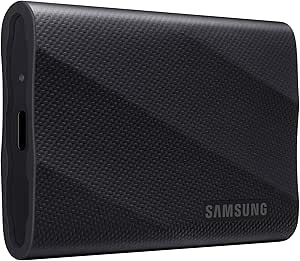
Samsung T9 Portable SSD 1TB USB 3.2 Gen 2×2 External SSD
The Samsung T9 is the speed leader of this lineup, and that’s its entire reason for being here. With USB 3.2 Gen 2×2 pushing up to 2,000 MB/s, it roughly doubles what the Samsung T7 and the SanDisk 1TB Extreme can manage — a difference you’ll actually notice when moving 4K video projects or huge game libraries. Dynamic Thermal Guard keeps speeds from throttling during long transfers, something cheaper aluminum-bodied drives like the SSK 1TB handle less gracefully. The catch is honest but real: without a Gen 2×2 port on your computer, you’re paying a premium for speed you can’t access, and it behaves like a regular 1,050 MB/s drive. This pick makes the most sense for creators with modern desktops or laptops who transfer massive files daily.
Pros:- Up to 2,000 MB/s transfer speeds — the fastest in this roundup
- Dynamic Thermal Guard prevents slowdowns during sustained transfers
- Broad compatibility including iPhone 15 Pro and gaming consoles
- Software support for security updates and drive health monitoring
Cons:- Top speeds require a USB 3.2 Gen 2×2 host port and proper cable
- Noticeably pricier than 1,050 MB/s competitors like the Samsung T7
Best for: Video editors and creators with USB 3.2 Gen 2×2 ports who move huge 4K files regularly
Not ideal for: Laptop owners with standard USB 3.2 Gen 2 ports — the T7 delivers the same real-world speed for less
- Capacity:1TB
- Interface:USB 3.2 Gen 2×2
- Transfer Speeds:Up to 2,000 MB/s
- Thermal Management:Dynamic Thermal Guard
- Compatibility:Desktop, camera, gaming console, iPhone 15 Pro 4K at 60fps
Our verdict“Buy the T9 only if your hardware supports Gen 2×2; otherwise the T7 offers nearly identical everyday performance for less money.”
SanDisk 1TB Extreme Portable SSD
Where the Samsung T9 chases raw bandwidth, the SanDisk 1TB Extreme matches its 2,000 MB/s ceiling while adding something no other drive in this batch offers: IP65 water and dust resistance plus 3-meter drop protection. For photographers shooting outdoors or travelers tossing a drive into a backpack, that durability matters more than a few extra MB/s. It also includes 256-bit AES hardware encryption, which the SSK 1TB lacks entirely — a genuine advantage if you carry client files or sensitive work. Compared with the standard SanDisk 1TB Portable SSD at 800 MB/s, this model justifies its premium with roughly double the speed. The tradeoff is price: ruggedness and encryption push it above basic drives, and you’re paying for protection you may never need at a desk.
Pros:- Up to 2,000 MB/s transfer speeds, matching the Samsung T9
- IP65 water and dust resistance with 3-meter drop protection
- 256-bit AES encryption for securing sensitive files
- Compact and lightweight enough for pocket carry
Cons:- Pricier than non-ruggedized 1TB drives like the SSK
- Durability features add cost with no benefit for indoor-only use
Best for: Outdoor photographers and travelers who need water, dust, and drop protection plus encrypted storage
Not ideal for: Desk-bound users — the rugged build and premium price buy durability a stationary drive never uses
- Capacity:1TB
- Transfer Speed:Up to 2000MB/s
- Protection:IP65 rated, up to 3m drop protection
- Encryption:256-bit AES
Our verdict“If your drive leaves the house, the Extreme’s combination of speed, encryption, and IP65 toughness is worth the premium over basic portable SSDs.”
SSK Portable SSD 1TB External Solid State Drive USB-C Up to 1050MB/s
The SSK 1TB occupies the smart middle ground: it delivers the same 1,050 MB/s speeds as the Samsung T7 at a lower price, in a 36.6g aluminum shell that dissipates heat well during long copy sessions. Unlike most competitors here, it includes both USB-C and USB-A connectivity, so older laptops and desktops work without hunting for an adapter — a practical advantage the Lexar ES3 and SanDisk Extreme don’t offer out of the box. Compared with its sibling, the SSK 500GB, this 1TB version doubles capacity for buyers who’ve outgrown starter storage. What you give up is polish: no hardware encryption, no rugged rating, and Windows will display roughly 931GB due to how the OS calculates capacity. For straightforward, fast, affordable storage, this model covers the fundamentals without gimmicks.
Pros:- 1,050 MB/s speeds at a lower price than the Samsung T7
- Includes both USB-C and USB-A connectivity for older machines
- Featherlight 36.6g aluminum body with good heat dissipation
- Compatible with smartphones, tablets, and laptops
Cons:- No hardware encryption or rugged durability rating
- Windows displays around 931GB of usable capacity
Best for: Budget-conscious students and professionals who want a full terabyte of fast storage with both USB-C and USB-A support
Not ideal for: Anyone carrying sensitive data — there’s no hardware encryption or water resistance like the SanDisk Extreme provides
- Capacity:1TB
- Speed:Up to 1050MB/s
- Interface:USB-C, USB-A
- Data Transfer Rate:10Gbps
- Weight:36.6g
- Dimensions:2.6 x 1.5 x 0.5 inches
- Material:Aluminum alloy
Our verdict“For most people who just need a fast, affordable terabyte of storage, this is the sensible default over pricier brand-name rivals.”
SSK Portable SSD 500GB External Solid State Drive USB-C Up to 1050MB/s
This is the entry point of the lineup, and it doesn’t pretend otherwise. The SSK 500GB delivers the same 1,050 MB/s read / 1,000 MB/s write performance as its 1TB sibling — no speed penalty for choosing the smaller capacity — while cutting the price to a level that makes sense for a first portable SSD. With dual USB-C and USB-A support and an aluminum shell that keeps the controller cool, it handles phone backups, photo offloads, and mobile video recording without fuss. Compared with the SanDisk 500GB Extreme, it trades rugged certification and encryption for a lower price; compared with the SSK 250GB, it doubles space for buyers who will outgrow 250GB within a year. The honest limitation is capacity itself: 500GB fills fast if you shoot video.
Pros:- Full 1,050 MB/s read and 1,000 MB/s write speeds despite the smaller capacity
- USB-C and USB-A compatibility covers both new and older devices
- Compact, lightweight aluminum design stays cool under load
- Lower entry price than the Samsung T7 or SanDisk Extreme at any capacity
Cons:- 500GB capacity limits longevity for media-heavy users
- No hardware encryption or drop protection
- Windows reports roughly 465GB of usable space
Best for: First-time buyers and students who need dependable fast storage for backups and photos without a big spend
Not ideal for: Video shooters and anyone archiving large libraries — 500GB fills up quickly once 4K files enter the mix
- Capacity:500 GB
- Interface:USB 3.2 Gen 2
- Read Speed:1050 MB/s
- Write Speed:1000 MB/s
- Compatible Devices:Desktop, Laptop, Smartphone, Tablet, iPhone
- Enclosure Material:Aluminum
Our verdict“A smart first portable SSD for light-to-moderate storage needs — just step up to the 1TB version if video is part of your workflow.”
Lexar ES3 1TB Portable SSD Silver, USB 3.2 Gen 2, Up to 1050MB/s
The Lexar ES3 splits the difference between the rugged SanDisk Extreme and the budget SSK 1TB: same 1,050 MB/s speed class, a slim card-like body at just 45g, and — unlike the SSK — 256-bit AES encryption built in. That makes it a natural fit for professionals who carry work files between devices all day: phones, consoles, laptops, everything connects. It lacks the SanDisk’s IP65 rating, so this is not the drive for rain-soaked shoots, but its slender profile slips into a wallet pocket where the chunkier Extreme won’t. Buyers should note that hitting rated speeds requires a USB 3.2 Gen 2 port; plug it into an older USB 3.0 slot and performance drops accordingly. There’s no bundled software suite either — the encryption and speed are essentially the whole package.
Pros:- 256-bit AES encryption at a lower price than the SanDisk Extreme
- Slim, lightweight 45g design ideal for everyday pocket carry
- Broad compatibility including iPhone, Android, and gaming consoles
- 1,050 MB/s read speeds match pricier name-brand rivals
Cons:- Performance drops on older USB 3.0 ports
- No rugged rating or water resistance
- No bundled software for backup or drive management
Best for: Professionals who shuttle encrypted work files between phones, laptops, and consoles and want a pocket-slim drive
Not ideal for: Outdoor adventurers — no water or drop protection means the SanDisk Extreme is the safer carry
- Storage Capacity:1 TB
- Interface:USB 3.2 Gen 2
- Read Speed:1050 MB/s
- Write Speed:1000 MB/s
- Weight:45 g
- Dimensions:3.96″ L x 1.97″ W x 0.41″ T
- Compatible Devices:Gaming Console, Laptop, Smartphone
Our verdict“A great middle path for everyday carry — encryption and speed without the SanDisk’s rugged premium or the SSK’s missing security features.”
SanDisk 1TB Portable SSD – Up to 800MB/s Read Speeds, Rugged Design
This model earns its spot as the rugged workhorse of the lineup. While most drives here promise faster paper specs, this one leans on drop protection up to two meters plus a rubber attachment hook, which translates to real peace of mind when the drive lives clipped to a backpack or rides in a camera bag. Compared with the Samsung T7 2TB, read speeds peak lower at 800MB/s, but the tradeoff is a chassis built for abuse rather than a sleek metal shell. It also undercuts the SanDisk 2TB Extreme on capacity while matching its durability philosophy at a friendlier price for 1TB buyers.
The catch is asymmetric speed: sustained write speeds trail reads, so anyone dumping long 4K video files will wait longer than the headline number suggests. If raw throughput matters more than toughness, the T7 or Samsung T9 make more sense.
Pros:- Drop protection up to two meters for real-world durability
- Rubber hook lets you clip the drive to bags and belts
- 800MB/s read speeds handle photo offloads quickly
- 1TB capacity hits a sweet spot for travel backups at a lower cost than 2TB rivals
Cons:- Write speeds lag well behind the 800MB/s read rating
- Slower than similarly priced 1050MB/s rivals like the Samsung T7
Best for: Photographers, hikers, and travelers who need a tough 1TB drive that survives drops and clips to gear
Not ideal for: Video editors moving huge files regularly — slower sustained writes than the Samsung T7 or T9
- Capacity:1TB
- Interface:USB 3.2 Gen 2, USB Type-C
- Max Read Speed:800 MB/s
- Drop Resistance:Up to 2 meters
- Form Factor:2.5-inch portable
- Color:Black
Our verdict“Buy this if your drive will take knocks outdoors; skip it if maximum transfer speed is your priority.”
Samsung T7 Portable SSD 2TB Titan Gray, USB 3.2 Gen 2, Up to 1,050MB/s
Among the twelve drives in this roundup, this is the one I’d point most buyers toward when capacity and speed need to coexist. The 2TB tier matters because it is where portable SSDs stop being shuttle drives and start being genuine working storage — enough for a full photo library, a game collection, or months of video projects. With reads at 1,050MB/s and writes near 1,000MB/s, it is one of the few options here whose write speed nearly matches its read speed, unlike the SanDisk 1TB Portable SSD, which drops off noticeably on writes.
It lacks the Gen 2×2 throughput of the Samsung T9, but that speed only matters on the newest PCs; on most laptops and consoles the two perform nearly identically. Cross-platform support spanning PC, Mac, Android, and consoles rounds out the case.
Pros:- Write speeds up to 1,000MB/s nearly match read performance
- 2TB capacity suits full project libraries and game installs
- Works with PC, Mac, Android, and gaming consoles out of the box
- Shock-resistant build rated for 6-foot drops
Cons:- Needs a USB 3.2 Gen 2 port to hit rated speeds; older ports throttle it hard
- No Gen 2×2 support, so it leaves speed on the table with the newest hardware
Best for: Content creators and gamers who want 2TB of fast, near-symmetric read/write storage that works across every device they own
Not ideal for: Owners of USB4 or Gen 2×2 PCs who want future-proofed speeds — the Samsung T9 doubles the ceiling
- Capacity:2TB
- Interface:USB 3.2 Gen 2
- Max Read Speed:1,050 MB/s
- Max Write Speed:1,000 MB/s
- Drop Resistance:Up to 6 feet
- Compatibility:PC, Mac, Android, Gaming Consoles
- Color:Titan Gray
Our verdict“The safest big-capacity pick in this lineup — fast both ways, huge storage, and compatible almost everywhere.”

How We Picked
My ranking logic starts with real-world transfer performance: not just the peak read speed on the box, but whether the drive maintains speed during large multi-hundred-gigabyte transfers, where cheaper controllers fall off a cliff. Interface generation mattered too — a Gen 2×2 drive like the Samsung T9 only earns its premium if it actually delivers extra speed on modern hardware. I also weighed price per gigabyte at each capacity, because that’s where budget brands like SSK and Lexar either justify themselves or don’t.
Beyond raw numbers, I evaluated build quality and portability: rubberized IP-rated shells versus bare aluminum, pocketability, and included cable quality. Software and warranty support separated the premium brands from the value tier — Samsung and SanDisk both ship encryption and drive-management tools that SSK and Lexar don’t match. Finally, I factored in who each drive is actually for: a 250GB SSK serves a completely different buyer than a 2TB SanDisk Extreme, and the rankings reflect fit-for-purpose rather than a single score.
| portable external SSD | Interface |
|---|---|
| SSK Portable SSD 250GB Externa | USB 3.2 Gen 2 |
| SanDisk 500GB Portable SSD | — |
| Samsung T7 Portable SSD 1TB Ti | USB 3.2 Gen 2 |
| SanDisk 2TB Extreme Portable S | — |
| SanDisk 500GB Extreme Portable | — |
| Samsung T9 Portable SSD 1TB US | USB 3.2 Gen 2×2 |
| SanDisk 1TB Extreme Portable S | — |
| SSK Portable SSD 1TB External | USB-C, USB-A |
| SSK Portable SSD 500GB Externa | USB 3.2 Gen 2 |
| Lexar ES3 1TB Portable SSD Sil | USB 3.2 Gen 2 |
| SanDisk 1TB Portable SSD | USB 3.2 Gen 2, USB Type-C |
| Samsung T7 Portable SSD 2TB Ti | USB 3.2 Gen 2 |
Factors to Consider When Choosing Portable External SSDs
Before settling on a specific model, it helps to understand what actually separates these drives — and where buyers commonly overspend or underbuy.Interface Generation: The 1,000 vs. 2,000MB/s Decision
The single biggest price fork in this category is USB 3.2 Gen 2 versus Gen 2×2. Every drive here except the Samsung T9 uses Gen 2, which caps real-world speed around 1,000MB/s. The T9’s Gen 2×2 interface can nearly double that, but only on ports that support it — most notably recent desktop motherboards and a handful of laptops. Plug a Gen 2×2 drive into an older USB-C port and it drops straight back to Gen 2 speeds, meaning you paid a premium for capability you can’t access. Check your computer’s port specifications before buying; if nothing supports 2×2, the T7 at the same capacity is the smarter spend. Mac users should also note that no current Mac supports Gen 2×2 at full speed.
Price Per Gigabyte: Why Capacity Math Matters
Across every brand in this roundup, cost per gigabyte falls as capacity rises. The 500GB models typically cost 60–80% as much as their 2TB siblings while holding a quarter of the data. That means the 250GB SSK, cheap in absolute terms, is actually one of the worst values per gigabyte here. My general guidance: if you’re torn between two capacities, the larger one is almost always the better long-term purchase, because SSD prices rarely drop as fast as your storage needs grow. The exception is deliberate small-capacity buys — a 250GB drive for bootable OS images or camera overflow cards is a legitimate niche. What you want to avoid is buying small because it’s cheaper today, then buying a second drive in six months.
Ruggedness Ratings: What IP65 Actually Buys You
The SanDisk Extreme line carries an IP65 rating, meaning it’s dust-tight and can survive water jets — a step above the bare-metal designs of the Samsung T7/T9 and the SSK drives. All of these drives survive drops far better than any hard drive, thanks to having no moving parts, so drop resistance is largely table stakes. The real question is whether your use case involves rain, beach sand, or job-site dust. Photographers and field workers get genuine value from the Extreme’s rubber shell; office users and students are paying for protection they’ll never invoke. One caution: IP ratings apply to the drive alone, not the port or cable, so a wet connector can still cause problems.
Sustained Speed Versus Peak Speed
Manufacturers advertise peak sequential read speeds, but sustained write performance is what you feel when moving a 200GB video project. Drives with small SLC caches and DRAM-less controllers can drop from 1,000MB/s to under 300MB/s once the cache fills. The Samsung drives hold their speeds longest thanks to better thermal management and DRAM buffering, which is part of why they command a premium over the SSK and Lexar alternatives. If your transfers are mostly documents and photos, this distinction barely matters. If you regularly shuttle large video files or game libraries, it’s the difference between a two-minute copy and a ten-minute one.
Encryption and Software Support
Samsung and SanDisk both ship hardware encryption and drive-management utilities, while SSK and Lexar offer little to nothing in bundled software. For anyone carrying client files, financial documents, or proprietary work, AES-256 hardware encryption is worth real money — a lost encrypted drive is an inconvenience, while a lost unencrypted drive can be a legal liability. Samsung’s Portable SSD software is the most polished of the group. The value brands aren’t insecure per se; you can still use your operating system’s built-in encryption tools like BitLocker or FileVault. But that requires setup discipline on your part, and software encryption can shave a few percent off transfer speeds.
Warranty Length and Brand Longevity
Samsung backs its portable SSDs with a five-year warranty, SanDisk typically offers three to five years depending on model, and the value brands range from three years down to shorter, less clearly documented coverage. Warranty length matters less for drives with no moving parts than it did for hard drives, but flash memory can still fail, and controller firmware issues do surface. Equally relevant is whether the manufacturer will exist in year four to honor the claim — Samsung and SanDisk (Western Digital) have established support channels, while smaller brands can be harder to pursue internationally. If your drive carries irreplaceable data, remember that no warranty replaces a backup; treat these as fast transport, not archive.
Frequently Asked Questions
Is the Samsung T9 worth the premium over the Samsung T7?
Only if your computer has a USB 3.2 Gen 2×2 port. On that port, the T9 delivers close to 2,000MB/s versus the T7’s 1,000MB/s, cutting large file transfers roughly in half. On a standard Gen 2 port — which is what most laptops, all current Macs, and the PlayStation 5 offer — the two drives perform nearly identically, and the T7’s lower price makes it the better buy. The T9 also has a slightly more premium rubberized body, but that alone rarely justifies the price gap. Check your machine’s port specs first; the answer determines everything.
Are the SSK drives as good as Samsung and SanDisk despite the lower price?
For straightforward file storage and transfers, the SSK drives deliver comparable everyday performance — they hit the same 1,050MB/s peak spec and handle typical photo, document, and media transfers without trouble. Where they fall short is polish: no hardware encryption utility, less consistent sustained write speeds on very large transfers, lighter warranty documentation, and a bare enclosure without the SanDisk Extreme’s water and dust resistance. If your data isn’t sensitive and your transfers aren’t massive, the savings are real. If you’re carrying client work or editing video directly off the drive, the brand-name options earn their premium.
What capacity should I buy: 500GB, 1TB, or 2TB?
The pattern across this roundup is clear: 1TB is the sweet spot for most buyers, offering per-gigabyte pricing well below the 500GB models while staying affordable. Choose 500GB only if your use case is genuinely small — offloading camera cards on a trip, carrying a bootable utility drive, or expanding a game console modestly. The 2TB models make sense if you edit video, maintain large game libraries, or know your storage needs are growing, because the cost per gigabyte is roughly half that of the 500GB tier. A common mistake is buying small to save $30 now and paying full price for a second drive later. Also remember that all capacities within a family perform identically, so you’re purely paying for space.
Do I need an IP65-rated rugged drive like the SanDisk Extreme?
It depends entirely on where the drive travels. The IP65 rating protects against dust and water jets, which matters for photographers shooting outdoors, contractors on job sites, or anyone working near beaches and rain. For commuting between home and office, or sitting mostly on a desk, the rating is unused protection — the Samsung T7 and SSK drives survive everyday drops just as well thanks to solid-state construction. Rugged drives are also slightly bulkier and their rubber shells attract lint in a pocket. Match the rating to your actual environment rather than paying for insurance you won’t use.
Will these drives work with my phone, tablet, or game console?
All 12 drives here use USB-C and work with modern Android phones, iPads with USB-C, the PlayStation 5, and the Steam Deck without issue. iPhones with Lightning ports need an adapter and are impractical for this purpose. The PS5 officially requires internal SSDs for playing current-gen games, so these external drives are best used there for storing PS4 titles and media. Phones will negotiate slower speeds than the drives’ peaks — typically 500–900MB/s depending on the handset — but that’s a limitation of the phone, not the drive. One practical tip: drives that draw power only from the cable, which is all of these, occasionally struggle with older USB hubs, so connect directly to the host device when possible.
Conclusion
If you want the best overall portable external SSD, the Samsung T9 1TB takes it — unmatched speed on Gen 2×2 ports, strong build quality, and five-year coverage, provided your hardware can feed it. For best value, the SSK 1TB hits the same headline speeds as the big brands for meaningfully less money, making it the smart pick for budget-minded buyers with everyday storage needs. The best premium option for capacity hogs is the Samsung T7 2TB, pairing proven reliability with the lowest cost per gigabyte in this lineup. For beginners or first-time SSD buyers, the SanDisk 500GB Extreme is nearly foolproof: rugged, simple, and forgiving of rough handling. And for specific needs, the SSK 250GB covers bootable utility drives and camera overflow on a tight budget, while the SanDisk Extreme 1TB and 2TB remain the field picks for anyone working outdoors in dust and rain. Whatever you choose, buy the capacity you’ll need in two years, not today — that’s the one mistake this roundup shows up repeatedly.
Fall Picks
fall essentials
As an affiliate, we earn on qualifying purchases.