
TL;DR

Get the latest gadgets delivered free with Prime
- Fast, free delivery on millions of items
- Prime Video, Amazon Music and more included
- Member-only deals all year
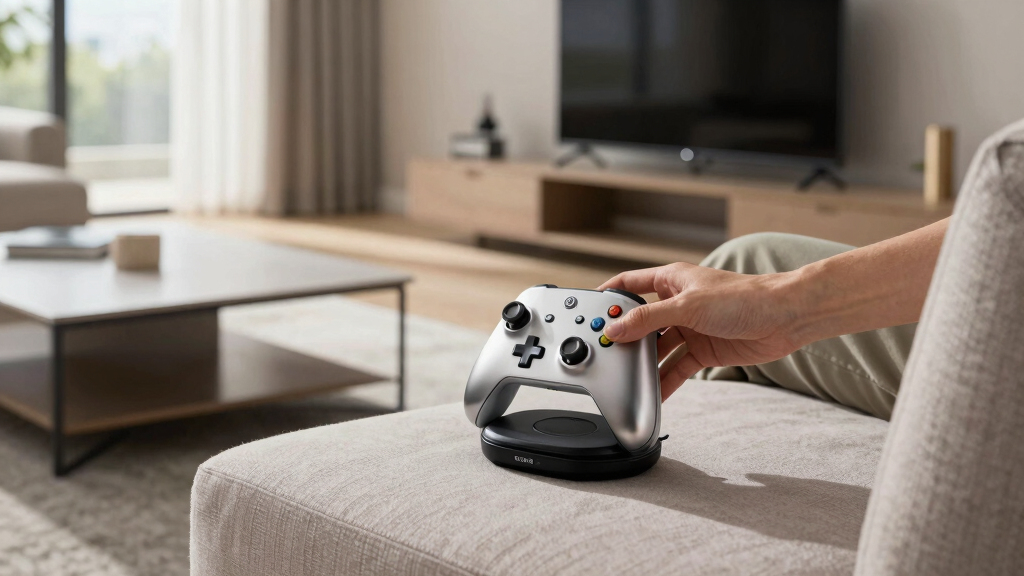
A new open-source web application enables Steam Controllers to automatically dock on their magnetic charging puck using optical flow computer vision. The system connects via WebHID and employs haptic navigation, making charging more seamless. Details are still emerging about deployment and hardware compatibility.
An open-source web application now allows a Steam Controller to automatically navigate and dock onto its magnetic charging puck using optical flow computer vision and WebHID telemetry. This development, demonstrated through a prototype, could significantly enhance the user experience by automating the charging process, which traditionally requires manual placement.
The project employs OpenCV.js for optical flow tracking, enabling the system to follow user-selected points on the controller and the puck via an overhead camera. It connects to the controller through WebHID, streaming input and telemetry data, including battery status and voltage. The system uses haptic feedback, firing 70Hz asymmetric pulses through the controller’s internal Linear Resonant Actuators (LRAs) to guide the controller toward the puck. When within 150 pixels, proximity creep mode reduces pulse frequency to ensure gentle docking.
The setup requires a webcam mounted overhead, a compatible browser supporting WebHID, and a Linux, Windows, or Mac system with the Nix package manager. Once configured, users can initiate auto-tracking through a web interface, which commands the controller to navigate autonomously to the puck, leveraging a combination of optical flow algorithms and a convolutional neural network running in-browser. The project is licensed under the MIT License and is inspired by prior work from a YouTube video by Very Lazy Pixel.
Potential Impact on Gaming and Device Management
This project demonstrates a novel use of computer vision and WebHID to automate physical interactions with gaming hardware, potentially reducing user effort and improving convenience during charging. If refined and widely adopted, it could lead to more autonomous gaming peripherals and influence future device management approaches, especially for setups involving multiple controllers or complex docking stations.
Steam Controller magnetic charging puck
As an affiliate, we earn on qualifying purchases.
As an affiliate, we earn on qualifying purchases.
Background on Steam Controller Charging Challenges
Steam Controllers traditionally require manual placement onto their magnetic charging puck, which can be inconvenient during extended gaming sessions or for users with accessibility needs. Prior efforts to automate or simplify charging have been limited, with most solutions relying on manual intervention. The recent project builds on advances in web-based hardware control, optical flow tracking, and in-browser neural networks, applying these to a practical problem in gaming hardware management.
“This system could make charging more seamless and reduce wear on the controller’s connectors.”
— an anonymous researcher
webcam for computer vision projects
As an affiliate, we earn on qualifying purchases.
As an affiliate, we earn on qualifying purchases.
Unconfirmed Aspects and Deployment Status
It is not yet clear how robust the system is in varied lighting conditions or with different controller models. The current prototype appears to be in testing, and there are no official statements about commercial availability or integration with existing Steam hardware. Details about long-term reliability, safety, and user control remain to be established.
As an affiliate, we earn on qualifying purchases.
Next Steps for Development and Adoption
Further testing and refinement are expected to improve accuracy and reliability. Developers may explore integrating this system into commercial products or open-source projects for broader community use. Updates could include enhanced object detection, multi-controller support, and user customization options, with potential demonstrations at gaming or maker events.
controller docking automation hardware
As an affiliate, we earn on qualifying purchases.
As an affiliate, we earn on qualifying purchases.
Key Questions
How does the system physically guide the controller to the puck?
The system uses haptic feedback—firing pulses through the controller’s internal LRAs—to nudge it toward the puck based on optical flow tracking.
Is this system compatible with all Steam Controllers?
The project currently supports controllers that can connect via WebHID; compatibility with all models has not been confirmed.
Can this be used with other charging docks or only the official magnetic puck?
The system is designed for the official magnetic charging puck; adaptation to other docks would require additional development.
Is this ready for everyday use or still experimental?
It remains experimental, primarily a proof of concept, and is not yet recommended for routine or safety-critical use.
Will this project be integrated into official Steam hardware or software?
There has been no indication from Valve or Steam about integrating this technology into official products.
Source: Hacker News
Halloween Picks
halloween
As an affiliate, we earn on qualifying purchases.