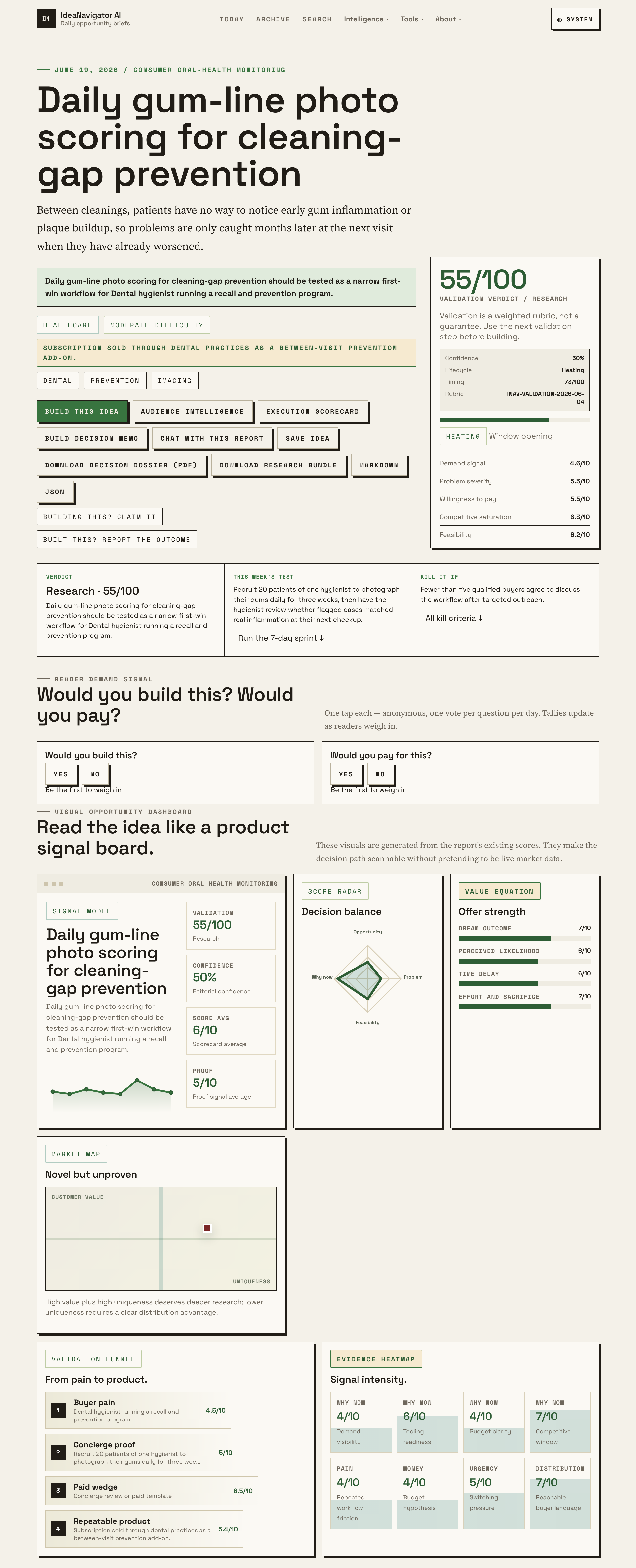
📊 Full opportunity report: The Impact Of Daily Gum Line Monitoring On Dental Prevention on IdeaNavigator AI — validation score, market gap, and execution plan.

Get the latest gadgets delivered free with Prime
- Fast, free delivery on millions of items
- Prime Video, Amazon Music and more included
- Member-only deals all year
TL;DR
A new approach involves patients taking daily photos of their gum line to monitor inflammation and plaque buildup. This method aims to enhance preventive dental care between visits. Testing is underway with a small patient group to validate its effectiveness.
Dental hygienists are piloting a new method that encourages patients to take daily photos of their gum line using smartphones, with the goal of detecting early signs of inflammation and plaque buildup. This development could significantly improve preventive dental care by providing real-time monitoring between routine visits, addressing a longstanding challenge in oral health management.
The approach involves patients snapping standardized photos of their gum line daily, which are then scored automatically using on-device algorithms. The scores generate a trend indicator, highlighting worsening redness or inflammation, which patients are instructed to report at their next hygienist appointment. The initiative is currently being tested with a cohort of 20 patients over a three-week period, with the aim of validating whether flagged cases correlate with actual inflammation observed during professional examinations.
According to an anonymous researcher involved in the project, the system leverages existing smartphone camera technology and simple scoring metrics based on established dental health benchmarks. The goal is to create a cost-effective, easy-to-adopt tool that can be integrated into existing preventive care workflows, encouraging patients to stay engaged in their oral health between visits.
Dental practices see this as a potential revenue stream, offering subscription-based add-ons to patients for ongoing monitoring. The broader market target includes consumer oral-health monitoring, aiming to empower individuals to take more active roles in preventing gum disease and other dental issues before they become severe.
Potential Shift in Preventive Dental Care Practices
If validated, daily gum-line photo scoring could transform how dental professionals monitor early signs of gum disease, potentially reducing the incidence of advanced periodontal issues. Early detection through at-home monitoring could lead to more timely interventions, improved patient outcomes, and reduced long-term treatment costs. This approach also aligns with increasing consumer interest in personal health tracking and digital health innovations.
As an affiliate, we earn on qualifying purchases.
Advances in Smartphone Technology Enable New Monitoring Tools
Recent developments in smartphone camera quality and on-device image analysis have made at-home health monitoring more feasible. Dental practices have increasingly adopted preventive recall programs, but there remains a gap in between-visit monitoring for early gum inflammation. The proposed daily photo scoring system aims to fill this gap by providing a simple, scalable solution that leverages existing consumer technology.
Previous efforts in oral health monitoring have focused on professional assessments or basic hygiene reminders, but this new approach emphasizes proactive, patient-driven engagement. The pilot study is part of a broader trend toward integrating digital health tools into routine care, with the potential to reduce the burden of late-stage dental disease.
“The goal is to create a cost-effective, easy-to-adopt tool that can be integrated into existing preventive care workflows, encouraging patients to stay engaged in their oral health between visits.”
— an anonymous researcher
As an affiliate, we earn on qualifying purchases.
Effectiveness of Daily Photo Scoring Still Under Evaluation
It is not yet confirmed whether the daily photo scoring accurately predicts or detects early gum inflammation in real-world settings. The pilot involves a small sample size, and results are still being analyzed to determine the correlation between flagged scores and actual clinical findings. Further larger-scale studies are needed to establish reliability and clinical utility.
As an affiliate, we earn on qualifying purchases.
Next Steps Include Larger Trials and Validation
Following the initial three-week pilot, researchers plan to expand the study to include more patients and longer monitoring periods. Data collected will be analyzed to assess the accuracy of the scoring system and its impact on patient engagement and early detection. If successful, the system could be refined and potentially integrated into commercial dental apps or practice workflows within the next year.
As an affiliate, we earn on qualifying purchases.
Key Questions
How does daily gum line photo scoring work?
Patients take daily photos of their gum line using a smartphone, which are then analyzed by on-device algorithms to generate a trend score indicating inflammation or plaque buildup. This helps identify early signs of gum problems between dental visits.
Is this method proven to prevent gum disease?
Not yet. The current pilot aims to validate whether the scoring system accurately detects early inflammation. Larger studies are needed before it can be confirmed as an effective preventive tool.
Who can benefit from this monitoring system?
Patients at risk of gum disease or those undergoing preventive dental care can benefit, especially if they are engaged in ongoing recall programs and want to monitor their oral health more actively between visits.
Will this replace professional dental checkups?
No. It is intended as a supplementary tool to enhance early detection and patient engagement, not as a replacement for professional examinations.
When might this system become widely available?
If the pilot results are positive, developers plan to refine the technology and seek broader validation within the next year, potentially leading to commercial availability within 1-2 years.
Source: IdeaNavigator AI
Halloween Picks
halloween
As an affiliate, we earn on qualifying purchases.