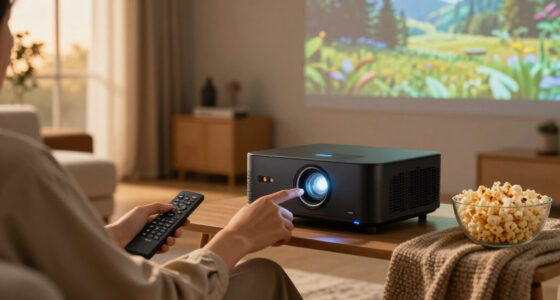
Many home theater terms can be confusing, like speaker calibration, which adjusts sound balance, or room acoustics, affecting how audio and visuals come together. Projection screens vary in type and material, impacting picture quality depending on room light and size. Understanding factors like gain or ambient light helps you choose the right equipment for your setup. Grasping these basics guarantees you avoid costly mistakes and opens a more immersive cinematic experience—continue on to discover more essential terms.

Get the latest gadgets delivered free with Prime
- Fast, free delivery on millions of items
- Prime Video, Amazon Music and more included
- Member-only deals all year
Key Takeaways
- Speaker calibration adjusts sound for balanced, immersive audio by optimizing volume, delay, and equalization for each speaker.
- Room acoustics significantly impact sound quality; proper placement and acoustic treatments improve clarity and immersion.
- Projection screens vary in type and material; selecting the right one depends on room size, ambient light, and projector specs.
- Screen gain and material affect picture contrast, brightness, and color accuracy, essential for optimal image quality.
- Understanding key concepts prevents costly mistakes and ensures a better setup for a cinematic home theater experience.

Ever wonder what all those technical terms mean when setting up a home theater? You’re not alone. The world of home theater is filled with jargon that can seem confusing at first, but understanding some key concepts can make the process much smoother. Take speaker calibration, for instance. This process guarantees that all your speakers deliver balanced sound, so you don’t have one speaker overpowering the others or creating uneven audio. When you set up your system, you might notice that some sounds are too loud or too quiet. Speaker calibration helps fix that by adjusting the volume, delay, and equalization for each speaker. Many modern receivers come with automatic calibration tools, which use a microphone to analyze your room’s acoustics and make the necessary tweaks. Proper calibration is vital for an immersive experience because it ensures that sound reaches you evenly, whether you’re watching a movie or listening to music. Additionally, understanding how room acoustics affect sound quality can help you optimize your setup for the best listening experience. Knowing how to control and improve room acoustics can significantly impact your overall sound clarity and immersion. Room acoustics are a crucial factor, and even small adjustments to furniture placement or adding acoustic panels can make a noticeable difference.
Another often-misunderstood term is projection screens. If you’re contemplating a big-screen experience at home, you might wonder whether to go for a traditional TV or a projection system. Projection screens are special surfaces onto which your projector displays images. They come in various types—fixed, pull-down, motorized, or portable—and different materials that affect picture quality. Some screens are designed to enhance contrast and color accuracy, while others are more affordable but may sacrifice some picture sharpness or brightness. When choosing a projection screen, you need to take into account your room’s size, ambient light, and the projector’s capabilities. The goal is to find a screen that provides clear, vibrant images without washing out in a bright room or feeling too small in a large space. Considering the screen material and gain can help you make the best choice for your environment and viewing preferences. Understanding these elements can help prevent common issues like glare or poor contrast, ensuring a more enjoyable viewing experience.
Understanding these terms helps you make smarter choices when designing your home theater. Speaker calibration isn’t just a technical step—it’s what makes your audio feel natural and immersive. Meanwhile, selecting the right projection screen can dramatically improve your viewing experience, making movies feel larger than life. These concepts might sound complicated at first, but once you grasp their importance, you’ll see how they contribute to the overall quality of your setup. With a little knowledge, you can avoid costly mistakes, optimize your system, and truly enjoy the cinematic experience right in your living room.
Products Worth Considering

Sonos Era 100 SL Compact Microphone-Free Speaker, Black

Bose SoundLink Flex Bluetooth Speaker (2nd Gen), Portable Waterproof Speaker, Black

Sonos Era 100 Wireless Smart Speaker, Black
As an affiliate, we earn on qualifying purchases.
Frequently Asked Questions
What Is the Difference Between 4K and HDR?
4K refers to resolution clarity, meaning the display has around 4,000 pixels horizontally, offering sharper, more detailed images. HDR, or High Dynamic Range, enhances color and contrast, making bright scenes brighter and shadows darker. While 4K improves resolution, HDR boosts color accuracy and dynamic range. Together, they create a more immersive viewing experience, with crisp details and vibrant, lifelike colors. Both features considerably enhance your home theater setup.
How Does Dolby Atmos Differ From Dolby Surround?
Think of Dolby Atmos as a symphony where sound floats above you, like clouds in the sky, thanks to speaker placement that creates a three-dimensional soundscape. Dolby Surround, however, is like a band playing around you, primarily on horizontal axes. Atmos uses additional audio channels for height, immersing you in a dome of sound, while Surround focuses on traditional channels around your space, making Atmos more dynamic and layered.
What Does “Refresh Rate” Mean in TVS?
A TV’s refresh rate refers to how many times per second the screen updates its image, measured in Hertz (Hz). A higher refresh rate, like 120Hz, provides smoother motion, which enhances image clarity during fast scenes. This is especially noticeable in sports and action movies. So, when choosing a TV, consider a higher refresh rate for better motion clarity, complementing good screen resolution for sharper, more detailed visuals.
Are Soundbars a Good Alternative to Full Surround Sound Systems?
Think of a soundbar as a sleek, focused orchestra conductor, guiding your audio experience without the complexity of a full surround system. While it offers impressive sound quality, placement is key to maximizing its impact. A soundbar can be a good alternative if you want simplicity and cleaner design, but it might lack the surround sound compatibility of a traditional system. For most, it’s a smart, space-saving upgrade.
How Important Is Calibration for Home Theater Performance?
Calibration is vital for peak home theater performance because it guarantees your speaker placement and room acoustics work together seamlessly. When you calibrate your system, you fine-tune audio levels, delay settings, and equalization, which enhances sound clarity and balance. Neglecting calibration can result in muddled dialogue or uneven sound. Taking the time to calibrate makes your viewing experience more immersive, providing crisp, balanced audio that matches your room’s unique acoustics.
Conclusion
Understanding home theater terms might seem tricky at first, but you’re well on your way. Did you know that nearly 70% of enthusiasts say that mastering these terms enhances their overall viewing experience? Imagine this: once you grasp these concepts, your movies will sound clearer, look sharper, and feel more immersive. So, keep learning, and soon you’ll be steering your home theater like a true pro—turning every movie night into a cinematic adventure right in your own living room.