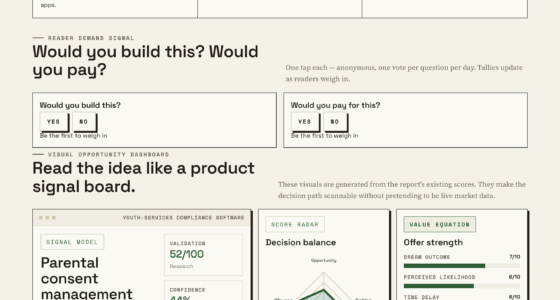
📊 Full opportunity report: Using AI To Prepare Clearer Reports For Investigation Clients on IdeaNavigator AI — validation score, market gap, and execution plan.

Get the latest gadgets delivered free with Prime
- Fast, free delivery on millions of items
- Prime Video, Amazon Music and more included
- Member-only deals all year
TL;DR

A product proposal from IdeaNavigator AI describes a report generator for independent private investigators and small firms. It would assemble field notes, timestamped photos and GPS tracks into chronological draft reports, but no product launch, test results or legal validation are reported.
IdeaNavigator AI has proposed an AI report generator for independent private investigators and small firms, designed to turn field notes, timestamped photos and GPS records into chronological draft reports. The proposal describes a potential workflow and a plan to test it; it does not report that a product has launched or that its reports have been shown to meet courtroom standards.
The proposed tool would take in investigators’ field notes, dated photographs and GPS tracks, then arrange observations into a chronological narrative. It would add references to exhibits, flag gaps in the timeline and export a draft using the firm’s report template. A human review pass is part of the proposed workflow.
The business case is that investigators may spend hours writing reports after surveillance work, assembling details from separate records. IdeaNavigator AI argues that this can leave time-consuming work unbilled and that report quality matters when investigative work is used in court. These are claims in the proposal; it provides no measurements of writing time, billing practices or report outcomes.
The suggested revenue model is a monthly subscription per seat, with pricing tiers based on report volume. To test demand and performance, the proposal recommends converting recent case files from 10 firms into reports, having attorneys review their admissibility quality and measuring time saved per report. No participating firms, attorney findings or results are identified.
Report Drafting and Courtroom Scrutiny
The proposal targets a specific administrative task: turning observations gathered during investigations into a readable, ordered report. If a tool can reduce drafting time while preserving accurate dates, exhibit references and context, small firms could have more time for investigative work and less spent assembling paperwork. That benefit remains unproven in the material available.
For clients and attorneys, the central concern is not simply whether AI can produce fluent prose. A report must reflect the underlying records faithfully, distinguish observation from inference and make supporting evidence easy to locate. A polished draft that misstates a time or omits a qualification could create problems rather than save time. The proposed human review and attorney assessment therefore matter as much as the text-generation feature.
The suggested evaluation also points to two separate questions: whether the software saves investigators time and whether attorneys consider its output usable for their purposes. Neither outcome can be assumed from the proposed feature set. A workflow that performs well on a sample of files would still need to be assessed across different case types, templates and record quality.
Products Worth Considering

DJI Mic 3 Wireless Microphone System (2 Transmitters, 1 Receiver, Charging Case)

Anker SOLIX S2000 Portable Power Station, 2,010Wh, 1,500W

Anker SOLIX C1000 Gen 2 Portable Power Station
As an affiliate, we earn on qualifying purchases.
A Narrow First Use Case
IdeaNavigator AI frames the idea as a narrow first product for independent investigators and small firms, rather than a general-purpose legal writing system. Its proposed input records—notes, photos and GPS logs—are materials an investigator may already collect, while the intended output is a formal narrative organized by time and linked to exhibits.
The proposal places the product in the investigation services software market and says private investigators remain underserved by modern software. It does not provide market-size figures, competitor comparisons, customer interviews or evidence supporting that assessment. Nor does it specify how the software would handle conflicting timestamps, incomplete records, corrections or different firm templates.
The recommended test is to use recent case files from 10 firms, generate reports and ask attorneys to assess admissibility quality while tracking time saved. This is a proposed validation method, not a completed study. The proposal does not define an admissibility standard or describe how attorney feedback would be collected and compared.
Accuracy and Legal Review Still Open
No product, launch date or test results are provided. It is not clear whether a development team has built a prototype, whether any firms have agreed to participate, or what the proposed subscription would cost.
The proposal also does not explain how generated reports would be checked against original records, how errors or missing information would be handled, or how sensitive case files would be stored and protected. It offers no attorney assessments establishing that generated reports would be admissible or appropriate for any particular proceeding. The suggested attorney review is a planned evaluation, not a legal guarantee.
Testing Must Establish Practical Value
The next step in the proposal is a 10-firm case-file test, followed by attorney review and measurement of time saved per report. To establish practical value, such a test would need to show not only faster drafting but also whether the reports accurately preserve the source records and meet each firm’s review requirements.
There is no announced schedule for that work or confirmation that it will proceed. Until results or a product release are reported, the idea remains a proposed workflow for investigation firms rather than a demonstrated service.
Source: IdeaNavigator AI
Key Questions
Has an AI report generator for investigators launched?
No launch is reported. IdeaNavigator AI describes a proposed product and a plan for testing it, without providing a release date or confirming that a prototype exists.
What would the proposed tool do?
It would turn field notes, timestamped photos and GPS tracks into chronological draft reports, add exhibit references, flag timeline gaps and export using a firm’s template. The proposed workflow includes human review.
Would its reports be admissible in court?
That has not been established. The proposal recommends attorney review of report quality as part of testing, but does not report legal assessments or guarantee admissibility.
How would the idea be tested?
The suggested test would use recent case files from 10 firms, have attorneys review the generated reports and measure time saved per report. No completed test or results are provided.
Source: IdeaNavigator AI