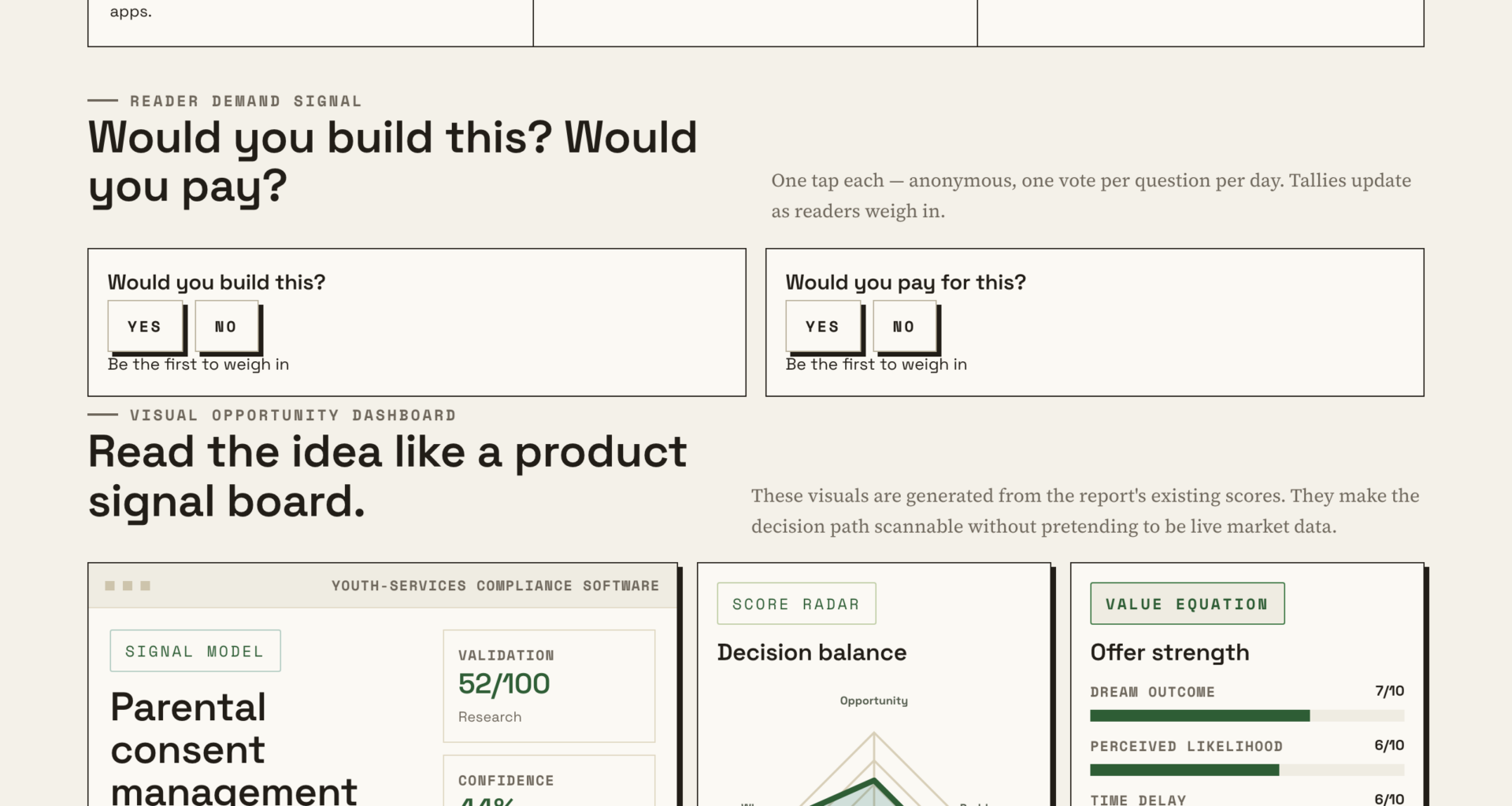

📊 Full opportunity report: What Does Consent Management Look Like For Kid-Facing Vendors? on IdeaNavigator AI — validation score, market gap, and execution plan.
TL;DR
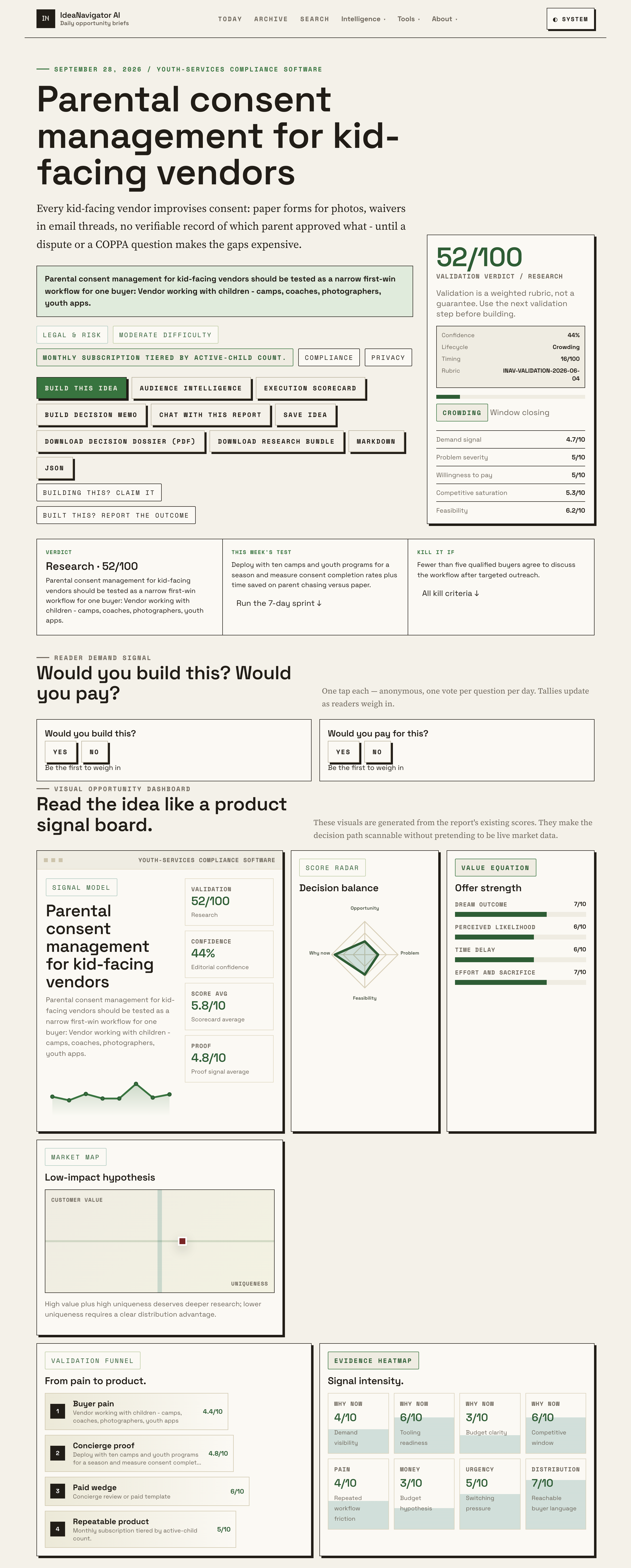
A product proposal outlines phone-based parental consent workflows for camps, coaches, photographers and youth apps, with records organized by child and consent type. The idea has not been shown to be deployed or tested; a proposed pilot would involve ten camps and youth programs over one season.
In its product proposal, IdeaNavigator AI describes a problem for the listed types of vendors: photo permissions, waivers and other approvals may be collected through separate paper forms or email threads. The proposal says vendors can lack a verifiable record showing which parent approved which use, a gap that could become costly if a dispute arises or a vendor faces a question about children’s privacy compliance. It provides no survey results or examples documenting how often this happens.
The proposed minimum product would let parents complete vendor-branded forms on their phones for photo use, data collection, medical information and liability waivers. It would organize approvals in a per-child consent ledger, track expiry dates, provide identity checks suited to the perceived risk, and allow vendors to export records for an audit. IdeaNavigator AI does not specify how identity checks would work or how sensitive records would be secured.
IdeaNavigator AI suggests charging vendors a monthly subscription based on active-child count. To test whether customers will use and pay for the service, it recommends a seasonal pilot with ten camps and youth programs, measuring consent completion and the time staff spend following up with parents compared with paper processes. The proposal identifies no participating organizations, schedule, pricing or pilot findings.
A Record for Every Permission
IdeaNavigator AI’s proposal says that, for a camp or youth program, a single child may have separate permissions covering photographs, data, medical details and liability. Putting those decisions in one record could help staff find an approval and check whether it remains valid, rather than search across folders and message threads. That potential benefit is a product hypothesis; the proposal reports no measured time savings or reduction in disputes.
The proposal cites children’s privacy rules and parental expectations as reasons vendors may seek more defensible records. It provides no legal analysis, and specific legal duties vary with the service and the information collected. A consent ledger could document what a parent agreed to, but the proposal does not establish that using such a tool would by itself satisfy any particular law or prevent a complaint.
From Paper Forms to Phone
IdeaNavigator AI’s concept is aimed at small organizations serving children, rather than presented as a general-purpose consent system. Camps and coaches may collect waivers; photographers may need permission to use images; youth apps may request approval for data collection. The proposed workflow groups these distinct permissions while retaining a record for each child.
IdeaNavigator AI frames the timing around updates to the Children’s Online Privacy Protection Act (COPPA), state laws and parents’ challenges to photo and data use. The proposal gives no legal analysis, dates for particular rule changes, enforcement examples or evidence measuring a rise in disputes. These points are the proposal’s rationale for exploring the opportunity, not findings from a reported market study.
Demand and Compliance Still Untested
IdeaNavigator AI’s proposal does not establish whether camps and other youth vendors would adopt a paid service, what subscription price they would accept, or whether a single workflow can accommodate their different consent needs. It includes no customer interviews, market-size estimate, named pilot partners or operating results. Its suggested ten-program trial is a validation plan, not evidence that a trial has taken place.
Important product questions also remain open: how parents’ identities would be checked at each risk level; how vendors would protect medical and other sensitive information; how consent could be withdrawn or corrected; and how records would be retained or deleted. The proposal does not explain how the service would map its forms and records to applicable legal requirements.
A Ten-Program Seasonal Pilot
IdeaNavigator AI proposes deploying the service with ten camps and youth programs for one season. The suggested test would compare consent completion rates and staff time spent chasing approvals with the programs’ paper-based process. The proposal announces no start date, recruitment plan or results.
Those measures could show whether the workflow reduces administrative effort and whether families complete forms on their phones. A pilot report would still need to explain how results were gathered, what kinds of organizations took part and whether the findings apply beyond the participating programs. Until then, the service’s demand, operational value and compliance role remain unverified.
Source: IdeaNavigator AI
Key Questions
Has a parental consent product for these vendors launched?
IdeaNavigator AI’s proposal describes a product concept. It does not report a launch, active customers or a completed pilot.
Who is the proposed service for?
The proposal targets vendors and programs serving children, including camps, coaches, photographers and youth apps.
What would the product do?
As outlined in the proposal, it would let parents complete phone-based forms for photo use, data collection, medical information and liability, while vendors track approvals by child and export records.
Would the platform guarantee legal compliance?
No such guarantee is established. IdeaNavigator AI’s proposal does not provide legal analysis or explain how the product would meet specific requirements.
How would the idea be tested?
The proposal recommends a one-season pilot with ten camps and youth programs, tracking form completion and staff time spent following up with parents. It reports no pilot results.
Source: IdeaNavigator AI