
Satellite internet like Starlink offers wide coverage, especially in rural or remote areas where cable and 5G can struggle. It’s usually slower, with higher latency and weather sensitivity, but it provides reliable access outside urban zones. In contrast, 5G delivers faster speeds and lower latency but depends on dense infrastructure. Whether Starlink might replace your cable depends on your location, needs, and future tech advances—exploring more can help you decide.
Key Takeaways
- 5G offers faster, more stable speeds ideal for urban areas, while satellite provides broader coverage in remote regions.
- Satellite internet, like Starlink, has higher latency and weather susceptibility but reaches underserved locations.
- 5G equipment is typically less expensive and easier to install compared to satellite dishes.
- Advances in satellite technology aim to reduce latency, potentially making it more competitive with 5G.
- The choice depends on location, coverage needs, and budget, with Starlink complementing rather than fully replacing cable.
Top picks for "internet satellite home"
Open Amazon search results for this keyword.
As an affiliate, we earn on qualifying purchases.
Comparing Coverage and Accessibility
When comparing coverage and accessibility, satellite internet often reaches remote and rural areas where traditional broadband struggles to provide service. Unlike 5G, which depends on urban infrastructure like cell towers, satellite signals can blanket vast regions, making connectivity feasible in isolated locations. This broad coverage has significant policy implications, as governments and providers must decide how to allocate resources effectively. Satellite networks bypass the limitations of dense urban infrastructure, offering access where fiber or cable isn’t practical. Additionally, satellite technology can be affected by factors like wave and wind, which can impact signal stability and quality. These environmental factors highlight the need for robust satellite infrastructure to maintain reliable service. Satellite signals can also be disrupted by weather conditions, which underscores the importance of resilient network design. Moreover, advancements in satellite technology continue to improve coverage and performance, making satellite internet increasingly competitive with terrestrial options. As launch capabilities improve, the deployment of new satellites promises even greater coverage and reliability. However, in urban areas, existing infrastructure supports high-speed internet, reducing satellite’s role. Overall, satellite internet provides unparalleled accessibility for underserved regions, but policy decisions will shape its deployment and integration with other networks, influencing the future landscape of connectivity.
Assessing Speed and Performance
When comparing satellite and 5G internet, understanding speed metrics like download and upload rates is essential. You should also consider latency and reliability, especially if you need consistent performance for streaming or work. In remote areas, performance differences can be significant, impacting your overall internet experience. Additionally, factors such as connected equipment and individual user needs can influence which technology is more suitable for your lifestyle. For instance, the Suprem fabric offers durability and stability, which can be advantageous in certain network setups. Knowing how network infrastructure affects signal quality can help you choose the best option for your location.
Speed Comparison Metrics
To accurately compare satellite internet and 5G home internet, analyzing their speed and performance metrics is vital. You should consider typical download and upload speeds, which vary depending on your location and provider. Satellite internet often has lower speeds due to signal latency and requires proper antenna installation for peak performance. In contrast, 5G offers faster speeds with more consistent performance, especially in urban areas. Keep in mind that data caps can limit your usage, affecting your experience regardless of speed. Satellite services tend to have stricter data limits, potentially throttling speeds after reaching caps. When evaluating these options, consider your bandwidth needs and whether your area supports the high-speed capabilities of 5G, or if satellite’s limitations will impact your daily internet use.
Latency and Reliability
Speed metrics provide a snapshot of internet performance, but understanding latency and reliability offers a deeper view of how well your connection handles real-time tasks. Satellite internet’s latency depends heavily on antenna design and satellite orbit. Lower orbit satellites reduce signal travel time, improving responsiveness. However, the orbit’s stability and antenna precision also impact connection reliability, especially during weather disturbances or signal interference. For instance, changes in ear wax odor can indicate underlying issues, similar to how environmental factors can affect satellite signals, impacting reliability. Additionally, satellite signals are more susceptible to weather disturbances, which can lead to interruptions or degraded performance. In some cases, signal interference from other devices or natural obstacles can further compromise connection quality. In contrast, 5G offers consistently low latency and high reliability due to its ground-based infrastructure and advanced antenna technology. You’ll notice that satellite internet can experience delays, affecting activities like gaming or video conferencing, while 5G tends to deliver a more stable, real-time experience. Evaluating these factors helps determine which technology aligns better with your need for dependable, low-latency internet.
Performance in Remote Areas
In remote areas, satellite internet generally provides better coverage than 5G, which relies on dense ground infrastructure that often isn’t available. While satellite internet may have higher latency, it still offers connectivity where 5G signals struggle. Conversely, 5G in remote zones can be hampered by congestion, reducing speeds and increasing latency. You might notice slower downloads and buffering during peak times with 5G, especially if coverage is spotty. Satellite internet has improved, but latency remains a concern for real-time activities. Here’s what to deem:
- Satellite latency can affect video calls and gaming
- 5G congestion causes unpredictable speeds
- Satellite coverage remains reliable in isolated locations
- 5G performance depends heavily on local infrastructure
Evaluating Reliability and Stability
When comparing satellite internet and 5G home internet, evaluating their reliability and stability is essential because these factors directly impact your daily connectivity. Satellite internet often experiences service outages during bad weather, affecting signal stability and causing interruptions. Its reliance on orbiting satellites can lead to latency issues, especially during peak usage. In contrast, 5G offers more consistent performance, with lower latency and fewer service outages, thanks to its infrastructure and proximity to cell towers. Signal stability with 5G is generally better, providing a more reliable connection for streaming, gaming, and remote work. Additionally, network infrastructure plays a crucial role in determining the overall stability and dependability of each technology. As 5G networks expand and improve, they are becoming increasingly capable of supporting household automation and other connected devices with greater reliability. However, 5G coverage isn’t universal yet, so your experience depends heavily on your location. Improvements in technology advancements continue to enhance 5G’s reliability, making it a more attractive option for many users. Overall, 5G tends to deliver more dependable and stable connectivity compared to satellite internet.
Cost Considerations and Affordability
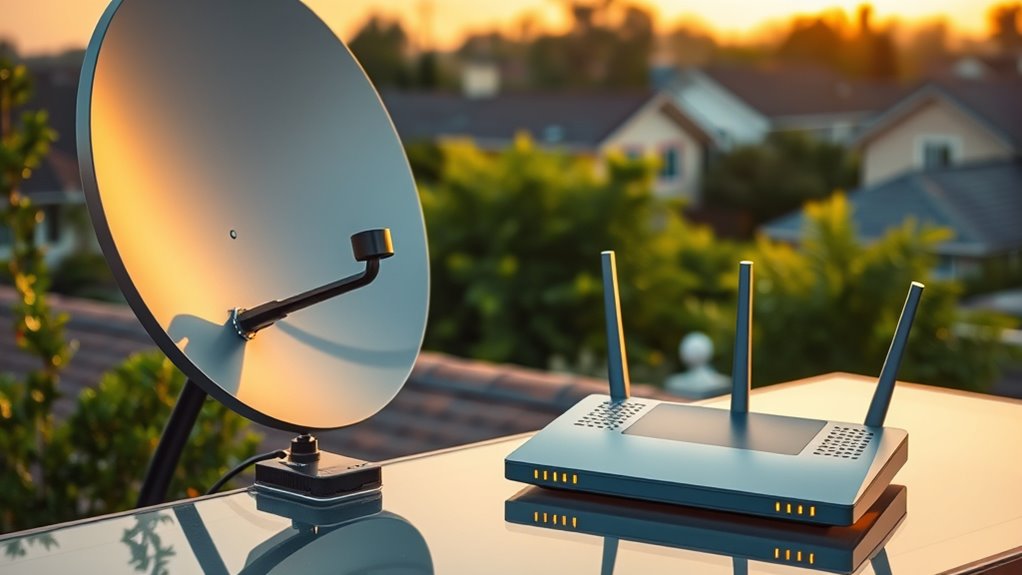
When comparing satellite and 5G internet, you’ll notice differences in equipment costs and monthly fees that can impact your budget. While satellite setups often require higher upfront investment, 5G plans might offer lower long-term expenses with flexible pricing. Considering these factors helps you determine which option provides better long-term affordability for your needs. Additionally, evaluating reliable backup power options can ensure consistent internet service during outages, especially since power outages can disrupt both satellite and 5G connections. Investing in water-resistant equipment can also help protect your setup from environmental damage, particularly in outdoor or humid conditions. Understanding installation planning resources can also help you prepare for potential challenges and optimize your setup for reliability. Being aware of coverage areas can further assist in choosing the most effective internet solution for your location.
Equipment Pricing Differences
Equipment costs can vary considerably between satellite internet and 5G home internet, impacting your overall affordability. With satellite options, you typically pay for a specific antenna type designed for your provider, which can be more expensive upfront but includes equipment warranties for peace of mind. In contrast, 5G home internet usually involves a smaller, more portable modem and router, often at a lower initial cost. However, some providers might charge extra for advanced antenna types or require upgrades over time. Consider these points:
- Satellite antennas are larger and more specialized
- 5G equipment tends to be compact and easy to install
- Equipment warranties differ, affecting long-term costs
- Upfront costs and potential upgrade expenses influence affordability
- Understanding Feature Buddies can help you compare equipment options more effectively, especially since 5G technology often involves advanced antennas. Additionally, evaluating the initial investment can help determine which service aligns better with your budget and long-term financial plans.
Understanding these differences helps you choose the best option for your budget.
Monthly Service Fees
Monthly service fees play a significant role in your overall internet costs, often influencing the long-term affordability of your choice. With satellite internet, service plan options can vary widely, sometimes including data caps or additional fees, which impact your monthly bill. Starlink, for example, offers flat-rate plans with straightforward pricing, but these costs can still add up over time. On the other hand, 5G home internet providers usually offer flexible plans with different speeds and data limits, billed on a monthly cycle. Some providers may charge extra for premium features or data overages, affecting your monthly expenses. Comparing these options carefully helps you understand what you’ll pay each month, so you can select a plan that fits your budget. Additionally, understanding service plan options can help you choose the most cost-effective solution for your needs. Considering the pricing structures of each service can further clarify your potential monthly expenses and aid in making an informed decision.
Long-Term Cost Savings
Long-term cost savings are essential to contemplate because initial affordability doesn’t always translate into lower expenses over time. When comparing satellite internet and 5G home internet, consider how data plans impact your overall costs. Some plans may have high data caps or extra charges for overages, increasing your monthly bill. Also, the quality of customer support can save you money by resolving issues quickly, preventing costly service interruptions.
- Evaluate the total cost of data plans over several years
- Check for hidden fees or equipment costs
- Consider the reliability of customer support
- Factor in potential upgrade or replacement expenses
Environmental and Installation Factors
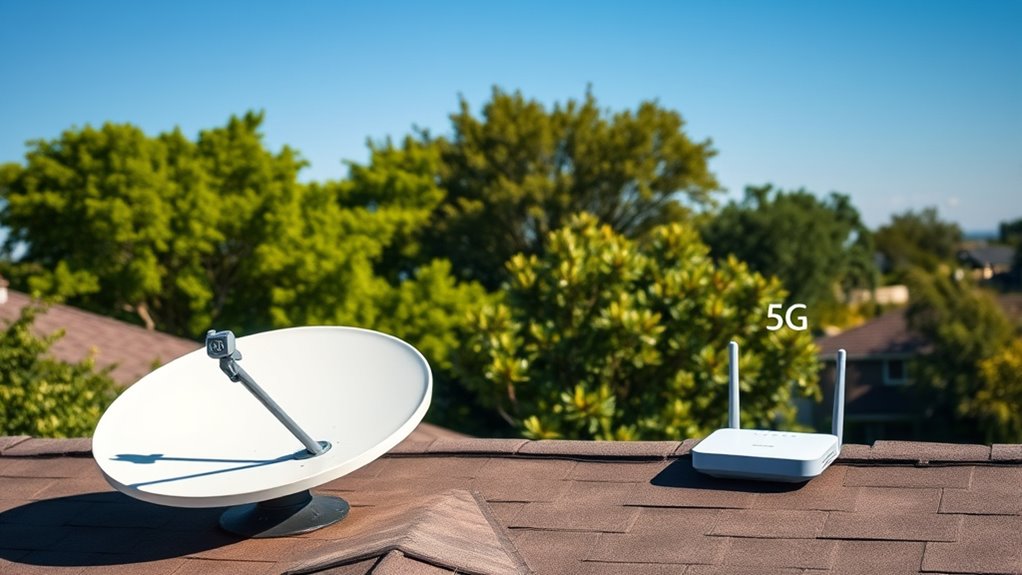
When considering satellite internet and 5G home internet, environmental and installation factors play a crucial role in your overall experience. Satellite power requirements can influence your household’s energy use, while environmental impact concerns highlight how each option affects the planet. Satellite dishes need clear skies and proper placement, which can be challenging in urban or wooded areas. 5G antennas require minimal space but depend on cell tower proximity. Here’s a quick comparison:
| Factor | Satellite Internet | 5G Home Internet | Notes |
|---|---|---|---|
| Installation Ease | Moderate; dish setup required | Simple; router installation | Depends on property and location |
| Environmental Impact | Higher due to satellite launches & power | Lower; minimal physical footprint | Focus on satellite power & emissions |
| Space Requirements | Dish installation in outdoor space | Indoor router, compact | Affects setup flexibility |
| Reliability | Weather-dependent | Less weather-sensitive | Environmental factors impact service |
Future Trends and Technological Developments

Advancements in satellite and 5G technologies are rapidly shaping the future of home internet, with innovations aimed at increasing speed, reducing latency, and expanding coverage. Expect satellite latency to decrease as companies deploy low Earth orbit satellites, making streaming and gaming smoother. Meanwhile, 5G spectrum improvements will allow for higher data rates and more reliable connections, even in densely populated areas. Future developments include smarter network management, AI-driven optimization, and increased use of edge computing. These innovations will make internet more accessible, faster, and more responsive. You’ll likely see a shift toward hybrid networks that combine satellite and 5G to deliver seamless connectivity. This evolution promises better user experiences and broader coverage, challenging traditional cable and fiber options.
Advancements in satellite and 5G tech will deliver faster, more reliable, and widespread internet with smarter, hybrid networks.
- Lower satellite latency through new satellite constellations
- Expanded 5G spectrum for faster speeds
- AI and edge computing for smarter networks
- Hybrid satellite and 5G solutions
Frequently Asked Questions
How Does Latency Differ Between Satellite and 5G Internet?
You’ll notice that latency differences between satellite and 5G internet are significant. Satellite internet typically has higher latency, around 40-50 milliseconds, which can cause delays in network responsiveness. In contrast, 5G offers much lower latency, often under 10 milliseconds, ensuring quicker responses and smoother online experiences. If low latency is vital, especially for gaming or real-time activities, 5G provides a distinct advantage over satellite internet.
Can Satellite Internet Handle High-Bandwidth Activities Like Gaming or Streaming?
You might find satellite internet struggles with high-bandwidth activities like gaming or streaming, especially during peak hours. While Starlink’s bandwidth capacity can reach up to 200 Mbps, signal stability can vary due to weather or obstructions. This means you may experience buffering or lag, making smooth gameplay or HD streaming challenging. For reliable, high-quality entertainment, wired or 5G options often provide steadier connections.
What Are the Privacy Implications of Using Satellite Versus 5G Services?
You should know that satellite and 5G services both pose privacy risks. With satellite internet, your data encryption might be weaker, making it easier for hackers to access your information. Plus, providers can track your location through satellite signals. On the other hand, 5G services also collect location data and could share it with third parties. Stay vigilant by understanding each service’s privacy policies and using strong encryption tools.
Are There Any Geographic Limitations for Accessing 5G Home Internet?
Sure, your 5G home internet might be a superstar, but it’s not quite ready to conquer every corner of the globe. Geographic limitations still exist, especially in rural areas where fiber expansion is slow and rural coverage is spotty. If you live in the boonies, don’t hold your breath for instant 5G—your best bet might still be satellite. So, check your coverage maps before dreaming of lightning-fast speeds.
How Will Upcoming Technological Advancements Impact Satellite and 5G Internet?
Upcoming advancements in antenna technology and spectrum allocation will notably improve both satellite and 5G internet. You’ll experience faster speeds, lower latency, and more reliable connections as new antenna designs enhance signal reception and transmission. Better spectrum management allows for more efficient use of wireless frequencies, expanding coverage areas. These innovations will make satellite and 5G internet more accessible, potentially replacing traditional cable options in many regions.
Conclusion
So, will Starlink replace your cable? Maybe. Or maybe you’ll just keep arguing over who’s faster—your satellite dish or your shiny new 5G router. Either way, you’re probably better off with a smartphone and a good attitude. Because, in the end, whether it’s satellites or cell towers, it’s all about convincing yourself that you’re getting the best deal while secretly hoping your connection doesn’t drop just when you need it most.