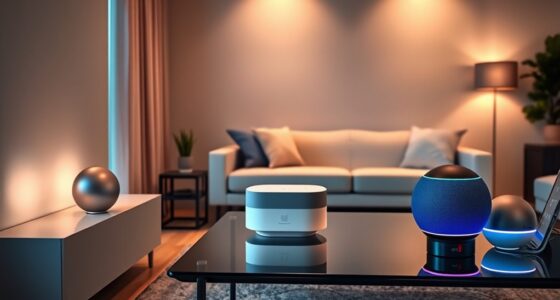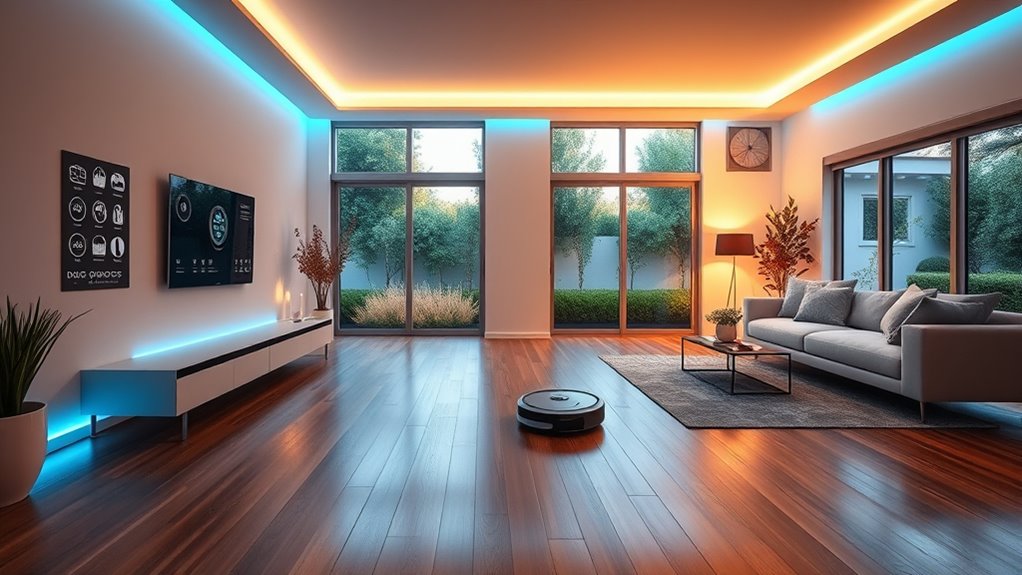

By 2025, your smart home will become more responsive with AI and machine learning, adapting to your routines and needs seamlessly. Voice-controlled and natural language interfaces will make interactions more human-like and intuitive. Security and privacy will be prioritized with advanced protections, giving you peace of mind. Eco-friendly technologies and renewable energy solutions will help you live sustainably. Plus, devices from different brands will work together effortlessly, creating a truly connected home — discover how these trends will shape your future.
Key Takeaways
- AI and machine learning will enable highly personalized and adaptive home environments that proactively respond to residents’ needs.
- Voice control and natural language interfaces will become more intuitive, allowing seamless, human-like interactions with smart devices.
- Enhanced security and privacy measures will protect smart home networks against cyber threats and ensure user data control.
- Sustainable energy solutions like solar integration and energy-efficient appliances will become standard, promoting eco-friendly living.
- Interoperability standards will unify device ecosystems, simplifying management and creating more connected, reliable smart homes.
Increased Integration of Artificial Intelligence and Machine Learning

As smart home technology advances, artificial intelligence (AI) and machine learning (ML) are becoming essential in creating more responsive and personalized living environments. You’ll notice adaptive automation that learns your routines, adjusting lighting, temperature, and security systems seamlessly. Predictive analytics analyze your behavior patterns, allowing your devices to anticipate your needs before you even ask. For example, your thermostat might lower the temperature when you typically leave for work or turn on the lights as you approach home. This integration makes your smart home more intuitive, reducing manual adjustments and increasing convenience. Additionally, incorporating European cloud servers ensures that your data remains secure and compliant with sustainability standards. The use of color accuracy in device calibration further enhances the effectiveness of personalized settings by providing consistent visual feedback. Integrating privacy protection measures helps safeguard your personal information in a highly connected environment. By harnessing AI and ML, your living space becomes smarter, more efficient, and better tailored to your lifestyle, ensuring a truly personalized experience.
Expansion of Voice-Controlled and Natural Language Interfaces

The rise of voice-controlled and natural language interfaces is transforming how you interact with your smart home. With ongoing voice command optimization, your devices become more intuitive and responsive, allowing you to speak naturally instead of using rigid commands. Advances in language understanding make it easier for your smart home to interpret context, slang, and complex requests accurately. As these interfaces improve, you’ll find it simpler to control lights, thermostats, and appliances seamlessly through conversation. You won’t need to learn specific commands; instead, your smart home will understand your intent effortlessly. This expansion enhances convenience and makes your interactions feel more human and natural. Overall, these developments are making voice and language interfaces central to a more intuitive, accessible smart home experience. For example, personalization techniques demonstrate how personal branding and familiarity can influence user engagement and trust in digital interactions.
Enhanced Focus on Home Security and Privacy Measures
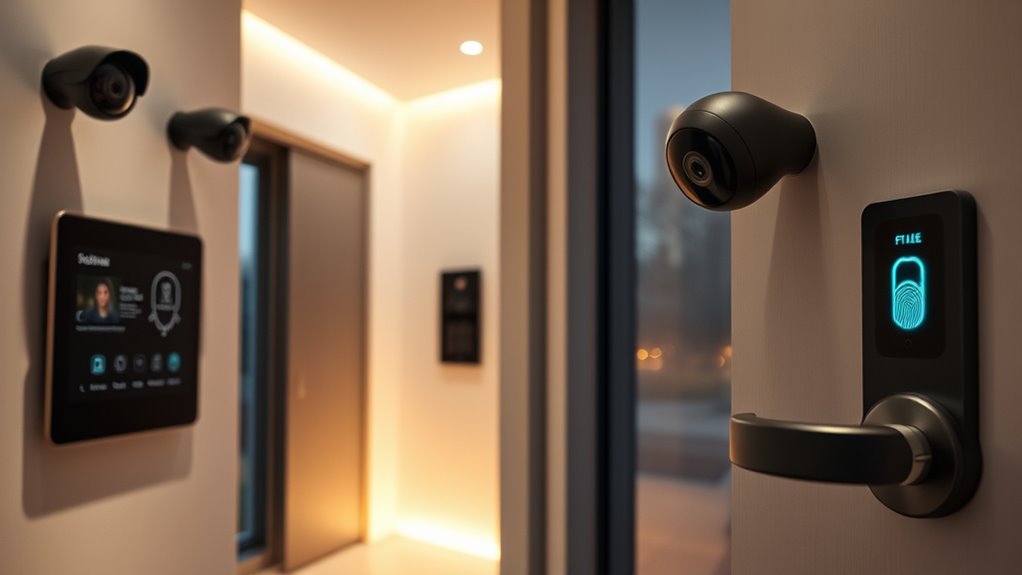
With increasing adoption of smart home devices, manufacturers are placing a stronger emphasis on security and privacy measures to protect your personal data. You’ll see advanced cybersecurity protocols integrated into devices to prevent hacking and unauthorized access. Additionally, privacy legislation is evolving to set clear standards for data collection and usage, giving you more control over your information. Manufacturers are adopting encryption methods and multi-factor authentication to secure your networks and devices. They’re also providing transparent privacy policies, so you know exactly how your data is handled. As these measures improve, your smart home becomes safer and more privacy-conscious, ensuring that your personal space remains secure from cyber threats and intrusive data collection. The integration of responsible data practices further enhances trust and confidence in smart home technology, especially as privacy policies become more comprehensive and user-focused. Moreover, implementing security standards across devices helps maintain a consistent level of protection throughout your smart home ecosystem. Enhanced security protocols are increasingly being embedded into device firmware, offering an additional layer of defense against cyberattacks.
Adoption of Sustainable and Energy-Efficient Technologies
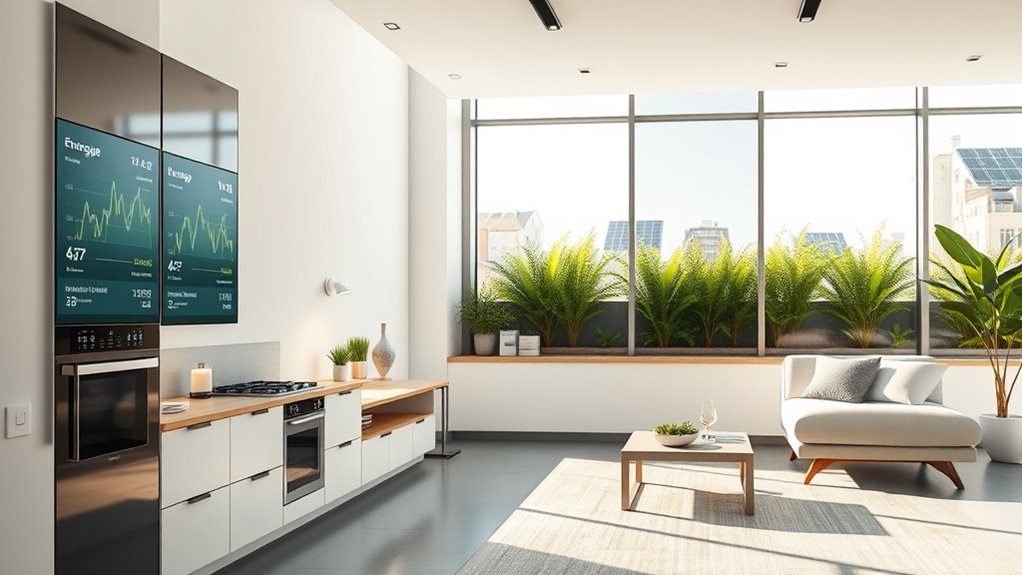
Growing concerns about climate change and rising energy costs are driving the widespread adoption of sustainable and energy-efficient technologies in smart homes. You’ll see more homes integrating renewable energy sources like solar panels and wind turbines, reducing reliance on non-renewable resources. Eco friendly appliances are becoming standard, helping you lower your carbon footprint while saving money. This shift makes your home smarter and greener, aligning comfort with responsibility. Imagine a future where your energy consumption is optimized, and your home actively contributes to environmental conservation. You’ll feel empowered knowing you’re making a difference. Additionally, understanding the science behind energy-efficient devices can help you select the most effective solutions for your home. Incorporating smart energy management systems can further enhance efficiency by automating energy use based on your habits and needs, making your home more sustainable and cost-effective. Advances in home automation technology continue to support these efforts, making it easier than ever to manage energy consumption effortlessly. As technology evolves, home energy storage solutions will become more accessible, allowing you to store excess energy for later use and further optimize your home’s energy profile.
Growth of Interoperability and Standardized Smart Home Ecosystems
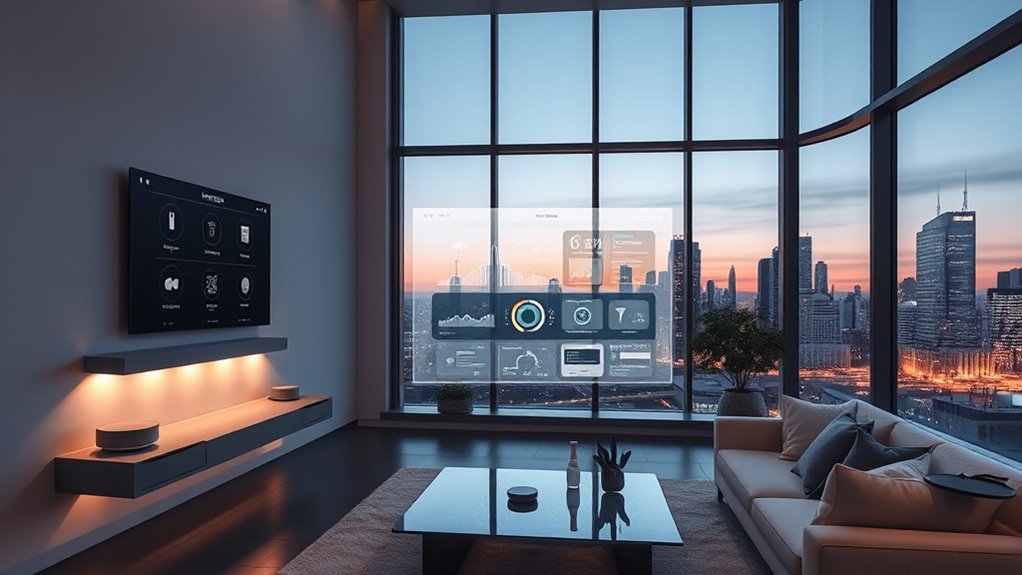
As smart home devices become more prevalent, the push toward interoperability and standardized ecosystems accelerates, making it easier for you to connect and control various technologies seamlessly. With improved device compatibility, you won’t have to worry about incompatible gadgets or complex setups. Cross platform standards are driving the industry toward unified protocols, ensuring devices from different brands work together effortlessly. This growth means your smart home can become more integrated and reliable, reducing frustration and enhancing convenience. As manufacturers adopt common standards, you’ll enjoy a smoother experience, whether you’re controlling lighting, security, or appliances. The result is a more cohesive ecosystem that adapts to your needs, simplifies management, and paves the way for smarter, more connected living in 2025.
Frequently Asked Questions
How Will AI Personalize Smart Home Experiences for Individual Users?
You’ll see AI personalize your smart home experiences through advanced personalization algorithms that adapt to your habits and preferences. By building detailed user profiles, the system learns when you prefer certain lighting, temperature, or music settings. This means your home automatically adjusts to your routine, creating a seamless environment that feels uniquely tailored to you. As AI evolves, these personalized experiences will become even more intuitive and responsive to your needs.
What New Privacy Regulations Could Impact Smart Home Device Data Sharing?
New privacy regulations will likely require you to give clear user consent before your smart home device data is shared or used. You might also see stricter rules around data encryption to protect your information from breaches. These measures guarantee your privacy is prioritized, and you stay in control of your data. Staying informed about these regulations helps you understand your rights and how your data is managed in your smart home.
How Will Smart Homes Adapt to Future Energy Grid Changes?
Did you know that by 2025, over 50% of smart homes will actively participate in energy grid integration? You’ll see smart homes adapting by optimizing energy storage and consumption, reducing reliance on traditional grids. Advanced automation will allow your devices to respond to real-time energy demands, maximizing efficiency. This shift helps balance the grid, lowers costs, and makes your home more sustainable, all while keeping you in control.
Will There Be Universal Standards for Smart Home Device Compatibility?
Yes, there will likely be universal standards for smart home device compatibility, but device interoperability remains a challenge. Standardization challenges involve coordinating multiple manufacturers and platforms to make certain of seamless integration. As a user, you’ll benefit from improved device interoperability, making it easier to connect and control various devices with a single system. Manufacturers are working towards common protocols, so expect more unified standards that simplify your smart home experience.
How Might Smart Homes Support Aging Populations and Accessibility Needs?
Did you know that by 2050, over 1.5 billion people will be aged 65 or older? Smart homes can help you support aging populations and accessibility needs through assistive technology and mobility support. You’ll find voice-activated systems, automated lighting, and fall detection devices that make daily life safer and more independent. These innovations empower you to age comfortably at home while maintaining your independence and well-being.
Conclusion
As you step into the future of smart homes, imagine yourself at the helm of a symphony where AI, security, and sustainability harmonize seamlessly. These trends are the brushstrokes painting a smarter, safer, and greener sanctuary—a place that responds to your every need like an intuitive friend. Embrace these changes, and you’ll find your home evolving into a living, breathing entity that molds itself to your life’s rhythm, guiding you effortlessly into tomorrow.