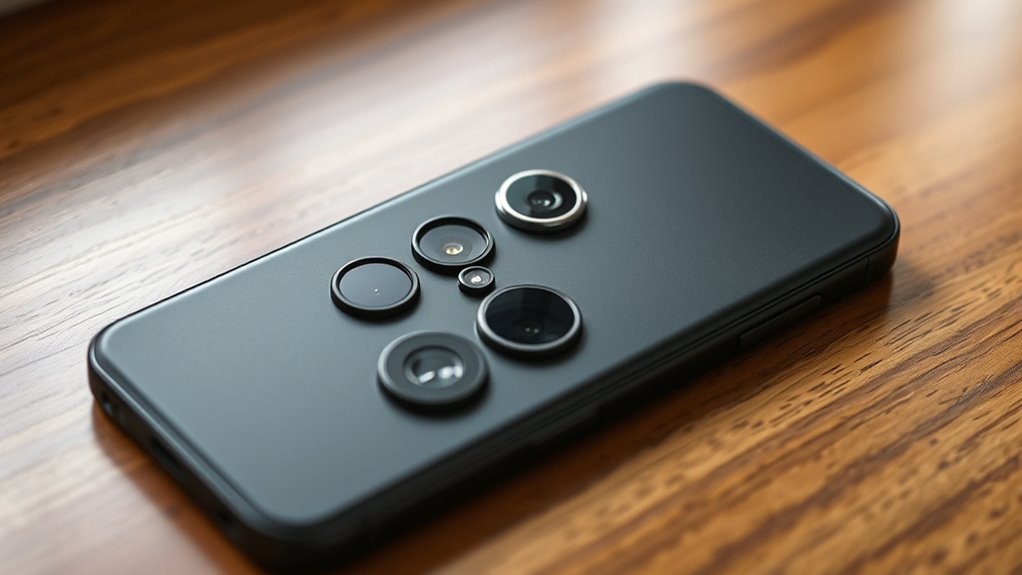

Your phone has multiple cameras to give you better photos and more versatility. Each lens serves a different purpose, like capturing wide scenes, zooming in without sacrificing quality, or taking clear low-light shots. They work together to produce sharper, more detailed images and smoother videos. This multi-lens setup also enhances your ability to take stunning portraits and leverage advanced features. If you want to discover how these lenses work together, keep exploring what makes your device shine.
Key Takeaways
- Multiple cameras enable versatile photography features like wide-angle shots, telephoto zoom, and macro photography for better image quality.
- They improve low-light performance and dynamic range by combining data from different sensors and lenses.
- Multiple lenses provide enhanced stabilization and smoother videos, resulting in professional-looking footage.
- They allow for advanced functionalities such as portrait mode with natural background blur and augmented reality.
- Multi-camera systems optimize device design, balancing powerful hardware with slim, durable smartphones for an improved user experience.
The Evolution of Smartphone Camera Design
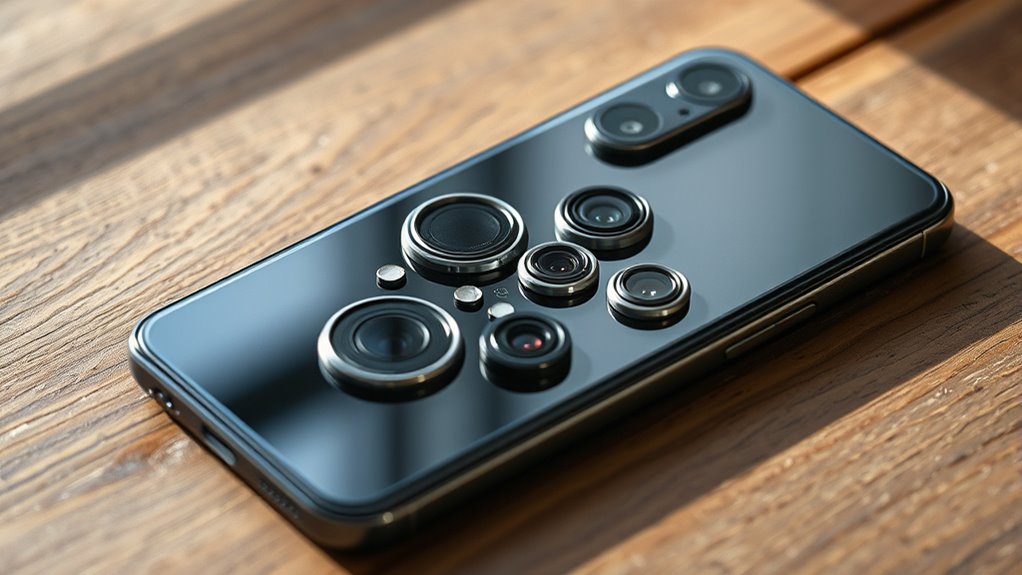
The design of smartphone cameras has evolved considerably over the years, driven by the demand for better image quality and more versatile photography options. Early models focused on simple, single-lens setups, but as camera capabilities improved, manufacturers prioritized camera ergonomics, making the devices easier to hold and operate. This shift often meant adding multiple lenses without compromising user comfort. However, these enhancements can impact battery life, as more advanced sensors and additional lenses demand extra power. Engineers work to balance camera ergonomics with battery impact, ensuring phones remain sleek and functional. Additionally, camera ergonomics have become a key focus, with designs that accommodate multiple lenses while still fitting comfortably in the hand. Over time, this evolution has resulted in multi-camera systems that offer improved performance while still considering user comfort and device longevity, all while incorporating innovative sensor technology to enhance image quality. As a result, manufacturers continually innovate to optimize power efficiency in camera modules, helping to extend battery life despite increased hardware demands. Furthermore, advanced image processing techniques are employed to maximize image quality without additional hardware, improving overall device performance. Continued advancements in miniaturization also enable these complex camera systems to fit into increasingly slim smartphones without sacrificing durability or usability.
How Multiple Lenses Improve Photo Quality
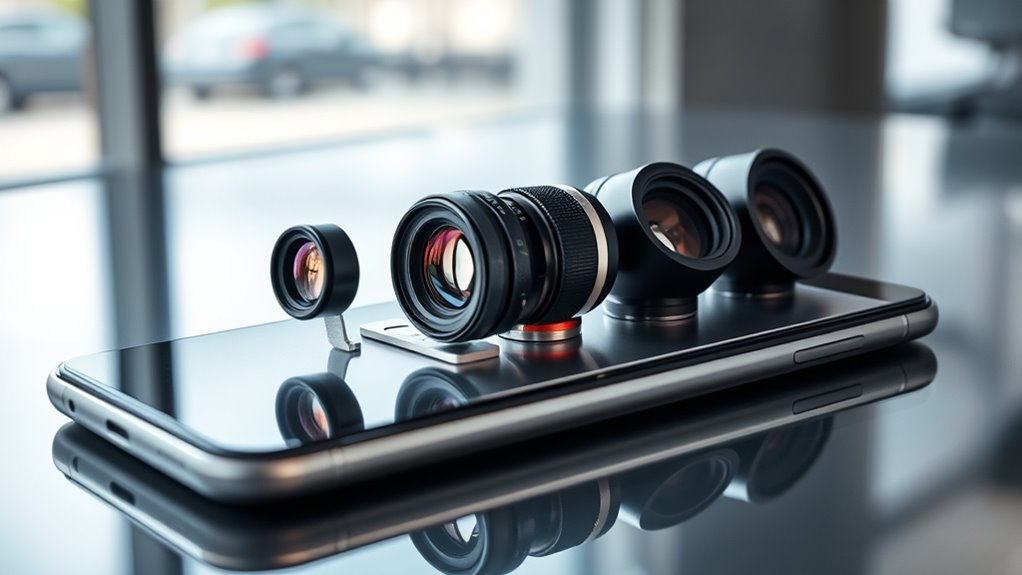
Multiple lenses on your smartphone work together to capture sharper, more detailed photos. Each lens is optimized with specialized coatings that reduce glare and lens flare, improving clarity and color accuracy. Additionally, different lenses often feature varying sensor sizes, which enhance photo quality depending on the scene. Larger sensors can gather more light, resulting in better low-light performance and richer images. Understanding how sensor size impacts image quality can help you make better photography choices. Moreover, the multi-lens system often includes software algorithms that seamlessly blend images from different lenses to produce a more balanced and dynamic final photo. Combining images from multiple lenses allows your phone to optimize each shot, whether you’re capturing a wide landscape or a close-up macro. This synergy ensures sharper details, more accurate colors, and improved depth perception. By leveraging lens coatings and sensor size differences, your smartphone’s multiple lenses work hand-in-hand to produce superior photos in a variety of conditions. Additionally, optical zoom capabilities benefit from multiple lenses, enabling closer shots without sacrificing image quality. Understanding the lens technology involved can also help you appreciate how your device adapts to different photographic situations. Furthermore, sensor technology advancements continually push the boundaries of mobile photography, allowing for even more versatile and high-quality images.
The Role of Wide-Angle and Ultra-Wide Cameras
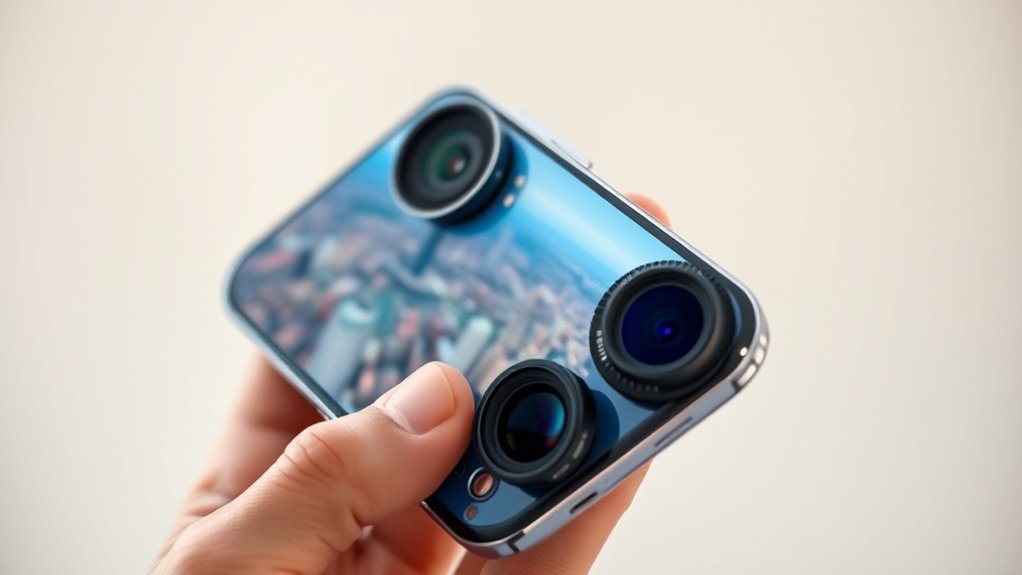
Wide-angle and ultra-wide cameras expand your smartphone’s perspective, allowing you to capture more of the scene in a single shot. These lenses typically feature a larger sensor size, which helps gather more light and improve image quality across different environments. The lens aperture also plays a pivotal role; a wider aperture lets in more light, making it easier to shoot clear photos even in challenging conditions. Ultra-wide cameras often have a smaller sensor size compared to main lenses, but they compensate with specialized optics to maintain sharpness across a broader field of view. By offering diverse perspectives and improved clarity, these cameras help you take stunning landscape shots, group photos, or creative shots that wouldn’t fit in a standard frame. Additionally, sensor size influences how much light is captured, impacting overall image brightness and quality in various settings. Understanding camera optics can help you make better choices for your photography needs. A deeper knowledge of training and behavior insights can also assist in capturing well-behaved and happy subjects. Recognizing how lens design affects image quality can further enhance your photography experience.
Enhancing Low-Light Photography With Multiple Sensors
When lighting conditions are poor, your phone’s ability to capture clear, detailed photos depends heavily on its sensors working together. Multiple sensors enhance low-light photography by combining data, allowing for better detail and brightness. Sensor calibration is vital here; it ensures each sensor’s output aligns perfectly, reducing noise and artifacts. Additionally, advanced image stabilization works with these sensors to minimize blurriness caused by hand movements, especially in dim settings. By intelligently merging images from different sensors, your phone can produce brighter, sharper photos even in challenging lighting. This multisensor approach effectively boosts low-light performance without sacrificing image quality. Proper sensor alignment is crucial in achieving seamless integration of data, leading to improved photo quality in low-light conditions. Furthermore, Sensor calibration involves fine-tuning each sensor to ensure consistent data collection, which is essential for optimal low-light results. Modern smartphones also employ multisensor processing techniques to further enhance image quality in difficult lighting, demonstrating how integrated sensor technology revolutionizes mobile photography. Additionally, precise calibration and sensor synchronization help in reducing color inconsistencies, ensuring more natural-looking images. Incorporating advanced algorithms further refines the merging process, enhancing overall image clarity. Ultimately, these techniques work seamlessly behind the scenes, giving you improved photos when lighting is less than ideal.
The Benefits of Telephoto Lenses in Smartphones
Telephoto lenses let you get closer to your subject without physically moving, giving you better zoom options. They also enhance portrait photos by creating a natural background blur that makes your subject stand out. With these lenses, your photos look more professional and detailed, even from a distance. Additionally, understanding the science behind smartphone camera technology can help you maximize the potential of your device’s multiple lenses. Recognizing passive voice detection techniques can further improve your writing clarity and effectiveness. Knowing about camera sensor fundamentals can also assist you in choosing the best lens setup for your needs. Exploring lens calibration methods can ensure your images are sharp and accurate across different camera modules. Moreover, familiarizing yourself with optical image stabilization can significantly reduce blurriness caused by hand movement.
Enhanced Zoom Capabilities
Thanks to telephoto lenses, your phone can zoom in closer without sacrificing image quality, making distant subjects appear sharp and detailed. This enhanced zoom capability relies heavily on sensor size; larger sensors capture more light, reducing noise and improving clarity at high zoom levels. Additionally, high-quality lens coatings minimize glare and reflections, ensuring your images stay crisp and vibrant even when zoomed in. The combination of a well-designed lens with a larger sensor allows you to get clearer, more detailed shots from afar. These features work together to deliver better results than digital zoom alone, giving you the power to capture distant scenes without losing quality. sensor size plays a crucial role in achieving optimal zoom performance and image clarity. With telephoto lenses, your phone transforms into a versatile tool for detailed, zoomed-in photography.
Improved Portrait Photography
Because telephoto lenses allow for greater separation between you and your subject, they substantially enhance portrait photography on smartphones. This separation creates a natural background blur, making your subject stand out sharply. Improved camera ergonomics also come into play, as telephoto lenses often enable steadier shots with less camera shake, especially when zoomed in. However, using these lenses can increase battery consumption, since they require more power to operate effectively. Despite this, the benefits of capturing professional-looking portraits outweigh the trade-offs, giving you clearer, more flattering images. With multiple cameras, your phone can switch seamlessly to the telephoto lens, allowing you to take detailed portraits without sacrificing convenience or image quality.
Depth Sensors and Portrait Mode Capabilities
Depth sensors play a crucial role in enhancing your phone’s camera capabilities, especially when it comes to portrait mode. They help create a more accurate separation between the subject and background, resulting in a natural blur effect. This technology also improves features like augmented reality, allowing virtual objects to interact seamlessly with your environment. Additionally, depth sensors enhance facial recognition by accurately mapping facial features for unblocking your phone or verifying identity. With precise depth data, your photos look more professional, and AR experiences feel more realistic.
- Improve background blur for professional-looking portraits
- Enable more accurate facial recognition
- Enhance augmented reality interactions
- Create better subject isolation in photos
- Support precise depth mapping for AR and security
Video Recording Enhancements Through Multiple Cameras

Multiple cameras on your phone work together to remarkably enhance video recording quality. Camera sensor advancements allow each lens to capture more detail and better handle challenging lighting conditions, resulting in clearer, more vibrant videos. When you record, the multiple lenses coordinate seamlessly, providing improved stabilization and smoother footage. Optical zoom improvements let you zoom in closer without sacrificing image quality, giving you more flexibility during filming. By combining data from different sensors, your phone can also achieve better dynamic range and color accuracy, making your videos look more professional. These enhancements mean you can capture high-quality videos in a variety of situations, from low light to distant scenes, all without needing external equipment. Overall, multiple cameras work together to make your video recordings sharper, more stable, and more visually stunning.
The Future of Multi-Lens Technology in Mobile Devices
Advancements in multi-lens technology are poised to transform the way your mobile device captures and processes images. Future innovations will enhance augmented reality experiences, making virtual objects seamlessly blend with real-world environments. Gaming performance will also benefit, as multi-lens systems improve real-time rendering and depth perception. Expect smarter cameras that adapt to different scenarios instantly. These enhancements could lead to:
Multi-lens tech will boost AR, gaming, and smarter camera capabilities for mobile devices.
- Better depth sensing for immersive AR applications
- Faster image processing for real-time gaming overlays
- More compact multi-lens modules with increased capabilities
- Enhanced low-light performance for clearer visuals
- Improved computational photography for richer, detailed images
As these technologies evolve, your phone will become more capable in both augmented reality and gaming, pushing the boundaries of what mobile devices can achieve.
How Multiple Cameras Impact Overall Phone Performance
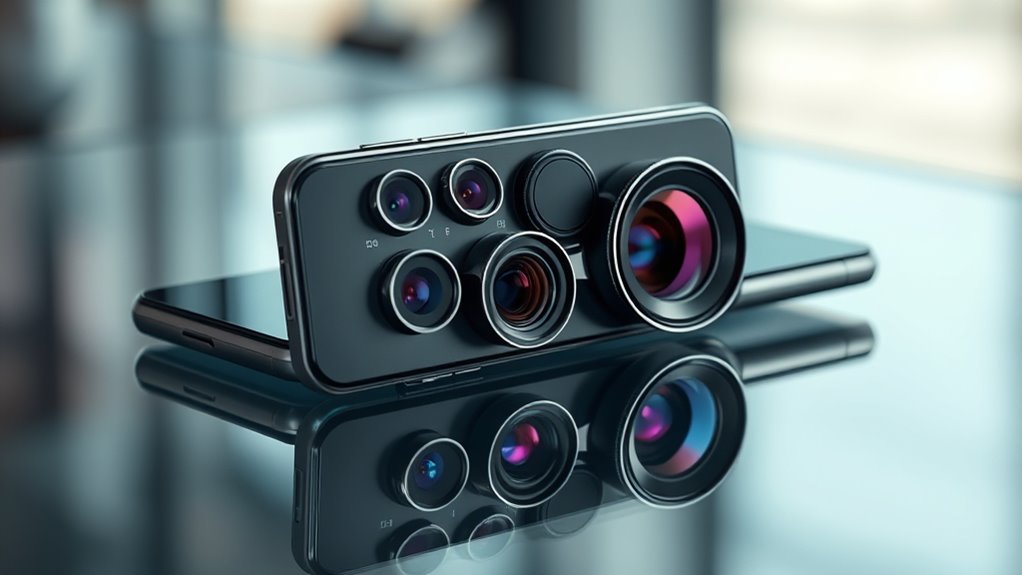
Having multiple cameras can boost your phone’s image quality and make photos clearer, even in tricky lighting. You’ll also notice faster processing speeds, so your apps run more smoothly. Plus, improved low-light capabilities let you capture better shots in dark environments without sacrificing detail.
Enhanced Image Quality
When your phone incorporates multiple cameras, it notably boosts image quality by capturing more detailed and accurate photos. Different cameras with specialized camera sensors and optimized lens calibration work together to improve clarity, color accuracy, and dynamic range. This synergy allows your device to handle various lighting conditions and scenes more effectively. You benefit from sharper images, richer colors, and better depth perception. Multiple cameras also enable you to take high-quality portraits with natural background blur and wide-angle shots without sacrificing detail. The combination of advanced camera sensors and precise lens calibration ensures each shot is optimized for quality. Overall, these enhancements give you professional-looking photos directly from your phone, elevating your photography experience considerably.
- Better low-light performance
- Improved color accuracy
- Enhanced depth perception
- Sharper images with finer details
- Superior overall photo quality
Faster Processing Speeds
Multiple cameras in your phone don’t just improve photos—they can also enhance processing speeds. When your device manages multiple lenses, it often uses advanced processors optimized for handling various camera data streams simultaneously. This efficiency can translate to smoother performance overall, reducing lag during multitasking. Additionally, faster processing helps conserve battery life because the phone completes tasks more quickly, reducing power drain. Higher screen resolution benefits from efficient processing, ensuring images load swiftly and display clearly without slowing down. By streamlining how your phone handles complex camera functions, manufacturers not only improve photo quality but also make everyday tasks more responsive. This synergy results in a more seamless user experience, with quicker app launches and smoother navigation—thanks to the intelligent processing behind those multiple cameras.
Improved Low-Light Shots
Thanks to multiple cameras, your phone can capture better low-light photos by combining data from different lenses. This technology improves image clarity without draining your battery excessively. Multiple sensors work together to gather more light, reducing noise and enhancing detail in dark environments. However, capturing more data can slightly impact battery life, so manufacturers optimize power use to maintain performance.
Keep in mind, as your phone processes more information, user privacy remains a priority; manufacturers ensure photos are stored securely. Multiple cameras also enable advanced features like night mode, making your low-light shots sharper and more vibrant. Overall, these innovations balance improved photo quality with efficient power management and privacy considerations, giving you better images without sacrificing your device’s performance.
Frequently Asked Questions
Do Multiple Cameras Drain Your Phone’s Battery Faster?
Yes, multiple cameras can drain your phone’s battery faster, but it depends on how you use them. When you switch between lenses or use features like zoom and HDR, your phone may consume more power. However, modern phones are designed with better power efficiency, so the impact is often minimal. To save battery, avoid constantly switching cameras or using intensive modes, especially when your battery is low.
Can Switching Between Lenses Be Automated or Manual?
You can switch between lenses on your phone either manually or automatically. Most phones offer user control, letting you select lenses manually through a camera app. Some devices also feature automatic lens switching, where the phone detects the scene and adjusts the lens accordingly. This seamless process enhances your photography experience, giving you flexibility whether you prefer to control your shots or let the phone handle lens selection for ideal results.
Are Multi-Camera Setups More Prone to Repair or Damage?
Multi-camera setups are slightly more prone to damage, with about 15% more repair costs than single-lens phones. The added lenses and complex mechanisms can compromise camera lens durability, making them vulnerable to scratches or cracks. Although they offer better photo versatility, you should be cautious, as repairs can be pricier. Proper protection like cases and avoiding drops helps extend their lifespan and keeps your multi-camera system functioning as effectively as possible.
How Do Camera Features Differ Across Smartphone Brands?
You’ll notice that camera features vary across smartphone brands thanks to lens versatility and brand innovation. Some brands focus on wide-angle, macro, or telephoto lenses, giving you more creative options. Others incorporate advanced software enhancements or unique sensor tech. These differences allow you to choose a device that best fits your photography style, making your photos sharper, more dynamic, and tailored to your preferences through continuous innovation.
Will Future Phones Eliminate the Need for Multiple Lenses?
Future phones might reduce the number of lenses, but they’ll still use advanced camera sensor sizes and lens apertures to improve photo quality. Instead of multiple lenses, manufacturers will focus on innovative sensor technology and smarter software to enhance clarity, depth, and low-light performance. So, while the lens count could drop, your phone will still deliver stunning images by optimizing sensor capabilities and aperture settings.
Conclusion
Think of your phone’s multiple cameras as a symphony, each lens playing a essential note to create a harmonious photo. Together, they elevate your photography from simple snapshots to stunning works of art. Embracing this technology means you’re not just capturing moments but composing visual stories with precision and depth. As cameras evolve, your device becomes a versatile artist’s toolkit—turning everyday scenes into masterpieces, one click at a time.