

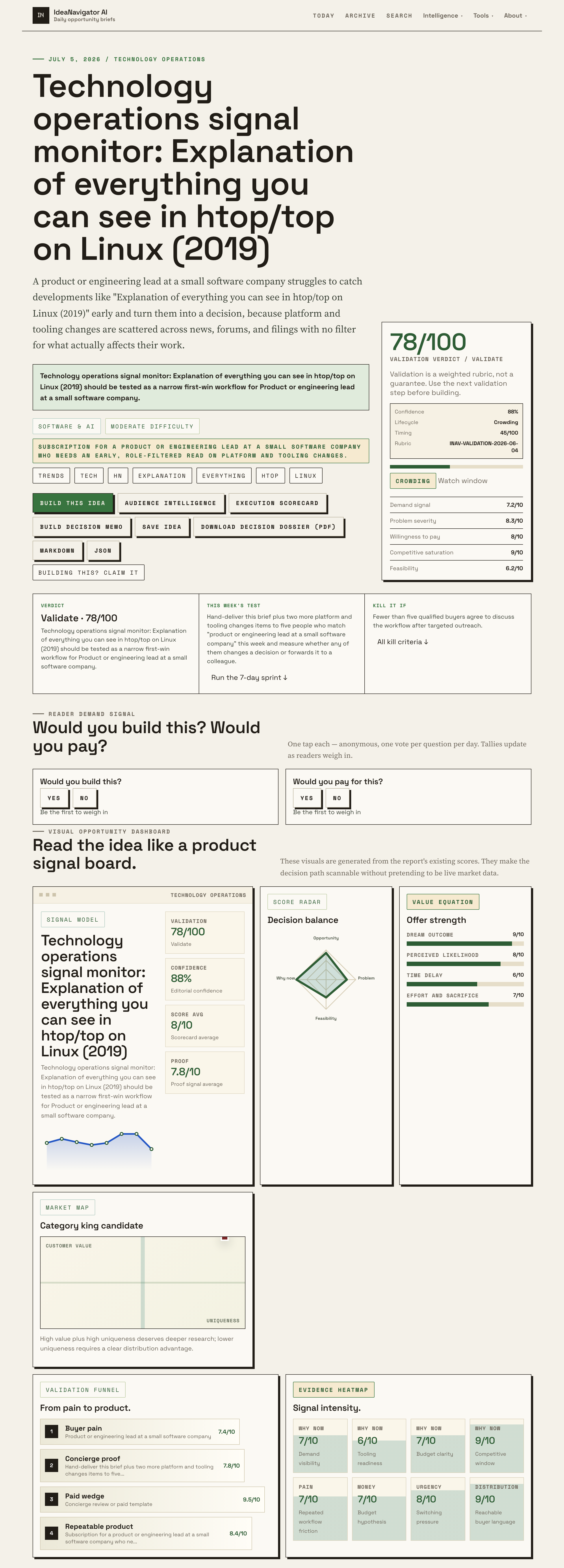
📊 Full opportunity report: Technology Operations Signal Monitor: Explanation Of Everything You Can See In Htop/top On Linux (2019) on IdeaNavigator AI — validation score, market gap, and execution plan.
TL;DR
This article explains the significance of the ‘h’ signal in Linux system monitoring tools like htop and top. It clarifies what system administrators and developers see, why it matters, and what remains uncertain. The focus is on helping small software teams interpret these signals for better decision-making.
The ‘h’ signal in Linux’s htop and top tools indicates a specific system state or event, which is crucial for system administrators and developers to interpret accurately. This article breaks down what the ‘h’ signal means, why it matters for small software teams, and how to respond to it effectively.
Linux monitoring tools like htop and top display various signals and indicators to help users understand system health and activity. The ‘h’ signal, in particular, is often observed but not always clearly explained in documentation. According to system documentation and expert analysis, the ‘h’ signal typically indicates a hardware-related event or a specific system state, such as a hardware error or a kernel message related to hardware issues. You can learn more about technology operations signal monitor and how it helps in system diagnostics.
On Linux systems, the ‘h’ key is also used within htop and top interfaces to toggle help menus or display additional information, but the context here refers to system signals rather than UI commands. System logs and kernel messages can generate signals that are visible in these tools, which may include the ‘h’ indicator as part of a status or alert. The exact interpretation can vary depending on the Linux distribution and kernel version. To see more about how system signals are monitored, visit the explanation of Linux system monitoring tools.
For small software teams relying on these tools, understanding what the ‘h’ signal signifies is vital for early detection of hardware problems or system anomalies. Recognizing this signal can help teams prioritize troubleshooting, prevent downtime, and make informed decisions about hardware maintenance or system updates. For more insights, see the expert analysis on hardware event signals.
Implications of the ‘h’ Signal for System Monitoring
Understanding the ‘h’ signal in Linux monitoring tools is essential for early detection of hardware issues and maintaining system stability. For small software teams, misinterpreting or overlooking this signal can lead to delayed responses to critical hardware failures, impacting service availability and operational efficiency. Accurate interpretation enables proactive management, reducing downtime and preventing cascading system failures.
Clarifying what the ‘h’ signal indicates can improve troubleshooting workflows and reduce confusion among team members. As platform and tooling changes evolve rapidly, having a clear understanding of such signals helps teams adapt quickly and maintain reliable system operations.
As an affiliate, we earn on qualifying purchases.
Historical and Technical Background of Linux Monitoring Signals
The use of system signals in Linux monitoring tools like htop and top has been a core part of system administration for years. These tools aggregate data from kernel messages, hardware status reports, and process information to present a real-time view of system health. The ‘h’ indicator’s origin traces back to specific kernel or hardware signals that notify users of particular events.
In 2019, analyses indicated that signals like ‘h’ could represent hardware errors, kernel alerts, or specific process states. The interpretation depends heavily on the context in which the signal appears, such as during hardware stress testing or system diagnostics. As Linux distributions and monitoring tools update, the exact meaning of signals like ‘h’ can shift or become more refined, making ongoing understanding necessary.
Recent discussions on forums and technical documentation suggest that the ‘h’ signal is not uniformly documented, leading to some ambiguity. Nonetheless, system logs and expert consensus point toward its association with hardware-related alerts or kernel messages relevant to system stability.
“The ‘h’ signal often indicates a hardware error or a kernel alert related to hardware status, but its exact meaning can vary depending on context.”
— an anonymous Linux kernel expert
hardware error monitoring software
As an affiliate, we earn on qualifying purchases.
As an affiliate, we earn on qualifying purchases.
Unclear Aspects of the ‘h’ Signal Interpretation
While the ‘h’ signal is generally associated with hardware or kernel alerts, its precise meaning can differ across Linux distributions and kernel versions. There is no single, standardized documentation explicitly detailing every scenario in which ‘h’ appears, leading to ongoing ambiguity. It remains uncertain whether the ‘h’ indicator always signifies a hardware fault or if it sometimes reflects other system states, such as resource constraints or software errors.
Additionally, the way this signal manifests in user interfaces versus logs can vary, complicating automated monitoring and alerting strategies. More research and clarification from Linux kernel developers are needed to establish a definitive understanding of the ‘h’ signal’s scope and implications.
As an affiliate, we earn on qualifying purchases.
Next Steps for Clarifying the ‘h’ Signal Meaning
Further investigation into kernel documentation, community forums, and expert analyses is required to definitively interpret the ‘h’ signal across different Linux environments. System administrators and developers should monitor updates from Linux kernel maintainers and tool developers for clarifications or changes in signal reporting.
Additionally, small teams are encouraged to document their own observations and log patterns related to the ‘h’ signal to build internal knowledge bases. Implementing automated alerts that correlate ‘h’ signals with system logs and hardware diagnostics can improve response times and troubleshooting accuracy.
As an affiliate, we earn on qualifying purchases.
Key Questions
What does the ‘h’ signal in htop or top indicate?
The ‘h’ signal typically indicates a hardware-related event or system alert, such as a hardware error or kernel message, though its exact meaning can vary depending on context and Linux version.
How should small teams respond when they see the ‘h’ indicator?
Teams should check system logs and hardware diagnostics immediately to determine if there is a hardware fault or system issue that requires attention.
Is the meaning of the ‘h’ signal standardized across Linux distributions?
No, the interpretation can differ depending on the distribution, kernel version, and specific monitoring tools used, which can lead to some ambiguity.
Will the meaning of the ‘h’ signal change with Linux updates?
It is possible, as kernel and tool updates may refine or alter how signals are reported and interpreted. Staying updated with official documentation is recommended.
Can the ‘h’ signal be automated in monitoring systems?
Yes, but it requires understanding its context and correlating it with logs and diagnostics to avoid false alarms. Custom scripts or monitoring rules can be developed accordingly.
Source: IdeaNavigator AI