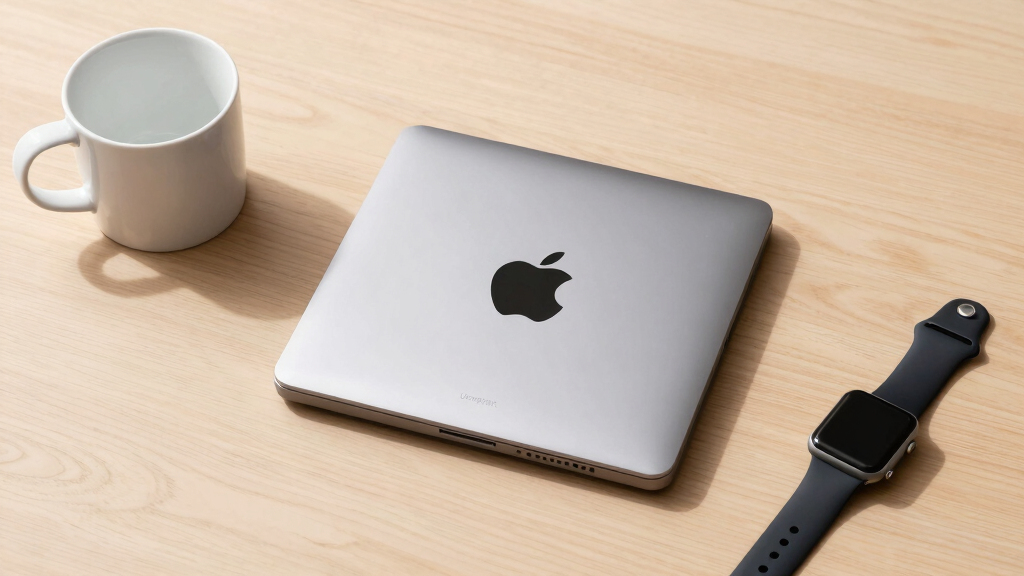

📊 Full opportunity report: Apple Silicon’s Quiet Memory Advantage on ThorstenMeyerAI.com — validation score, market gap, and execution plan.

Get the latest gadgets delivered free with Prime
- Fast, free delivery on millions of items
- Prime Video, Amazon Music and more included
- Member-only deals all year
TL;DR
Apple Silicon’s unified memory design allows consumer Macs to handle larger AI models than traditional GPUs, offering a capacity advantage. However, this comes with slower inference speeds and some recent hardware and pricing limitations.
Apple Silicon’s unified memory architecture provides a significant capacity advantage for running large AI models, enabling Macs to handle models exceeding 100GB of effective memory, a feat not possible with traditional discrete GPUs.
Unlike traditional PCs with separate system RAM and VRAM, Apple Silicon shares a single pool of physical memory accessible by both CPU and GPU. This design allows Macs with 64GB or more RAM to run large models—such as a 70-billion-parameter model—without the need for multi-GPU setups or external memory solutions, which are costly and complex.
While this architecture offers a clear capacity benefit, it does so at the expense of inference speed. Apple Silicon’s lower memory bandwidth results in slower token processing per second compared to NVIDIA GPUs. For example, a recent exploit on Apple M5 shows some of the hardware limitations affecting performance.
Recent industry-wide RAM shortages and supply chain issues have affected Apple, leading to the discontinuation of certain configurations and price increases. Despite the architectural advantage, Apple is not immune to the broader memory scarcity affecting component availability and pricing in 2026.
Apple Silicon’s quiet memory advantage
While the discrete-GPU world fought over 24GB of brutally expensive VRAM, a Mac quietly offered to run the big model on one silent, low-watt box. Not magic — but the rare place an architecture beats the squeeze.
Mac Studio 256GB holds a 70B at near-lossless Q8, or 200B+ at Q4 — no single GPU reaches that at any price. Win zone: 32–200B models at 10–30 tok/s for personal/dev use.
M5 Max ~614 GB/s vs RTX 4090’s 1,008. A 70B runs ~12–18 tok/s on M5 Max vs 40–50 on a 5090. You buy capacity, not raw throughput. Bandwidth & capacity matter — not FLOPs.
Apple turned a laptop-efficiency design — one shared memory pool — into the most elegant answer to the part of the squeeze that hurts most: capacity. Bonus: 25–90W vs a GPU rig’s 600–1,200, ~$35–55/yr to run 24/7 vs $300–400, and silent. Right for large models, privacy, low-power always-on; wrong for max speed on small models or heavy training. Next: Build, Rent, or Quantize.
Why Apple Silicon’s Memory Design Matters for AI
This architecture provides a practical, cost-effective solution for individuals and small teams needing to run large AI models locally. It enables access to models larger than what high-end consumer GPUs can handle, at a fraction of the cost and power consumption. This could shift the landscape of local AI deployment, especially for privacy-conscious users and developers.
However, the trade-off in inference speed means it’s less suitable for applications requiring rapid token processing or real-time responses. The design emphasizes capacity and efficiency over raw throughput, making it ideal for specific use cases like model development, offline inference, and personal AI experimentation.
Apple Silicon MacBook with 64GB RAM
As an affiliate, we earn on qualifying purchases.
As an affiliate, we earn on qualifying purchases.
Background on Memory Architecture and Industry Trends
Traditional PCs rely on separate pools of system RAM and GPU VRAM, with performance bottlenecks when models exceed VRAM capacity, causing significant slowdowns. Apple Silicon’s unified memory approach, first introduced in Macs, shares the same physical memory between CPU and GPU, allowing larger models to run without external memory or multi-GPU setups.
In 2026, the industry faces a memory shortage driven by supply chain constraints and rising RAM prices. Apple, which had previously benefited from long-term memory contracts, has had to withdraw certain configurations and raise prices, reflecting the broader market squeeze. Despite these issues, Apple’s design remains a unique solution for large-model AI workloads in consumer devices.
“Apple’s unified memory architecture allows Macs to handle models exceeding 100GB of effective memory, a feat not feasible with traditional discrete GPUs.”
— Thorsten Meyer
As an affiliate, we earn on qualifying purchases.
Remaining Questions on Performance and Market Impact
It is not yet clear how widespread adoption of Apple Silicon for AI workloads will be, given its slower inference speeds. The long-term impact on the AI hardware market and whether Apple can sustain its capacity advantage amid ongoing supply constraints remains uncertain.
external memory expansion for Apple Silicon
As an affiliate, we earn on qualifying purchases.
As an affiliate, we earn on qualifying purchases.
Future Developments in Apple Silicon AI Capabilities
Further updates from Apple are expected, potentially including new hardware configurations with increased bandwidth or memory options. Monitoring how the industry responds to these capacity advantages and whether competitors develop similar unified memory approaches will be key in the coming months.
As an affiliate, we earn on qualifying purchases.
Key Questions
Can Apple Silicon replace high-end NVIDIA GPUs for AI work?
It depends on the use case. Apple Silicon excels in handling large models with high capacity but offers lower inference speeds, making it suitable for specific applications like offline inference and model development, not real-time processing.
What are the limitations of Apple Silicon’s unified memory approach?
The main limitation is lower memory bandwidth, which results in slower token processing speeds compared to discrete GPUs, especially for inference tasks requiring rapid throughput.
Will Apple Silicon’s capacity advantage grow in the future?
It is uncertain. Future hardware updates may improve bandwidth and memory capacity, but supply chain constraints and industry-wide shortages could impact availability and performance enhancements.
Is Apple Silicon’s approach more cost-effective?
Yes, for large AI models, it offers a more affordable and power-efficient solution than multi-GPU setups, especially for individual users and small teams.
Source: ThorstenMeyerAI.com
Fall Picks
fall essentials
As an affiliate, we earn on qualifying purchases.