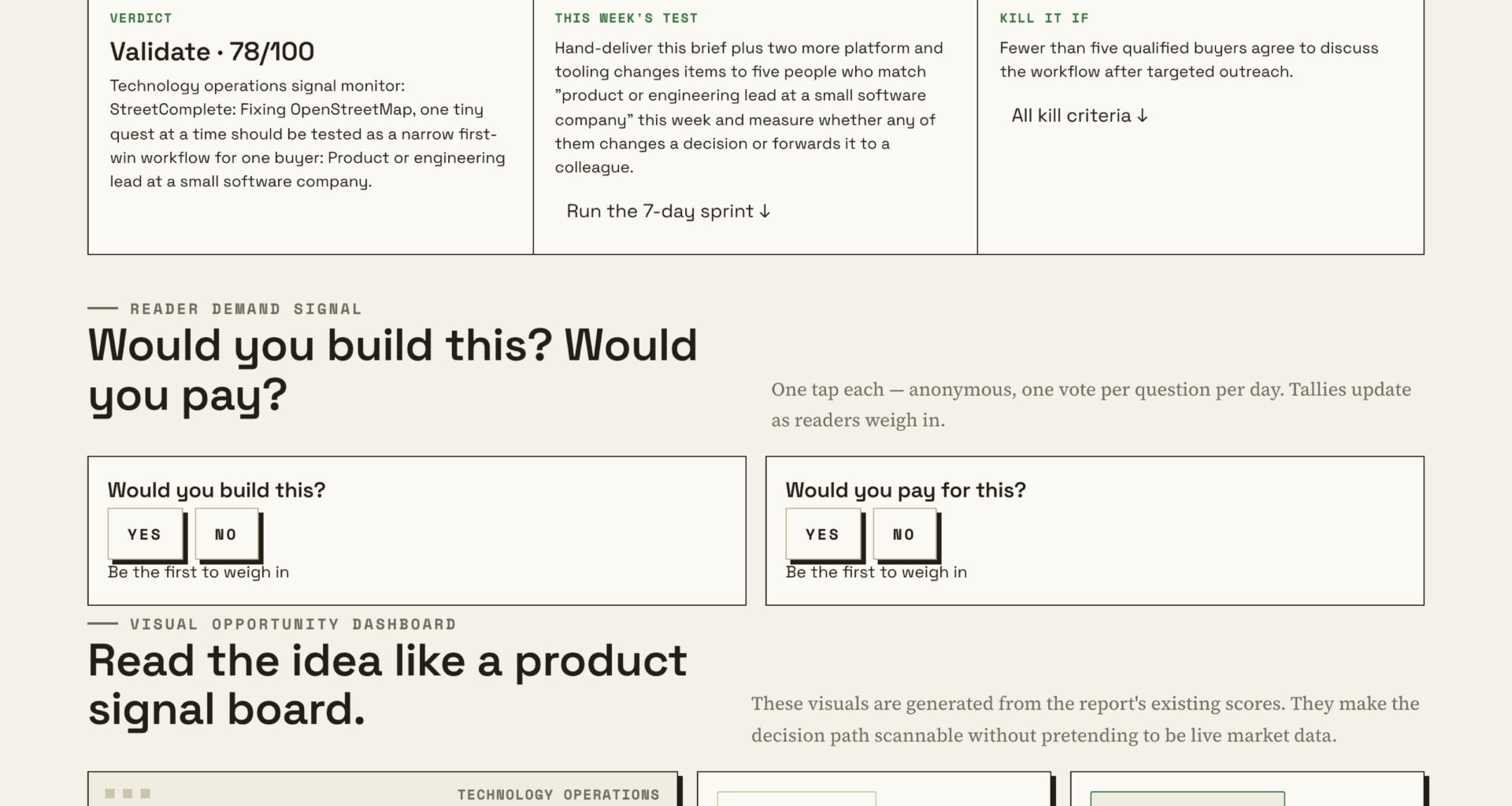

📊 Full opportunity report: How StreetComplete Connects Everyday Exploration With OpenStreetMap on IdeaNavigator AI — validation score, market gap, and execution plan.

Get the latest gadgets delivered free with Prime
- Fast, free delivery on millions of items
- Prime Video, Amazon Music and more included
- Member-only deals all year
TL;DR
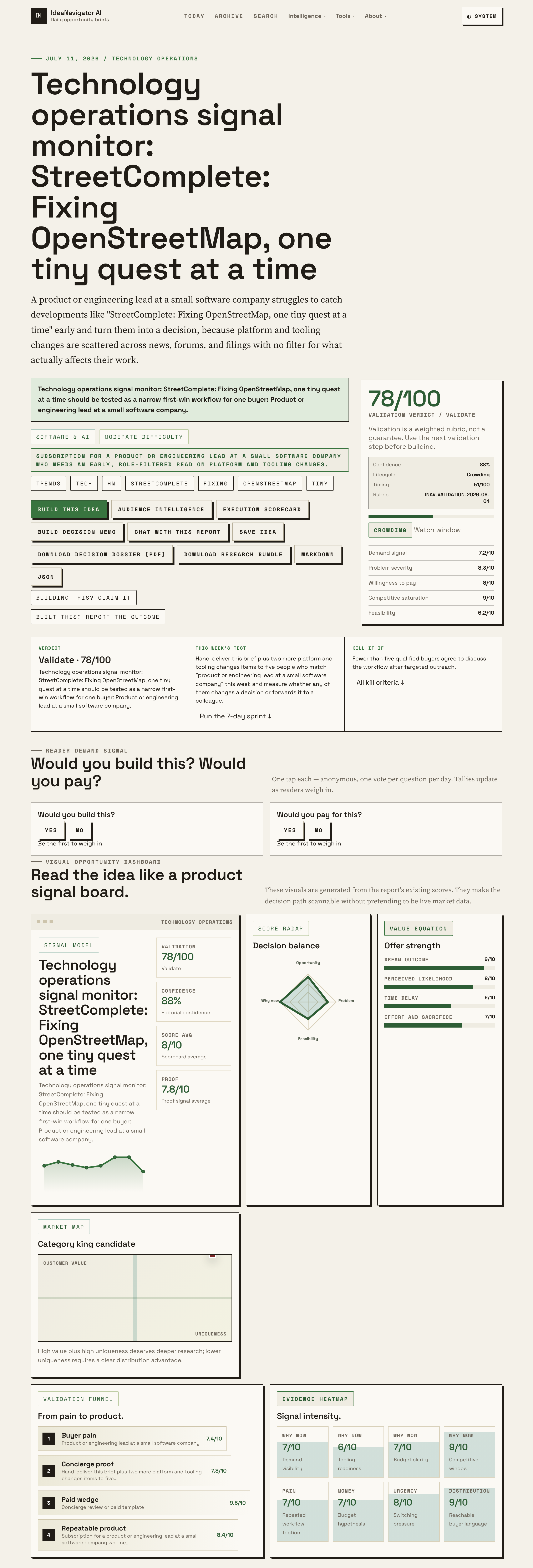
IdeaNavigator AI proposes testing a subscription monitor that turns platform and tooling developments into short briefs for product and engineering leads at small software companies. StreetComplete is the example item, but the material does not document a new StreetComplete announcement or verify the stated Hacker News signal score.
IdeaNavigator AI has proposed testing a focused technology monitor for product and engineering leads at small software companies, using an item about StreetComplete and OpenStreetMap as an example. In the supplied proposal, the service would turn relevant platform and tooling developments into briefings about what changed, why it matters and what a reader might do; the material does not report a new StreetComplete release or feature.
According to IdeaNavigator AI’s proposal, the suggested minimum product would watch Hacker News and similar feeds, then filter items for developments likely to affect the work of a small-company product or engineering lead. Each selected item would become a short decision brief, rather than a general technology roundup. The proposal presents the StreetComplete item as one possible briefing topic, not as evidence that the app has just changed.
The proposal says Hacker News surfaced the item with an 88/100 signal. It does not explain how that score was calculated, what scale or comparison it uses, or when the score was recorded. It should be read as a score reported by the proposal, not as a measure of audience interest or proof that the topic changed a business decision.
For validation, IdeaNavigator AI recommends hand-delivering the StreetComplete brief and two other platform or tooling items to five people in the target role during the week, then tracking whether a recipient changes a decision or forwards a brief to a colleague. The proposal describes a subscription for early, role-filtered coverage as the business model. It includes no interviews, conversion results, pricing, product launch or customer commitments.
Testing a Narrow Briefing Service
IdeaNavigator AI’s proposal centers on a familiar operational problem: product and engineering leads can encounter relevant changes across scattered feeds, yet still have to decide which deserve attention. A service that reliably connects a development to a reader’s responsibilities could save time and help teams notice changes earlier. Whether it does so depends on relevance, accuracy and timing, not simply on finding more links.
The proposal’s suggested test is small enough to examine those assumptions directly. A recipient forwarding a brief or changing a decision would be a useful early signal, but five hand-delivered examples would not establish broad demand or subscription viability. The test would need to record what readers actually did and why, including when an item was interesting but had no practical consequence.
The StreetComplete example in the proposal also illustrates a possible boundary for the product: a topic can be relevant to mapping, open data or software tools without affecting every small company. The monitor’s value would rest on explaining that connection accurately, and on leaving out items whose relevance cannot be established. A role-specific filter matters only if it improves the quality of decisions compared with a reader’s existing feeds.
StreetComplete as the Example Item
IdeaNavigator AI’s proposal frames StreetComplete as an item about fixing OpenStreetMap one small quest at a time. The supplied material gives no publication date, linked product announcement, version details or description of a particular change. Its wording identifies the example topic but does not establish what happened to the app or when.
The proposal presents OpenStreetMap as a collaborative mapping project and StreetComplete in connection with contributing map information through small tasks. That subject offers a concrete test of whether a general technology feed can be translated into a concise briefing for a particular job. However, the proposal does not specify how a mapping-app development would affect a product or engineering lead at a small software company. That relevance would have to be explained in the brief or established with readers.
The wider concept in the proposal is a technology operations signal monitor, rather than a report on a new mapping feature. Its suggested input is Hacker News and comparable feeds; its intended output is a short, actionable summary. The material names no feeds beyond those examples, describes no filtering method, and provides no existing service or user results. Those details remain part of the idea to test.
No Product Change Is Specified
The supplied proposal does not identify a dated StreetComplete announcement, release, developer statement or change to OpenStreetMap. It also provides no link to the Hacker News discussion and does not explain the stated 88/100 score. On the information provided, readers cannot determine what the item was based on, how recently it appeared or whether the score reflects a consistent measurement.
For the monitor concept, the proposal leaves open which sources it would cover, how it would decide that an item matters to a specific role, how it would handle uncertain claims and how much human review each brief would require. It gives no evidence that the recommended five readers have been approached, that anyone has acted on a briefing, or that prospective customers would pay. Demand and usefulness remain untested.
A Five-Reader Validation Test
IdeaNavigator AI proposes preparing three briefs, including the StreetComplete example, and delivering them to five product or engineering leads at small software companies during the week. The proposal recommends capturing whether recipients forward a brief or make a decision differently, along with their reasons. It gives no calendar date for the test and does not report that it has begun.
If recipients respond, the proposed follow-up is to identify which details made a brief useful and whether the same approach works across the other two items. A subscription proposition would require further evidence about repeat use and willingness to pay; neither is established by a one-week hand-delivery exercise. Until results are available, the monitor remains a product hypothesis, and the StreetComplete reference remains an example rather than a reported product development.
Key Questions
Has StreetComplete announced a new feature?
The IdeaNavigator AI proposal does not describe a new StreetComplete feature, release or dated announcement. It uses an item about the app and OpenStreetMap as an example for a monitoring service.
What is the proposed monitor meant to do?
According to the proposal, it would track Hacker News and similar feeds, filter developments for product and engineering leads at small software companies, and turn relevant items into short decision briefs.
What does the 88/100 signal score mean?
The proposal reports that score but does not explain its method, baseline or timing. It cannot establish how much interest the item received or whether it affected anyone’s work.
Has the subscription idea been validated?
The proposal provides no results. Its suggested first test is to send three briefs to five people in the target role and measure whether they forward a brief or change a decision.
Source: IdeaNavigator AI
Fall Picks
fall essentials
As an affiliate, we earn on qualifying purchases.



![Rails World 2026 Opening Keynote [Video]](https://gadgetfee.com/wp-content/uploads/2026/09/rails-world-2026-opening-keynote-video-featured-560x300.jpg)