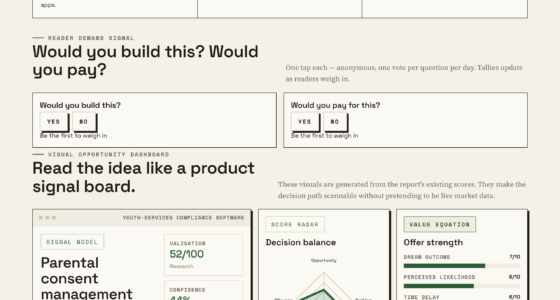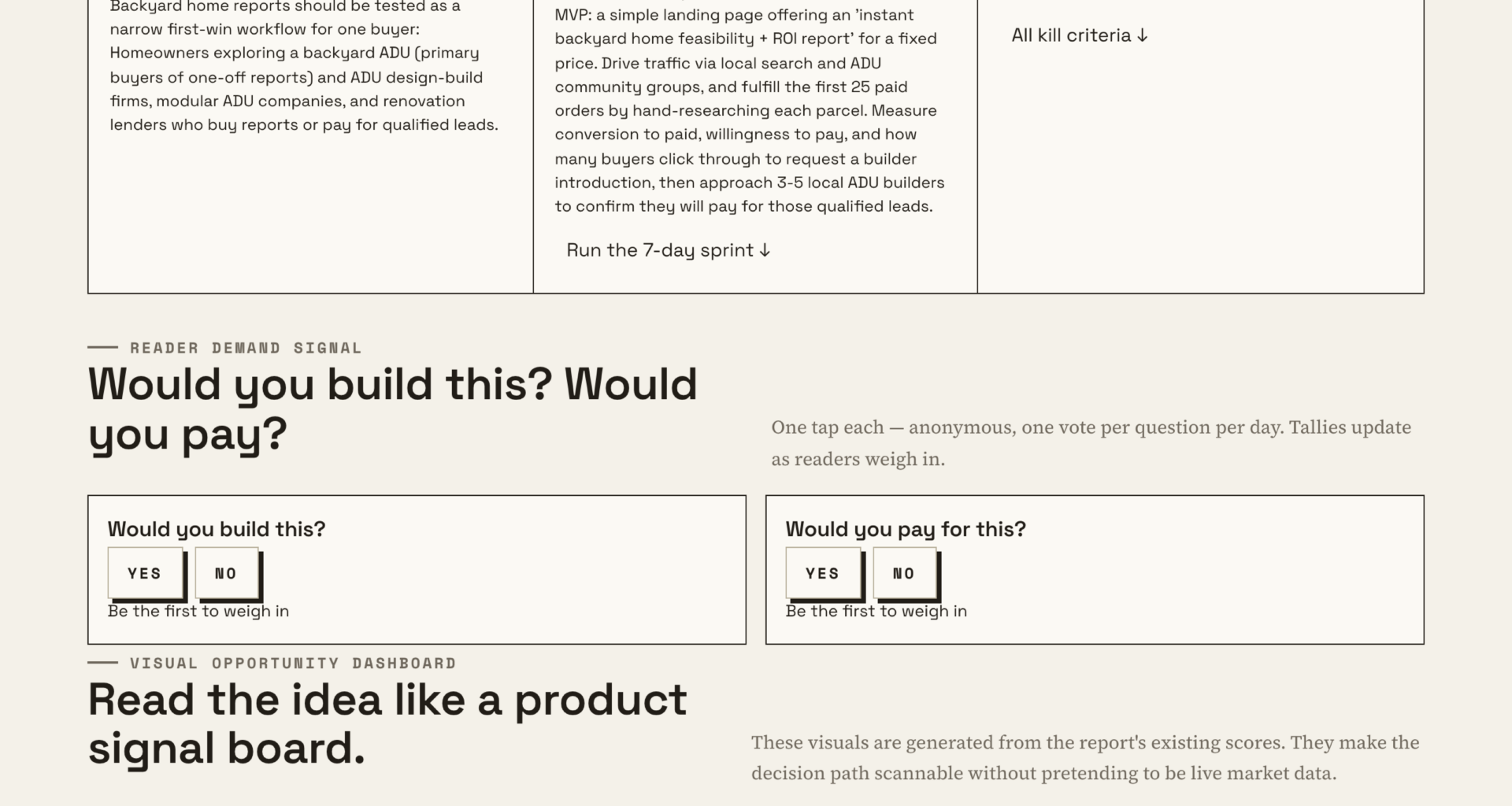
📊 Full opportunity report: Backyard Home Development Across The US on IdeaNavigator AI — validation score, market gap, and execution plan.

Get the latest gadgets delivered free — and shop member deals
- Fast, free delivery on millions of items
- Access to Prime Big Deal Days deals on October 6–7
- Prime Video, Amazon Music and more included
TL;DR
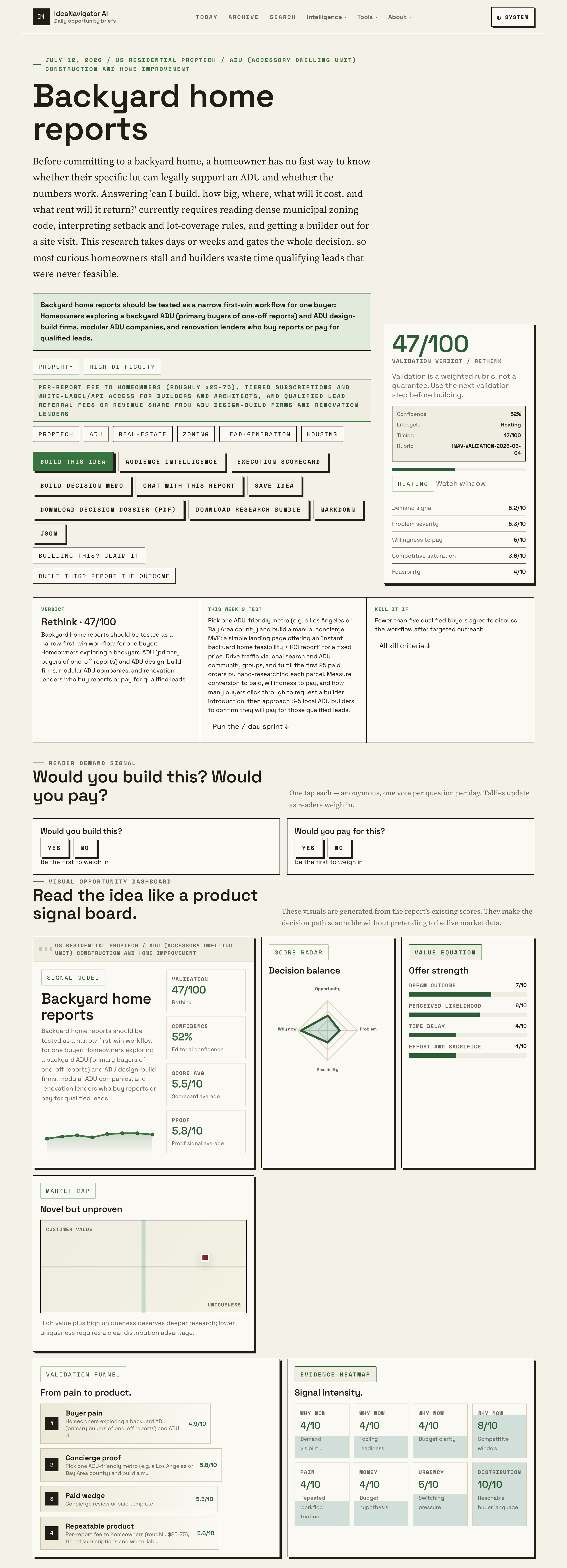
IdeaNavigator AI has published an analysis proposing instant, per-address backyard home feasibility reports as a new product category for the US ADU market. The report cites surging ADU permitting — including over 45,000 ADUs permitted in Los Angeles County in 2023 — and says parcel data and LLM-based zoning tools now make such reports practical.
A new market analysis from IdeaNavigator AI proposes instant backyard home feasibility reports — paid, per-address PDF assessments that tell homeowners whether their lot can legally support an accessory dwelling unit (ADU) and whether the financials work — as a timely new product category in US residential proptech. The analysis points to a sharply expanded ADU market, with Los Angeles County alone permitting over 45,000 ADUs in 2023 and ADUs now accounting for roughly one in five new housing units produced in California, and argues that mature parcel data and LLM-based zoning-code parsing have only recently made such reports feasible to generate at scale.
The analysis identifies two customer groups. The primary buyers are individual homeowners exploring a backyard ADU, who would pay a one-off fee of roughly $25–75 for a report. The second group consists of businesses that would buy reports in bulk or pay for qualified leads: ADU design-build firms, modular ADU companies, and renovation lenders.
The core problem the analysis targets is the research bottleneck. Before committing to a backyard home, a homeowner currently has no fast way to know whether their specific lot can legally support an ADU and whether the numbers work. Answering the questions ‘can I build, how big, where, what will it cost, and what rent will it return?’ requires reading dense municipal zoning code, interpreting setback and lot-coverage rules, and scheduling a builder site visit. According to IdeaNavigator AI, this research takes days or weeks and gates the entire decision — most curious homeowners stall, and builders waste time qualifying leads that were never feasible.
The proposed minimum viable product is a web app where a homeowner enters a property address and pays for a homeowner-ready PDF report. The report would ingest county parcel data — lot boundaries, lot size, and existing footprint — and evaluate the lot against state ADU law plus a manually curated rule set for one launch market, such as a few California counties. Each report would cover allowed ADU types, maximum size, setback and lot-coverage constraints, a buildable-area estimate, a realistic build-cost band, and projected rental income drawn from local rent comps. A ‘connect me with a vetted ADU builder’ button would capture lead-generation revenue alongside per-report fees. Additional revenue streams proposed include tiered subscriptions and white-label or API access for builders and architects.
Why Feasibility Reports Fit the ADU Moment
The analysis matters because it targets a friction point at the front of a fast-growing housing segment. Since California legalized ADUs statewide in 2016 and loosened rules nearly every year since, other states and cities have followed, and permitting volumes have surged. ADUs now represent roughly one in five new housing units in California, according to the analysis — a scale at which even small per-household decision costs add up to a real market.
The proposed product also sits at the intersection of two larger trends: a persistent US housing shortage estimated in the millions of units, and the maturing of two technical building blocks — parcel and zoning data, and LLM-based parsing of legal code. The analysis argues this combination is what makes instant per-address reports newly practical rather than merely possible, a claim that distinguishes the current moment from earlier, more manual feasibility services.
For builders and lenders, the value proposition is lead quality rather than consumer convenience: if a report filters out infeasible lots before a site visit, firms spend less time qualifying prospects that were never viable. Whether that efficiency gain justifies paying for leads is, per the analysis itself, something to be tested rather than assumed.
California’s ADU Legalization Wave
California legalized accessory dwelling units statewide in 2016 and has loosened restrictions nearly every year since, according to the analysis, reducing barriers such as parking requirements, size caps, and owner-occupancy rules. Other states and cities have been following California’s lead, expanding the addressable market for ADU-related services beyond the West Coast.
The permitting surge has been concentrated in major California metros: Los Angeles County alone permitted over 45,000 ADUs in 2023, as stated in the analysis. This concentration is why the proposed validation plan targets ADU-friendly metros — specifically a Los Angeles or Bay Area county — rather than a national launch. The broader backdrop is a US housing shortage the analysis estimates in the millions of units, which has increased policy and consumer interest in adding density to existing single-family lots.
What the Analysis Leaves Unproven
The IdeaNavigator AI analysis is a business opportunity assessment, not a validated business, and no company, product, or paying customers are identified in it. Several key assumptions remain untested. It is not yet established that homeowners will actually pay $25–75 for a feasibility report, or at what conversion rate — the analysis itself treats willingness to pay as something to measure, not a given.
Second, the accuracy of curated rule sets against dense and frequently changing municipal codes is unverified at scale. California’s ADU rules have changed nearly every year since 2016, which cuts both ways: it creates demand for up-to-date analysis but also means any curated rule set requires ongoing maintenance, and errors in a paid report could carry liability.
Third, whether ADU builders and lenders will pay for qualified leads — and at what price — is explicitly listed as an open validation question in the analysis, to be tested by approaching 3–5 local ADU builders after early customer data is collected. Projected rental income figures in such reports would also depend on local rent comps whose quality varies by market.
The Recommended Validation Path
The analysis prescribes a deliberately manual first step: launch in one ADU-friendly metro, such as a Los Angeles or Bay Area county, with a simple landing page offering an ‘instant backyard home feasibility + ROI report’ at a fixed price. Traffic would come from local search and ADU community groups, and the first 25 paid orders would be fulfilled by hand-researching each parcel rather than by automated tooling.
The metrics to watch, per the analysis, are conversion to paid, willingness to pay, and how many buyers click through to request a builder introduction. If those numbers hold up, the next milestones would be approaching 3–5 local ADU builders to confirm demand for paid qualified leads, then expanding curated coverage to additional counties and automating the zoning-rule ingestion. Until such a launch happens, the market opportunity described remains a well-reasoned hypothesis rather than a demonstrated business.
Source: IdeaNavigator AI
Key Questions
What is a backyard home feasibility report?
It is a proposed paid report, generated from a homeowner’s property address, that assesses whether a lot can legally support an ADU and whether the finances work — covering allowed ADU types, maximum size, setback and lot-coverage constraints, buildable area, estimated build cost, and projected rental income based on local rent comps.
Why is this idea considered timely now?
According to the IdeaNavigator AI analysis, three factors converged: California’s post-2016 ADU legalization and annual rule-loosening, a permitting surge that included over 45,000 ADUs permitted in Los Angeles County in 2023, and the maturing of parcel/zoning data plus LLM-based code parsing, which makes instant per-address analysis newly practical.
How much would a report cost a homeowner?
The analysis proposes a one-off fee of roughly $25–75 per homeowner report, with additional revenue from tiered subscriptions, white-label or API access for builders and architects, and referral fees or revenue share from ADU design-build firms and renovation lenders.
Does this product exist today?
No product, company, or paying customers are identified in the analysis. It is a business opportunity assessment with a recommended validation plan — a manual concierge launch in one metro, fulfilling the first 25 paid orders by hand — that has not been reported as executed.
Who benefits besides homeowners?
ADU design-build firms, modular ADU companies, and renovation lenders. The analysis argues these businesses currently waste time qualifying leads that were never feasible, and could pay for pre-screened, qualified homeowner leads or bulk access to feasibility reports.
Source: IdeaNavigator AI
Fall Picks
fall essentials
As an affiliate, we earn on qualifying purchases.