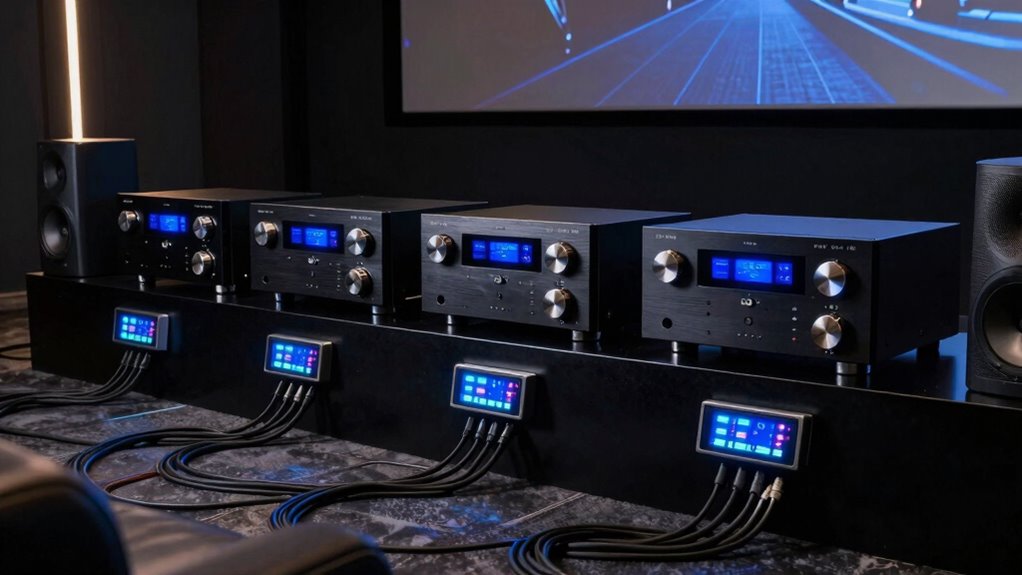

If you’re searching for an AV receiver with 112 channels, you’re likely aiming for the ultimate home theater experience. The best options balance power, connectivity, and future-proof features like 8K support, but they come with tradeoffs such as higher cost or complexity. The Denon AVR-X1700H stands out for its solid performance and user-friendly HEOS integration, while the Sony STR-AZ5000ES offers premium build quality and advanced features for demanding setups. Keep reading to see how these models compare and which one might fit your needs best.

Get the latest gadgets delivered free with Prime
- Fast, free delivery on millions of items
- Prime Video, Amazon Music and more included
- Member-only deals all year
Complete the kit



Key Takeaways
- Higher channel counts typically mean more immersive surround sound, but they also increase complexity and cost.
- Premium models like Sony ES and Marantz offer advanced features and build quality for dedicated home theater enthusiasts.
- Budget-friendly options such as Yamaha RX-V385 focus on essential features, making them ideal for simpler setups or newcomers.
- Connectivity options like Wi-Fi, Bluetooth, and multi-room support are common in higher-end models, providing versatile integration.
- Power output per channel varies widely; higher wattage isn’t always necessary unless you have large or demanding speakers.


More Details on Our Top Picks
Denon AVR-X1700H 7.2 Channel AV Receiver – 80W/Channel, Built-in HEOS
This model stands out for its support of the latest 8K and 4K/120Hz video standards, making it a future-proof choice for those upgrading their setups. Compared with the Onkyo TX-NR6100, it offers a more user-friendly interface, but it still requires a complex setup that might challenge beginners. Its support for Dolby Atmos and DTS:X elevates the audio experience, especially when paired with a compatible speaker system. The built-in HEOS streaming simplifies multi-room audio, although its advanced features may be more than casual viewers need. For users seeking a balance of modern features and ease of use, this makes a compelling case, despite the steep learning curve.
Pros:- Supports 8K/60Hz and 4K/120Hz pass-through for future-ready video
- Dolby Atmos and DTS:X support create immersive soundscapes
- Built-in HEOS for seamless multi-room streaming
- Advanced voice control options
Cons:- Setup can be challenging for beginners
- High-end features may be unnecessary for casual users
- Complex menu system can be overwhelming
Best for: Home theater enthusiasts who want a feature-rich receiver with multi-room streaming and future-proof video capabilities.
Not ideal for: Casual viewers or those new to AV receivers who prefer simple plug-and-play setups without extensive configuration.
- Power Output:80W per channel
- Channels:7.2
- HDMI Inputs:6
- HDMI Outputs:1
- Supports:8K/60Hz, 4K/120Hz pass-through, HDR10+, Dolby Vision, eARC
- Audio Formats:Dolby Atmos, DTS:X, DTS Virtual:X
Our verdict“This receiver suits tech-savvy home theater lovers seeking comprehensive features, despite its setup complexity.”
Sony STR-AZ5000ES 11.2 Channel 8K A/V Receiver (Renewed)
This premium Sony model excels with its extensive connectivity, supporting 11.2 channels and 8K HDMI pass-through, making it ideal for large, dedicated home theaters. Compared with the Sony STR-AZ5000ES Premium ES, the renewed version offers the same robust features but may come with limited warranty or wear concerns. Its support for Dolby Atmos, DTS:X, and IMAX Enhanced ensures immersive audio, while multiple HDMI ports facilitate complex setups. Its compatibility with smart home devices like Google Assistant and Apple AirPlay adds convenience, though the complex installation process can be daunting for those unfamiliar with high-end AV gear. If your priority is a powerful, flexible, and expandable system, this is a prime choice.
Pros:- Supports 8K HDMI with high bandwidth for advanced video
- 11.2 channels with Dolby Atmos and DTS:X for immersive sound
- Flexible connectivity including Bluetooth, Wi-Fi, Chromecast, and AirPlay
- Designed for custom integration and smart home compatibility
Cons:- Setup can be complex and require technical expertise
- Premium price may be prohibitive for some buyers
- Renewed product might have limited warranty
Best for: Home theater builders and audiophiles wanting a high-capacity, expandable system with smart integration.
Not ideal for: Casual users or small spaces where a more compact or straightforward receiver suffices, due to its size and complexity.
- Channels:11.2
- Power:130W per channel
- HDMI Ports:9
- Supports:8K & 4K/120 HDMI
- Supported Formats:Dolby Atmos, DTS:X, Dolby Vision, HDR10, IMAX
- Connectivity:Bluetooth, Wi-Fi, Chromecast, AirPlay
Our verdict“This receiver is ideal for users who want a high-performance, expandable system with smart home features, despite its complexity and cost.”
Sony STR-AZ5000ES Premium ES 11.2-Channel 8K A/V Receiver
This Sony flagship model offers extensive support for immersive audio formats and multiple HDR standards, making it a top option for premium home theaters. It supports 11.2 channels and 8K HDMI with HDMI 2.1, matching the specifications of the Onkyo TX-NR6100 but with a more refined build and enhanced calibration options. Its robust connectivity, including Bluetooth, Wi-Fi, Chromecast, and AirPlay, allows seamless integration into complex setups. While setup can be intricate, the advanced calibration features help optimize sound for large rooms. The absence of a specified price and potentially heavy design could limit its appeal for more compact or budget-conscious installations. It’s best suited for dedicated AV enthusiasts seeking a high-end, customizable experience.
Pros:- Supports Dolby Atmos, DTS:X, Dolby Vision, HDR10, and IMAX Enhanced
- Multiple HDMI 2.1 ports support 8K & 4K/120Hz
- Flexible connectivity with streaming and control options
- Enhanced calibration for optimal sound in large rooms
Cons:- Setup may require professional assistance
- No specific price info limits accessibility
- Heavy and potentially bulky for smaller spaces
Best for: Experienced installers and audiophiles wanting a premium, comprehensive AV solution with smart home compatibility.
Not ideal for: Entry-level buyers or those with limited space due to its potentially bulky design and complex setup.
- Channels:11.2
- Power per Channel:130W
- HDMI Ports:9
- Supports:8K & 4K/120 with HDMI 2.1
- Supported Formats:Dolby Atmos, DTS:X, Dolby Vision, HDR10, IMAX
- Wireless Tech:Bluetooth, Wi-Fi, Chromecast, AirPlay
Our verdict“Ideal for dedicated AV aficionados seeking a high-end, fully customizable system, despite its installation complexity.”
Pioneer VSX-935 7.2 Channel Surround Sound Network Receiver with Dolby Atmos
The Pioneer VSX-935 combines Dolby Atmos support with HDMI 2.1 and 8K capabilities, making it well-suited for gamers and movie lovers who want solid performance without the premium price of flagship models. It offers 7.2 channels with 80W per channel, which is sufficient for most home theaters, but falls behind the power levels of the Onkyo TX-NR6100 or Sony ES models. Its multiple HDMI ports and support for streaming services like TuneIn enhance versatility, though it lacks detailed speaker calibration features found in higher-end units. This pick balances features and affordability, making it a good choice for users who want immersive sound and high-quality video support without overpaying for unnecessary extras.
Pros:- Supports Dolby Atmos for immersive audio
- HDMI 2.1 with 8K support for modern gaming and streaming
- Multiple HDMI ports for flexible connections
- Wireless streaming options including Bluetooth and Wi-Fi
Cons:- Limited speaker calibration features
- Wattage per channel is moderate, less suited for large rooms
- Setup may be complex for non-technical users
Best for: Mid-range home theater enthusiasts and gamers seeking Dolby Atmos and HDMI 2.1 support at a reasonable price.
Not ideal for: Audiophiles or large room setups needing maximum power and detailed calibration.
- Channels:7.2
- Output Power:80W
- HDMI Version:HDMI 2.1
- Supports:8K & 4K/120Hz
- Supported Services:TuneIn
- Connectivity Technology:Bluetooth, Wi-Fi
Our verdict“This receiver offers a strong mix of gaming-ready features and modern video support for users on a budget, with some compromises on power and calibration details.”
Yamaha AVENTAGE RX-A8A 11.2-Channel Surround Sound Network AV Receiver with MusicCast, Wi-Fi, and Bluetooth
The Yamaha AVENTAGE RX-A8A stands out for its powerful 150W per channel output and support for Dolby Atmos and DTS:X, making it ideal for those seeking a truly immersive experience. Its support for advanced video formats like 4K/120 and 8K/60 pass-through surpasses many competitors, ensuring future-proofing. Unlike the Marantz AV7706, which is more focused on audio calibration and multi-room streaming, the RX-A8A offers broader connectivity options and voice control via Google Assistant, making it more versatile for a range of users. However, its size and complexity may pose challenges for beginners, and the premium price might be a barrier for some.
Pros:- Powerful 150W per channel with Dolby Atmos and DTS:X support
- Supports 4K/120 and 8K/60 pass-through for future-proof video
- Built-in Wi-Fi, Bluetooth, and MusicCast for flexible streaming
Cons:- Setup can be complicated for beginners
- Large physical size requiring ample space
- Higher price point compared to simpler models
Best for: Home theater enthusiasts wanting high power, immersive sound, and advanced video support in a single unit
Not ideal for: First-time setup novices or those with limited space, due to its bulk and complex configuration
- Channels:11.2
- Power per channel:150W at 8 ohms
- HDMI inputs:7
- HDMI outputs:3
- Video support:4K/120, 8K/60 UHD pass-through
- Connectivity:Wi-Fi, Bluetooth
Our verdict“This receiver suits experienced home theater fans who want top-tier audio and future-ready video capabilities without compromise.”
Sony STRDH590 5.2 Channel Surround Sound Home Theater Receiver
The Sony STRDH590 offers a straightforward 5.2-channel experience with support for 4K HDR pass-through and Bluetooth, making it suitable for users who prioritize simplicity and affordability. While it can’t match the multi-channel depth of the Yamaha RX-A8A or Marantz AV7706, it delivers virtual surround with S Force PRO, which can enhance sound without additional speakers. Compared to the Onkyo TX-NR5100, which provides 7.2 channels and HDMI 2.1 support, the Sony is less future-proof but also less complex and more affordable. Its limited channels and lack of built-in Wi-Fi make it less ideal for larger, more elaborate systems, but it remains a solid choice for smaller spaces.
Pros:- Supports 4K HDR, Dolby Vision for high-quality video
- Bluetooth streaming for easy wireless music playback
- Affordable price for basic surround sound
Cons:- Limited to 5.2 channels, not suitable for larger setups
- No built-in Wi-Fi or network streaming features
- Setup can require manual adjustments for optimal sound
Best for: Casual viewers or smaller living rooms needing reliable 5.1/5.2 sound at a low price
Not ideal for: Home theater enthusiasts seeking extensive surround sound options or future-proof connectivity
- Channels:5.2
- Power Output:725W total
- Supported Video:4K HDR
- HDMI Inputs:4
- Connectivity:Bluetooth, HDMI
- Supported Audio Formats:WAV, High-Resolution Audio
Our verdict“This receiver is perfect for budget-conscious users wanting decent sound and simple operation in smaller spaces.”
Marantz AV7706 11.2Ch 8K Ultra HD AV Surround Pre-Amplifier with HEOS Built-in and Voice Control
The Marantz AV7706 excels in supporting the latest 8K Ultra HD video and immersive audio formats like Dolby Atmos and DTS:X, making it ideal for high-end setups. Its extensive HDMI inputs, including a dedicated 8K port, provide flexibility for multiple devices, while built-in HEOS allows seamless multi-room streaming. Compared to the Yamaha RX-A8A, which offers more integrated amplification, the AV7706 is a pre-amplifier requiring separate power amplification, making it suited for custom, high-fidelity systems. Its Room EQ calibration (Audyssey MultEQ XT32) ensures optimal sound, but its complexity and premium price make it less suitable for casual users or those with space constraints.
Pros:- Supports 8K Ultra HD, Dolby Vision, and advanced HDMI 2.1 features
- Extensive connectivity with multiple HDMI inputs and outputs
- Built-in HEOS for multi-room wireless streaming
Cons:- Requires separate amplification, increasing system complexity and cost
- High price point may be prohibitive
- Setup can be complex for non-technical users
Best for: Audiophiles and home theater enthusiasts designing custom systems with high-end calibration and multi-room needs
Not ideal for: Users seeking an all-in-one unit for simplicity or those with limited budget and space
- Channels:11.2
- Video Support:8K Ultra HD, HDMI 2.1
- HDMI Inputs:8
- Supported Audio:Dolby Atmos, DTS:X
- Wireless Streaming:Wi-Fi, Bluetooth, AirPlay 2
- Room Calibration:Audyssey MultEQ XT32
Our verdict“This pre-amp is best suited for high-end custom systems aiming for the latest video and audio formats with multi-room flexibility.”
Onkyo TX-NR5100 7.2-Channel 8K AV Receiver
The Onkyo TX-NR5100 offers a compelling mix of 8K support, HDMI 2.1, and gaming-oriented features like VRR and ALLM, making it a smart choice for gamers who also want high-quality audio. Its 7.2 channels provide adequate surround sound for most home theaters, but it falls behind the 11.2 offerings in speaker flexibility. Compared to the Yamaha RX-A8A, the Onkyo emphasizes gaming performance and HDMI 2.1 enhancements, but lacks built-in Wi-Fi and multi-room streaming, limiting its versatility for integrated smart home setups. Its user interface might require careful setup, especially for newcomers, but its future-proofing makes it a strong contender for those prioritizing gaming and 8K video.
Pros:- Supports 8K video and HDMI 2.1 for high-end gaming and media
- VRR and ALLM for smooth gaming experience
- Multiple wireless streaming options including Chromecast and AirPlay 2
Cons:- Limited to 7.2 channels, less surround flexibility
- No built-in voice assistants or smart home integration
- Setup can be complex for beginners
Best for: Gaming enthusiasts wanting 8K video support and advanced gaming features in an AV receiver
Not ideal for: Users who want multi-room streaming or extensive multi-channel surround sound without additional equipment
- Channels:7.2
- HDMI Version:HDMI 2.1
- Supported Video:8K HDR
- Number of HDMI Ports:4
- Supported Audio Formats:Dolby Atmos, DTS:X
- Wireless Technology:Bluetooth
Our verdict“This receiver is well-suited for gamers and future-ready home theaters emphasizing 8K and gaming features over multi-channel expansion.”
Yamaha RX-V385 5.1-Channel 4K Ultra HD AV Receiver with Bluetooth
The Yamaha RX-V385 provides a reliable 5.1 surround experience with support for 4K Ultra HD, HDR10, and Dolby Vision, all in a compact and affordable package. Its 100W per channel capacity makes it suitable for smaller rooms or less demanding setups. Compared with the Sony STRDH590, which also offers 4K HDR, the RX-V385 emphasizes Yamaha’s auto-calibration and user-friendly controls, but it doesn’t support multi-room streaming or Wi-Fi, limiting its smart features. This makes it a good option for those new to home theater or with space constraints, despite its limited channels and simpler connectivity options.
Pros:- Supports 4K Ultra HD, HDR10, Dolby Vision
- Auto-calibration simplifies setup
- Compact design suitable for small spaces
Cons:- Limited to 5.1 channels, not suitable for larger setups
- No built-in Wi-Fi or streaming apps
- Multiple HDMI connections may be complex for some users
Best for: Newcomers or small-room users seeking straightforward 5.1 sound with reliable video support
Not ideal for: Advanced users needing multi-channel surround or integrated streaming services
- Channels:5.1
- Output Power:100W
- Supported Video:4K HDR
- HDMI Ports:4
- Connectivity:Bluetooth
- Supported Audio Formats:Dolby Atmos, DTS:X
Our verdict“This receiver makes sense for beginners or small-room users prioritizing simplicity and solid video quality over expandability.”

How We Picked
I evaluated each AV receiver based on performance, build quality, connectivity options, future-proof features (like 8K support), and user-friendly interfaces. Price-to-performance ratio played a significant role, ensuring the selections offer good value for different budgets. Each model was ranked considering how well it balances these factors for typical home theater setups, with a focus on models that can handle 112 channels reliably and with room for expansion. The lineup aims to cover a spectrum from entry-level to premium, helping buyers find the best fit for their specific needs.Factors to Consider When Choosing Av Receivers 112 Channel
Choosing an AV receiver with 112 channels involves balancing several key factors. Understanding your specific needs, such as room size, speaker configuration, and future upgrades, helps narrow down options. The following sections highlight critical considerations to ensure you select a receiver that delivers the performance and features you require.Power and Channel Capacity
While having 112 channels suggests a highly capable receiver, the actual power output per channel is equally important. Larger rooms or demanding speakers benefit from higher wattage, but many high-channel receivers are designed more for expansive multi-zone setups rather than raw power. Assess your room size and speaker demands carefully to avoid overspending on channels you won’t fully utilize or underpowering your system.
Connectivity and Future-Proofing
Look for AVRs that support current standards like HDMI 2.1, 8K video, and multiple HDMI inputs. Wireless features such as Wi-Fi, Bluetooth, and multi-room audio extend your setup’s flexibility. If you plan to expand or upgrade your home theater system, choosing a receiver with ample ports and compatibility ensures longevity and seamless integration without frequent replacements.
Ease of Use and Setup
High-channel receivers often come with complex menus and numerous options. A user-friendly interface, good remote control, and setup assistance features can significantly reduce frustration. Consider models with auto-calibration tools and clear on-screen menus, especially if you’re new to advanced home theater systems.
Build Quality and Reliability
Premium brands like Sony ES and Marantz typically offer superior build quality and durability, which can justify higher prices for dedicated home theater enthusiasts. Cheaper models may struggle with heat dissipation or long-term stability, so evaluate customer reviews and brand reputation when investing in a high-channel receiver.
Budget and Value
While high-channel receivers can be expensive, it’s important to balance features with your actual needs. Sometimes, a slightly lower channel count with better power management or connectivity options delivers better value. Avoid paying extra for channels you won’t use, but don’t skimp on essential features like 8K support or multi-zone capabilities if your setup demands it.
Frequently Asked Questions
Do I really need 112 channels in my AV receiver?
Most home theater setups don’t require 112 channels unless you’re running a very large multi-zone system or aiming for extremely detailed sound in a commercial or dedicated theater. For typical consumers, a receiver with 7.2 or 9.2 channels often suffices, with additional channels reserved for complex multi-zone configurations. Consider your current and future needs before paying for extra channels that may go unused.
Is a more powerful AV receiver worth the extra cost?
Higher power ratings can benefit large or difficult-to-drive speakers, but for most home theaters, wattage is less critical than correct speaker matching and room acoustics. Investing in a receiver with ample headroom ensures clean sound at higher volumes, but overspending on power might not improve sound quality if your speakers or room are not demanding. Focus on overall performance and features instead.
How important is future-proofing in a 112-channel AV receiver?
Future-proofing becomes more relevant as technology evolves rapidly. Features like 8K support, HDMI 2.1, and multi-room streaming ensure your system stays compatible with new devices and standards. If you plan to upgrade your home theater over the next several years, investing in a receiver with these capabilities can save money and hassle by avoiding frequent replacements.
Can I use a 112-channel receiver in a small room?
While technically possible, a 112-channel receiver is usually unnecessary for small rooms. The extra channels and power may not be fully utilized, and the complexity could make setup more challenging. For small spaces, focus on a model with enough channels to handle your speaker configuration and good connectivity options, rather than maximum channel count.
What features should I prioritize if I’m new to home theater systems?
Beginners should prioritize ease of setup, intuitive interfaces, and essential features like auto-calibration, HDMI support, and reliable connectivity options. A simpler, more user-friendly model can help you enjoy your system without being overwhelmed by options. As you gain experience, you can consider more advanced models with additional channels and capabilities.
Conclusion
For most users, the Denon AVR-X1700H offers a compelling balance of performance, usability, and value, making it the best overall choice. The Sony STR-AZ5000ES is ideal for dedicated home theater enthusiasts seeking premium features, while the Yamaha AVENTAGE RX-A8A suits those wanting future-proofing and multi-room capabilities. Beginners or those with smaller setups should consider more straightforward models like the Yamaha RX-V385. Ultimately, your choice depends on your room size, speaker setup, and how much you’re willing to invest in advanced features.
As an affiliate, we earn on qualifying purchases.Halloween Picks

Kalolary 11 ft Halloween Inflatable Archway Ghost House Tunnel

Haunted Hill Farm 4.6‑Ft Head‑Spinning Beatrix Halloween Animatronic Prop

12.2 ft Halloween Inflatable Outdoor Decoration – Giant Pumpkin