

Complete the kit




Get the latest gadgets delivered free with Prime
- Fast, free delivery on millions of items
- Prime Video, Amazon Music and more included
- Member-only deals all year
Key Takeaways
- The M6 chip represents a significant leap in single-core performance for the iMac and Mac mini, making them superior to older M4 models for multitasking.
- Refurbished M1 and M4 models offer unmatched value for students and light users, often costing less than half of new equivalents while retaining 90% of daily utility.
- The MacBook Pro 16-inch is the only option with ProLED XDR, making it mandatory for color-critical work despite its higher cost and weight.
- Entry-level laptops like the MacBook Neo with the A18 Pro chip are suitable only for basic web browsing and streaming, lacking the memory bandwidth for professional apps.
- Desktop buyers should prioritize unified memory over storage speed, as upgrading RAM later is impossible on all current Mac models.



| Macintosh computer | Display | Weight | Memory | Storage |
|---|---|---|---|---|
| MacBook Pro | 16.3-inch ProLED XDR | 4.05 pounds | — | — |
| MacBook Air 13-inch Laptop wit | 13.6-inch Liquid Retina | 2.71 pounds | 16GB unified memory | 512GB SSD |
| Apple MacBook Air 13.3-inch | 13.3-inch Retina, 2560 × 1600 | 2.8 pounds | 8GB | 128GB SSD |
| Apple 2024 iMac 24-inch All-in | 24-inch 4.5K Retina, 500 nits | 9.72 pounds | 16GB unified memory | 256GB SSD |
| iMac | 24-inch 4.5K Retina, 500 nits, up to one billion colors | 9.77 pounds | 16GB unified memory | 512GB SSD |
| iMac | 24-inch 4.5K Retina, up to 500 nits | 9.72 pounds | — | — |
| Mac mini | — | 1.47 pounds | — | — |
| Apple Mac Studio Desktop Compu | — | 5.94 pounds | — | — |
| Apple MacBook Air | 13.3-inch Retina, 2560 x 1600 | 2.8 pounds | 8 GB DDR3 SDRAM | 128 GB SSD |
| MacBook Neo 13-inch Laptop wit | 13-inch Liquid Retina, 1 billion colors | 2.71 pounds | 8 GB unified memory | 512 GB SSD |
| Apple iMac 24" All-in-One Desk | 24-inch 4.5K Retina, 500 nits, up to 1 billion colors | 9.77 pounds | Up to 32GB unified memory | — |
| Apple iMac 2024 24" 10-core M4 | 24-inch 4.5K Retina, 4480 x 2520, 500 nits | — | 16GB unified memory | 256GB SSD |
| Apple iMac 27-inch Retina 5K A | 27-inch Retina 5K, 5120 x 2880 | — | 8GB DDR3 | 1TB Fusion Drive |
| Apple iMac 2024 24-inch with A | 24 inches | — | 16GB SDRAM | 512GB SSD |
| MacBook Air 15-inch Laptop wit | 15.3-inch Liquid Retina, up to 1 billion colors | 3.32 pounds | 24GB unified memory | 1TB SSD |
More Details on Our Top Picks
MacBook Pro (2026) 16.3-inch ProLED XDR, Silver
The 16.3-inch MacBook Pro is the strongest fit here for buyers who need a laptop built around demanding visual and compute work. Its ProLED XDR screen reaches up to 2000 nits, while M5 Pro or M5 Max configurations and a Neural Accelerator target graphics-heavy projects and AI workloads. Compared with the 13-inch MacBook Air with M5, it offers a larger, higher-contrast screen and more versatile connections, including Thunderbolt 5, HDMI, and an SDXC slot. That flexibility comes with a real portability cost: at 4.05 pounds, it is much heavier than the Air. The stated battery life of up to 22 hours is appealing, though intensive graphics or AI use can reduce it. I rank it above the Air for professional workloads, not everyday value.
Pros:- ProLED XDR display offers up to 2000 nits brightness and a 10,000,000:1 contrast ratio.
- M5 Pro or M5 Max options and a Neural Accelerator target graphics and AI workloads.
- Three Thunderbolt 5 ports, HDMI, SDXC, and MagSafe reduce dependence on adapters.
- Listed battery life reaches up to 22 hours.
Cons:- At 4.05 pounds, it is substantially heavier than the 13-inch MacBook Air.
- Battery endurance can fall during intensive AI or graphics work.
- The powerful display and processor options are more than many everyday users need.
Best for: Video editors, 3D artists, and AI-focused professionals who need a high-brightness built-in display and broad port selection.
Not ideal for: Commuters who prioritize a light daily carry or people whose work is mostly browsing, writing, and video calls.
- Display:16.3-inch ProLED XDR
- Display brightness:Up to 2000 nits
- Contrast ratio:10,000,000:1
- Processor options:M5 Pro or M5 Max
- Battery life:Up to 22 hours
- Ports and wireless:Three Thunderbolt 5, MagSafe 3, HDMI, SDXC, Wi-Fi 7
- Weight:4.05 pounds
- Model number:MJ2Y4LL/A
Our verdict“Choose this MacBook Pro for demanding creative or AI work on the go, and pick the lighter MacBook Air if portability matters more than pro-level display and connectivity.”
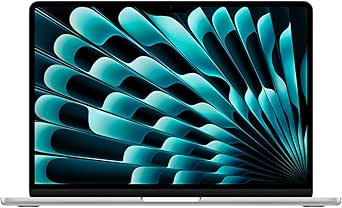
MacBook Air 13-inch Laptop with M5 chip, 13.6-inch Liquid Retina Display, 16GB Unified Memory, 512GB SSD, Silver
The 13-inch MacBook Air with M5 earns its place as the most balanced portable choice in this group: it pairs a current-generation chip with a 2.71-pound body, a colorful 13.6-inch display, and listed battery life of up to 18 hours. For typical work, study, and everyday creative tasks, that combination is easier to carry than the 16.3-inch MacBook Pro without requiring buyers to move to an older M1 model. Its 16GB of unified memory and 512GB SSD also give it a more comfortable starting configuration than the renewed M1 Air’s 8GB and 128GB. The tradeoff is connectivity: it has only two Thunderbolt 4 ports, and it supports up to two external displays. I’d choose it for a flexible daily laptop, not a workstation replacement.
Pros:- M5 chip with 16GB unified memory is suited to everyday multitasking and AI-enabled tasks.
- Light 2.71-pound design is easier to carry than the MacBook Pro.
- 13.6-inch Liquid Retina display supports one billion colors.
- Listed battery life is up to 18 hours, with a 12MP Center Stage camera for calls.
Cons:- Two Thunderbolt 4 ports limit direct peripheral connections.
- External display support tops out at two displays.
- Its display and port selection are less suited to demanding professional workflows than the MacBook Pro.
Best for: Students, mobile professionals, and home users who want a current Mac laptop for multitasking, calls, and general creative work.
Not ideal for: People who need numerous built-in ports, more than two external displays, or the larger XDR workspace of the MacBook Pro.
- Chip:Apple M5
- Display:13.6-inch Liquid Retina
- Memory:16GB unified memory
- Storage:512GB SSD
- Camera:12MP Center Stage
- Ports:Two Thunderbolt 4, MagSafe, headphone jack
- Battery life:Up to 18 hours
- Weight:2.71 pounds
Our verdict“Pick the M5 MacBook Air for a capable, easy-to-carry everyday Mac, unless your work calls for the MacBook Pro’s XDR display and broader ports.”
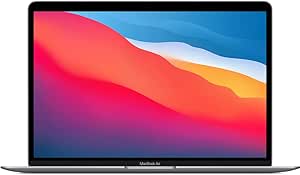
Apple MacBook Air 13.3-inch (2020) with M1 Chip, 8GB RAM, 128GB SSD, Space Gray (Renewed)
This renewed M1 MacBook Air is the entry-level option for buyers whose needs are modest and who are comfortable with older hardware. Its 8-core CPU, Retina display, Touch ID, and backlit keyboard cover the basics for writing, browsing, and routine home or school tasks. It is a different proposition from the M5 MacBook Air: that newer model has twice the listed memory, four times the storage, a 12MP camera, and newer wireless connectivity. The M1 Air’s 128GB SSD is the biggest practical constraint, especially if you keep photos, large documents, or apps locally. Its 720p camera also trails the newer Air’s Center Stage camera for frequent video calls. I’d treat the listed 90-day limited warranty and renewed condition as part of the buying decision, not as a substitute for current hardware.
Pros:- M1 processor combines an 8-core CPU, 7-core GPU, and 16-core Neural Engine.
- 2560 × 1600 Retina display provides a detailed workspace.
- Touch ID and a backlit Magic Keyboard add convenient everyday controls.
- Listed battery life is up to 18 hours.
Cons:- 128GB SSD leaves little room for large applications and locally stored files.
- 720p camera is lower resolution than the M5 MacBook Air’s 12MP Center Stage camera.
- Renewed model has 8GB memory and a 90-day limited warranty.
Best for: Budget-conscious first-time Mac buyers who mainly browse, write, stream, and store most files in the cloud.
Not ideal for: People who need ample local storage, a sharper video-call camera, newer wireless features, or a laptop for sustained demanding workloads.
- Model year:2020
- Processor:Apple M1, 8-core CPU
- Graphics:7-core GPU
- Memory:8GB
- Storage:128GB SSD
- Display:13.3-inch Retina, 2560 × 1600
- Camera:720p FaceTime HD
- Weight:2.8 pounds
- Warranty:90-day limited warranty
Our verdict“Choose this renewed M1 Air for basic Mac tasks at a lower hardware tier, but opt for the M5 Air if you need more storage, memory, or modern video-call features.”
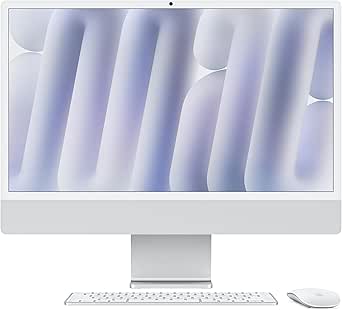
Apple 2024 iMac 24-inch All-in-One Desktop, M4 8-Core CPU and GPU, 16GB Memory, 256GB SSD, Silver
This 24-inch M4 iMac is the desktop pick for buyers who want a polished, contained setup rather than a laptop or a tower with separately chosen components. Its 4.5K Retina display, 12MP Center Stage camera, microphones, and six-speaker Spatial Audio system put the screen and video-call hardware together, which makes it well suited to a shared family workspace or a home office. Compared with the 10-core M4 iMac in this roundup, this version keeps the same screen size and core all-in-one appeal but has a smaller 256GB SSD and an 8-core CPU and GPU. That makes it less attractive for larger libraries or sustained graphics work. It can also drive up to two 6K displays, though the built-in 24-inch screen remains a compact workspace. I rank it for simplicity, not maximum storage.
Pros:- 4.5K Retina display delivers a detailed image at up to 500 nits.
- 12MP Center Stage camera and studio-quality microphones suit video calls.
- Six speakers with Spatial Audio provide integrated sound without separate desktop speakers.
- All-in-one design keeps the computer and display in one compact desktop setup.
Cons:- 256GB SSD may fill quickly with large apps, media libraries, or project files.
- 24-inch built-in display offers less workspace than the 16.3-inch MacBook Pro screen or a larger external monitor.
- Its 8-core CPU and GPU configuration is less capable on paper than the other 10-core M4 iMac.
Best for: Home-office users and families who want a tidy desktop with a high-resolution screen, strong built-in audio, and a quality video-call camera.
Not ideal for: People who need a large built-in workspace, substantial local storage, or more graphics headroom than the 8-core M4 configuration offers.
- Chip:Apple M4, 8-core CPU and 8-core GPU
- Display:24-inch 4.5K Retina, 500 nits
- Memory:16GB unified memory
- Storage:256GB SSD
- Camera:12MP Center Stage
- Audio:Three microphones; six speakers with Spatial Audio
- Connectivity:Up to four Thunderbolt 4 ports, Wi-Fi 6E, Bluetooth 5.3
- Weight:9.72 pounds
Our verdict“Choose this iMac for a compact, ready-to-use home desktop, but select the 512GB 10-core M4 iMac if you need more storage and graphics capacity.”
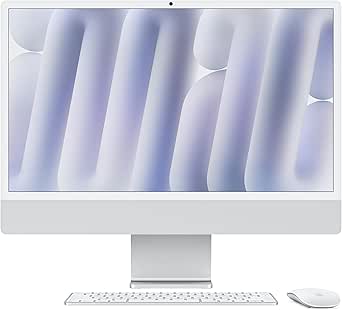
iMac (2024) 24-inch All-in-One Desktop with M4 chip, 16GB Unified Memory, 512GB SSD, Silver
This 10-core M4 iMac with 512GB SSD is the stronger all-in-one choice for buyers who want more room for apps and files without moving to a separate desktop and monitor. It shares the other 24-inch M4 iMac’s 4.5K display, Center Stage camera, and six-speaker audio, but doubles the listed SSD capacity and steps up to a 10-core CPU and GPU. That makes this configuration a better fit for people juggling a larger photo library or creative projects, though it is not a replacement for a pro desktop when workloads demand more. Its compact all-in-one format keeps setup simple, but the memory and storage are not user-replaceable, so choosing the configuration carefully matters. I place it ahead of the 256GB iMac for flexibility, while buyers who need a larger screen should look beyond both.
Pros:- 10-core M4 CPU and GPU offer a stronger configuration than the 8-core iMac.
- 512GB SSD provides more room than the 256GB iMac for apps and local files.
- 24-inch 4.5K Retina display supports up to one billion colors and reaches 500 nits.
- Center Stage camera, studio-quality microphones, and six speakers form a capable video-call setup.
Cons:- Memory and storage are not user-replaceable, limiting later upgrades.
- The fixed 24-inch display may feel small for users who manage multiple large windows.
- All-in-one construction offers less flexibility than choosing a separate desktop and display.
Best for: Home-office professionals and creative hobbyists who want a high-resolution desktop, integrated call and audio gear, and 512GB of built-in storage.
Not ideal for: Users who want upgradeable components, a screen larger than 24 inches, or the flexibility to choose a separate monitor and desktop.
- Chip:Apple M4, 10-core CPU and 10-core GPU
- Memory:16GB unified memory
- Storage:512GB SSD
- Display:24-inch 4.5K Retina, 500 nits, up to one billion colors
- Camera:12MP Center Stage
- Audio:Six speakers with Spatial Audio; three studio-quality microphones
- Connectivity:Four Thunderbolt 4, Wi-Fi 6E, Bluetooth 5.3
- Weight:9.77 pounds
- Model number:MWUV3LL/A
Our verdict“Pick this 512GB iMac over the 256GB model if you want more local storage and the 10-core M4 configuration in the same all-in-one format.”
iMac (2026) All-in-One Desktop Computer with M6 Chip – Blue
I’d rank this iMac as the strongest fit for buyers who want a capable desktop without assembling a separate monitor, camera, and speaker setup. Its M6 chip and up to 32 GB of unified memory give it more headroom for demanding everyday work and AI features than the 2024 iMac with M4. The 24-inch 4.5K Retina display, built-in 12 MP Center Stage camera, and six speakers also make it a tidy choice for video calls and shared family spaces. The tradeoff is the all-in-one design: the screen and computer are a single purchase, and internal upgrades are limited. I’d choose the Mac mini (2026) instead if I already had a display or wanted more flexibility in choosing peripherals.
Pros:- M6 chip and up to 32 GB unified memory support demanding work and AI features.
- 24-inch 4.5K Retina display provides a sharp, bright workspace.
- Built-in 12 MP Center Stage camera, three microphones, and six speakers reduce the need for extra desk equipment.
- Wi-Fi 7 and up to four Thunderbolt 4 ports offer modern connectivity.
Cons:- All-in-one construction limits internal upgrades and component replacement.
- The display and computer cannot be upgraded independently.
- Optional nano-texture glass and other configurations may affect which setup is available.
Best for: Home-office workers and families who want a polished desktop with a high-resolution screen, strong built-in camera, and speakers in one setup.
Not ideal for: Buyers who want to reuse a monitor, replace components over time, or configure a workstation around separate displays and peripherals.
- Processor:Apple M6 chip
- Display:24-inch 4.5K Retina, up to 500 nits
- Maximum unified memory:Up to 32 GB
- Camera:12 MP Center Stage
- Ports:Up to four Thunderbolt 4 ports
- Wireless:Wi-Fi 7 and Bluetooth 6
- Dimensions:21.54 x 5.79 x 18.15 inches
- Weight:9.72 pounds
- Model number:MH094LL/A
Our verdict“Choose this iMac if you want a powerful, ready-to-use desktop with a quality screen and built-in conferencing hardware.”
Mac mini (2026) with M6 chip
The Mac mini (2026) is my compact-desktop pick for buyers who already own a monitor and want a small Mac that can support a flexible workspace. Its five-by-five-inch case takes up little desk room, while the M6 chip, support for up to 32 GB of unified memory, and connections for up to three external displays make it more adaptable than the iMac (2026). That flexibility comes with a practical catch: you supply the screen, keyboard, and mouse, so it is less of an out-of-the-box setup. The port selection is a strong point, including HDMI, Thunderbolt 4, and front USB-C ports. Like the iMac, it offers limited internal upgradeability, so I’d choose the memory and storage configuration carefully.
Pros:- Five-by-five-inch footprint fits easily on a crowded desk or behind a display.
- M6 chip and up to 32 GB unified memory suit a broad range of everyday and creative tasks.
- Supports up to three external displays.
- Useful connectivity includes Thunderbolt 4, HDMI, front USB-C, and 2.5 Gb Ethernet.
Cons:- Requires a separate display, keyboard, and mouse.
- Internal upgrade options are limited by the compact design.
- Its built-in setup is less convenient for video calls than the iMac’s camera and speakers.
Best for: Desk-space-conscious buyers who already have a monitor and want a compact Mac for home, office, or multi-display setups.
Not ideal for: First-time desktop buyers who need a complete setup, or people who want to upgrade internal components later.
- Processor:Apple M6 chip
- Maximum unified memory:Up to 32 GB
- Display support:Up to three external displays
- Ports:Thunderbolt 4, HDMI, and front USB-C
- Networking:2.5 Gb Ethernet, Wi-Fi 7, and Bluetooth 6
- Dimensions:5 x 5 x 1.97 inches
- Weight:1.47 pounds
- Model number:MHQK4LL/A
Our verdict“Pick the Mac mini if compact size and monitor flexibility matter more than an all-in-one setup.”
Apple Mac Studio Desktop Computer with M5 Max Chip
I’d put the Mac Studio with M5 Max above the M6 Mac mini for users whose work benefits from substantial graphics power, high memory capacity, and fast peripheral connections. Its support for up to 128 GB of unified memory and four Thunderbolt 5 ports suits large creative projects and data-heavy workflows better than the Mac mini’s up-to-32-GB ceiling. It can also drive up to five external displays, making it a more capable center for a multi-screen studio. The compact case stays desk-friendly, but this is a specialized desktop rather than a complete workstation: you still need to provide a display, and it runs macOS only. I’d skip it for routine browsing and office tasks, where the Mac mini is the more sensible, less elaborate fit.
Pros:- M5 Max chip targets demanding CPU, GPU, and on-device AI workloads.
- Up to 128 GB unified memory and 614 GB/s memory bandwidth support large projects.
- Four Thunderbolt 5 ports and support for up to five external displays suit complex workstations.
- Compact desktop enclosure is designed to remain quiet under heavy workloads.
Cons:- Requires a separate display and other desktop peripherals.
- Limited to macOS, which does not fit workflows that require Windows.
- Its high-end capabilities are unnecessary for many everyday tasks.
Best for: Video editors, 3D artists, and other Mac professionals working with large projects, multiple displays, or memory-intensive applications.
Not ideal for: General-purpose home and office users, or buyers who need Windows compatibility or an all-in-one computer.
- Processor:Apple M5 Max chip
- Maximum unified memory:Up to 128 GB
- Memory bandwidth:614 GB/s
- Ports:4 Thunderbolt 5, 2 USB-C, 2 USB-A, HDMI, SDXC, and headphone jack
- Display support:Up to five external displays
- Dimensions:7.76 x 7.76 x 3.74 inches
- Weight:5.94 pounds
- Model number:MHL64LL/A
Our verdict“Choose the Mac Studio if your creative workload needs more memory, graphics capacity, and display support than the Mac mini provides.”
Apple MacBook Air (2019) 13-inch, 1.6GHz Intel Core i5, 8GB RAM, 128GB SSD, Gold
This 2019 MacBook Air has a clear niche: buyers who specifically need an older Intel Mac or prefer its familiar macOS laptop format. Its 13.3-inch Retina display, Touch ID, and 2.8-pound weight still make it portable for basic writing, browsing, and travel. But its dual-core Intel processor, 8 GB of soldered memory, and 128 GB SSD leave much less room for demanding work or growing files than the MacBook Neo, which offers an A18 Pro chip and 512 GB SSD. The Air’s listed battery life reaches up to 10 hours, below the Neo’s stated 16 hours. I’d treat this as a narrow legacy-use choice, not a general recommendation for buyers seeking a current Mac experience.
Pros:- Light 2.8-pound chassis is easy to carry.
- 13.3-inch Retina display includes True Tone.
- Touch ID provides fingerprint login.
- Listed battery life is up to 10 hours.
Cons:- Dual-core 8th-generation Intel processor is less suited to demanding modern workloads than the MacBook Neo’s A18 Pro.
- 8 GB RAM is soldered and cannot be upgraded.
- 128 GB SSD may fill quickly, and the two USB-C ports may require adapters.
Best for: Buyers who need a lightweight Mac laptop for basic tasks and have a specific reason to use an Intel-based Mac.
Not ideal for: Students or professionals seeking long-term performance, ample storage, heavy multitasking, or a current-generation Apple chip.
- Processor:1.6 GHz 8th-generation dual-core Intel Core i5
- Memory:8 GB DDR3 SDRAM
- Storage:128 GB SSD
- Display:13.3-inch Retina, 2560 x 1600
- Graphics:Intel UHD Graphics 617
- Battery life:Up to 10 hours
- Ports:2 Thunderbolt/USB-C
- Weight:2.8 pounds
- Color:Gold
Our verdict“Consider this Air only if you specifically need an Intel Mac and your workload is limited to basic portable computing.”
MacBook Neo 13-inch Laptop with A18 Pro chip, Liquid Retina Display, 8GB Unified Memory, 512GB SSD, 1080p FaceTime HD Camera, Touch ID – Blush
For a light, current-style laptop aimed at everyday work, I’d choose the MacBook Neo over the 2019 MacBook Air. The Neo’s A18 Pro chip, 512 GB SSD, and stated battery life of up to 16 hours make it better equipped for routine multitasking and a full day away from an outlet than that older Intel model with 128 GB storage. Its 13-inch Liquid Retina display supports a billion colors, while the 1080p camera and Touch ID round out a practical portable setup. The main limitation is 8 GB of unified memory, which can constrain professional applications or heavy multitasking. I’d pick an M5 MacBook Air instead if a workload needs more memory; this model makes more sense for lighter daily use.
Pros:- A18 Pro chip is designed for everyday performance and Apple Intelligence features.
- 512 GB SSD offers substantially more listed storage than the 2019 MacBook Air’s 128 GB.
- Up to 16 hours of battery life supports extended use away from an outlet.
- 2.71-pound aluminum laptop includes a 1080p camera and Touch ID.
Cons:- 8 GB unified memory may limit demanding applications and heavy multitasking.
- Memory and storage are not user-upgradable.
- The listing specifies a single 512 GB storage configuration.
Best for: Students and mobile users who want a lightweight laptop for everyday productivity, video calls, and travel.
Not ideal for: Creative professionals and heavy multitaskers who need more than 8 GB memory or expect to expand storage later.
- Processor:Apple A18 Pro chip
- Memory:8 GB unified memory
- Storage:512 GB SSD
- Display:13-inch Liquid Retina, 1 billion colors
- Camera:1080p FaceTime HD
- Battery life:Up to 16 hours
- Weight:2.71 pounds
- Dimensions:8.12 x 11.71 x 0.5 inches
- Color:Blush
Our verdict“Choose the MacBook Neo for portable everyday computing and longer stated battery life, but look to an M5 MacBook Air for heavier workloads.”
Apple iMac 24″ All-in-One Desktop with M6 Chip – Silver
The M6 iMac is my strongest all-around desktop pick here: it pairs a current-generation chip with a sharp 24-inch 4.5K Retina display and a compact all-in-one setup. Compared with the renewed M4 iMacs in this group, its M6 processor, Wi-Fi 7, and support for up to 32GB of unified memory give buyers more headroom for demanding work and newer connectivity. Its 12MP Center Stage camera and six-speaker system also make it better suited to a shared home office than a display-focused older Intel model. The tradeoff is that memory and storage are fixed at purchase, and storage capacity is not specified here. I’d choose it over the MacBook Air 15-inch when a permanent desk setup matters more than portability.
Pros:- M6 chip and support for up to 32GB unified memory offer more performance headroom than the renewed M4 models.
- 24-inch 4.5K Retina display delivers a large, detailed workspace in a single unit.
- 12MP Center Stage camera and six-speaker Spatial Audio setup suit video calls and media use.
- Wi-Fi 7 and up to four Thunderbolt 4 ports provide modern connectivity.
Cons:- Memory and storage configurations cannot be upgraded after purchase.
- Storage capacity is not specified in the supplied product details.
- Its desktop design is a poor fit for buyers who need portability.
Best for: Home-office workers and families who want a current, high-performance Mac desktop with a built-in display, camera, and speakers.
Not ideal for: People who need a computer they can carry between rooms or upgrade later, or buyers who need a confirmed storage capacity before choosing.
- Processor:Apple M6 chip
- Display:24-inch 4.5K Retina, 500 nits, up to 1 billion colors
- Memory:Up to 32GB unified memory
- Ports:Up to four Thunderbolt 4; optional 2.5Gb Ethernet
- Camera:12MP Center Stage
- Wireless:Wi-Fi 7 and Bluetooth 6
- Weight:9.77 pounds
Our verdict“Choose the M6 iMac for a capable, polished desktop setup, but confirm the storage configuration before committing.”
Apple iMac 2024 24″ 10-core M4, 16 GB RAM, 256 GB SSD, Silver (Renewed)
This renewed M4 iMac makes the most sense for buyers who want a modern Apple desktop chip and a 4.5K screen without stepping up to the M6 model. Its 10-core M4 and 16GB of unified memory suit everyday productivity, video calls, and general creative work, while the 24-inch display keeps the desk setup simple. Against the blue renewed M4 iMac in this roundup, the main practical difference is storage: this silver version has a 256GB SSD, half the other model’s listed capacity. That can be tight for large photo libraries or local video projects. It also has a 90-day limited warranty and fixed memory, so I’d favor the M6 iMac for longer-term performance headroom and the 512GB M4 for more room to keep files onboard.
Pros:- 10-core M4 chip provides capable performance for common work and entertainment.
- 24-inch 4.5K Retina display offers a detailed, bright workspace.
- 16GB unified memory supports everyday multitasking.
- All-in-one design keeps the desktop setup uncluttered.
Cons:- 256GB SSD can fill quickly with applications and local media.
- 16GB memory is fixed and not user-upgradable.
- Renewed condition comes with a 90-day limited warranty.
Best for: Buyers seeking a renewed M4 desktop for office tasks, browsing, calls, and light creative work, with most files stored externally or in the cloud.
Not ideal for: People with large local media libraries, buyers who need expandable memory, or anyone seeking the longer-term headroom of the M6 iMac.
- Processor:Apple M4, 10-core
- Memory:16GB unified memory
- Storage:256GB SSD
- Display:24-inch 4.5K Retina, 4480 x 2520, 500 nits
- Graphics:Apple integrated graphics
- Connectivity:Wi-Fi 6E and Bluetooth 5.3
- Warranty:90-day limited
Our verdict“Pick this renewed M4 iMac for everyday desktop use if 256GB is enough and you do not need the M6 model’s extra headroom.”
Apple iMac 27-inch Retina 5K All-in-One Desktop, 3.2 GHz Intel Core i5, 8 GB RAM, 1 TB Fusion Drive (Renewed)
The renewed 27-inch Retina 5K iMac earns a distinct place for buyers who prioritize screen area and resolution over newer hardware. Its 5120 x 2880 display is physically larger than the 24-inch panels on both M4 iMacs, which can make side-by-side documents and detailed images easier to work with. The 1TB Fusion Drive also offers more listed capacity than the 256GB M4 model, though it is not an SSD. This Intel-era machine is a substantial compromise beside the M4 and M6 options: it has just 8GB of DDR3 memory, an older processor, and Mac OS X listed as its operating system. I’d shortlist it only when the bigger 5K canvas matters more than current-generation performance, memory, and a clearly specified modern macOS setup.
Pros:- 27-inch Retina 5K display provides more screen area than the 24-inch iMac models.
- 5120 x 2880 resolution supports detailed viewing and a spacious desktop.
- 1TB Fusion Drive offers more listed capacity than the 256GB renewed M4 iMac.
- Includes a keyboard and mouse, though they may be generic.
Cons:- 8GB DDR3 memory is limited beside the 16GB M4 and up-to-32GB M6 options.
- Fusion Drive is not an SSD and may feel slower than the newer iMac storage options.
- Renewed product ships in a generic box with potentially generic accessories.
Best for: Buyers who specifically want a large 27-inch 5K screen for documents, image viewing, or a spacious home-office desktop.
Not ideal for: People doing demanding modern creative work, buyers who need fast SSD storage or more memory, and anyone seeking a newer-generation Mac than the M4 iMacs.
- Display:27-inch Retina 5K, 5120 x 2880
- Processor:3.2GHz quad-core Intel Core i5
- Memory:8GB DDR3
- Storage:1TB Fusion Drive
- Graphics:AMD Radeon R9 M390
- Ports:2 Thunderbolt and 4 USB 3
- Wireless:802.11ac and Bluetooth
Our verdict“Choose this renewed iMac only if its larger 5K display is your priority and you can accept older Intel hardware and limited memory.”
Apple iMac 2024 24-inch with Apple M4, 16GB RAM, 512GB SSD, Blue (Renewed)
Among the renewed desktop choices, this blue M4 iMac with a 512GB SSD is the more practical pick for buyers who want room for more apps and files than the silver M4’s 256GB drive allows. Its 16GB memory and M4 chip are suited to everyday multitasking, while the 24-inch format brings the same compact all-in-one appeal as the newer M6 iMac. The blue finish adds a distinct look, but the included keyboard and mouse are compatible third-party accessories, not original Apple parts, and the product ships in a generic box. Compared with the silver renewed M4, this one offers twice the listed storage; compared with the M6, it gives up newer-generation processing and connectivity. I’d weigh that storage advantage against the 90-day limited warranty.
Pros:- 512GB SSD provides twice the listed capacity of the silver renewed M4 iMac.
- M4 chip and 16GB memory suit typical productivity and multitasking.
- 24-inch all-in-one format keeps the desk setup straightforward.
- Blue finish offers a color option distinct from the silver models.
Cons:- Included keyboard and mouse are compatible third-party accessories rather than original Apple parts.
- Ships in a generic box and has a 90-day limited warranty.
- Memory is listed as a maximum of 16GB, leaving less headroom than the M6 iMac.
Best for: Renewed-Mac shoppers who want an M4 desktop with 16GB memory and enough SSD capacity for a broader everyday app and file collection.
Not ideal for: Buyers who require original Apple accessories, a longer stated warranty, or the newer M6 chip and Wi-Fi 7 features.
- Processor:Apple M4, 8 cores
- Memory:16GB SDRAM
- Storage:512GB SSD
- Display:24 inches
- Graphics:Integrated graphics
- Ports:4 USB ports
- Warranty:90-day limited
Our verdict“Choose this renewed blue M4 iMac over the silver 256GB version when extra SSD space matters more than original accessories or newer M6 hardware.”
MacBook Air 15-inch Laptop with M5 chip, 24GB Unified Memory, 1TB SSD, 12MP Center Stage Camera, Touch ID, Wi-Fi 7 – Midnight
This 15-inch MacBook Air is the clear choice in this group for buyers who need a Mac they can carry, rather than a desktop that stays on one desk. Its M5 chip, 24GB unified memory, and 1TB SSD provide a stronger listed memory and storage configuration than either renewed M4 iMac, while the 15.3-inch display gives more workspace than the 13-inch Air without the iMac’s fixed location. The stated battery life of up to 18 hours supports long stretches away from a charger. Compared with the M6 iMac, it gives up the larger 4.5K desktop screen and built-in six-speaker system; its port selection is also limited to two Thunderbolt 4 ports, MagSafe, and a headphone jack. I’d pick it for mobility, not as a stationary all-in-one replacement.
Pros:- M5 chip, 24GB unified memory, and 1TB SSD make a well-equipped portable configuration.
- 15.3-inch Liquid Retina display offers more workspace than a 13-inch laptop.
- Up to 18 hours of stated battery life supports extended use away from a charger.
- 12MP Center Stage camera and Wi-Fi 7 suit calls and current wireless networks.
Cons:- Two Thunderbolt 4 ports may require adapters for several wired peripherals.
- Its 15.3-inch display is smaller than the 24-inch iMac screens and lacks their 4.5K specification.
- The portable design cannot provide the fixed desktop setup and six-speaker system of the M6 iMac.
Best for: Students, hybrid workers, and frequent travelers who need a large-screen Mac laptop with substantial memory and storage.
Not ideal for: People who want a fixed desktop with a larger 4.5K display, multiple built-in speakers, or several peripherals connected without adapters.
- Chip:Apple M5
- Memory:24GB unified memory
- Storage:1TB SSD
- Display:15.3-inch Liquid Retina, up to 1 billion colors
- Battery life:Up to 18 hours
- Ports:2 Thunderbolt 4, MagSafe charging, headphone jack
- Weight:3.32 pounds
Our verdict“Choose this MacBook Air if portability and all-day battery life matter more than an iMac’s larger fixed display and desktop audio.”