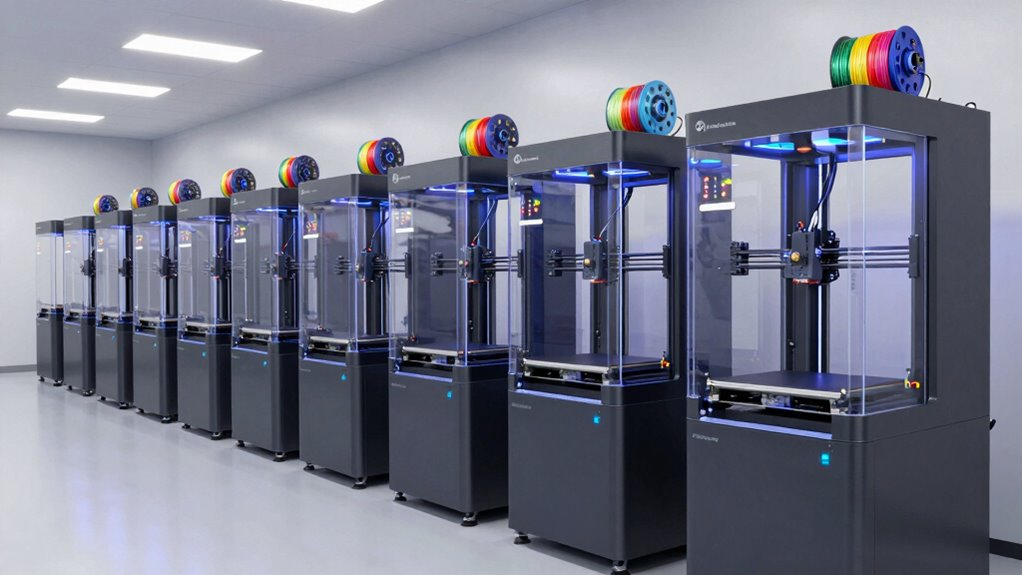
Choosing a belt 3D printer capable of continuous operation dramatically expands your manufacturing capacity. The IdeaFormer-3D IR3 V2 Belt Printer stands out for its high-speed, large-volume capabilities, making it ideal for industrial batch production. Meanwhile, the IdeaFormer IR3 V2 Conveyor Belt offers a large, stable platform with auto-leveling, suitable for prototyping or long-term serial work. The IdeaForme IR3 V2 with Extended Roller Enclosure combines compact design with infinite Z-axis functionality, perfect for serial or large-scale projects in smaller spaces. Each of these options balances speed, size, and automation differently, with tradeoffs in complexity, space requirements, and cost, so your choice depends heavily on your specific manufacturing needs.

Get the latest gadgets delivered free — and shop member deals
- Fast, free delivery on millions of items
- Access to Prime Big Deal Days deals on October 6–7
- Prime Video, Amazon Music and more included
Complete the kit


Key Takeaways
- All four options support continuous Z-axis printing with conveyor belt systems, enabling large or serial production.
- Klipper firmware is a common feature, providing high-speed and precise control across models.
- Setup complexity varies, with some models requiring technical expertise for calibration and maintenance.
- Build volume is consistently 250×250mm with infinity Z, but footprint and features differ significantly.
- Material compatibility ranges widely, supporting everything from PLA to ABS and TPU.


| belt 3d printers continuou | Build Volume | Filament Compatibility | Printing Method | Max Speed |
|---|---|---|---|---|
| IdeaFormer-3D IR3 V2 Belt Prin | 250×250×∞mm | PLA, PETG, ABS, TPU, ASA, PP, and more | Core XY Belt Printer | 400mm/s |
| IdeaFormer IR3 V2 Conveyor Bel | 250×250×∞mm | — | — | — |
| IdeaForme 3D Conveyor Belt IR3 | 250×250×∞mm | PLA, PETG, ABS, TPU, ASA, PP, and more | — | — |
| IdeaFormer-3D IR3 V2 Infinite | 250×250×∞mm | PLA, PETG, ABS, TPU, ASA, PP, and more | Conveyor belt continuous Z-axis | 400mm/s |
More Details on Our Top Picks
IdeaFormer-3D IR3 V2 Belt Printer, Core XY Infinite Z Axis Conveyor Belt Printer Auto-Leveling with Direct Extruder for Large, Batch Model Printing
This model excels at enabling continuous, large-volume printing thanks to its conveyor belt system with an infinite Z-axis. It supports multiple filament types, including tough materials like ABS and PETG, with an auto-leveling system that reduces manual calibration. Powered by Klipper firmware, it offers high speeds up to 400mm/s with precise motion. The setup can be complex, especially for users unfamiliar with advanced 3D printing configurations, and its large size demands a dedicated space. Yet, its ability to produce endless large models makes it a top choice for industrial applications.
Pros:- Enables continuous, large-scale printing with an endless Z-axis
- Supports a wide range of filament types for versatile materials
- Auto-leveling simplifies setup and calibration
- High-speed motion with Klipper firmware
Cons:- Complex setup requiring technical expertise
- Requires significant space due to size
- Potential for belt wear over extended use
Best for: Industrial batch production and large-scale prototype manufacturing
Not ideal for: Hobbyists or small workshops with limited space and technical skills
- Build Volume:250×250×∞mm
- Printing Method:Core XY Belt Printer
- Auto-Leveling:Yes
- Filament Compatibility:PLA, PETG, ABS, TPU, ASA, PP, and more
- Belt Material:PEI-coated metal conveyor belt
- Max Speed:400mm/s
Our verdict“This printer delivers exceptional capacity for continuous, large-format production but demands technical skill and dedicated space.”
IdeaFormer IR3 V2 Conveyor Belt 3D Printer, Large Format 250×250×∞mm, Auto Leveling, 400mm/s Speed
This large-format conveyor belt printer shines in high-speed, continuous printing scenarios, supporting models up to 250mm in width with an auto-leveling system that reduces calibration time. Its robust design and speed capability of up to 400mm/s make it suitable for rapid prototyping or production runs. However, the setup can be intricate, and some users report calibration or filament compatibility issues. Its weight and size may also challenge smaller workshops or limited spaces.
Pros:- Large continuous printing area for long models and batches
- Auto-leveling system that eases calibration
- Supports diverse filament types, including tough materials
- Fast printing speeds up to 400mm/s
Cons:- Setup complexity requiring technical knowledge
- Heavy and large footprint
- Some users face calibration or filament issues
Best for: Prototyping and high-volume batch production where speed matters
Not ideal for: Small-scale hobbyists or environments with space constraints
- Product Dimensions:20.47 x 30.71 x 12.6 inches
- Build Volume:250×250×∞mm
- Auto Leveling:Yes
- Maximum Speed:400mm/s
- Firmware:Klipper
Our verdict“A high-speed conveyor belt printer suited for rapid batch production, though setup and space considerations are notable.”
IdeaForme 3D Conveyor Belt IR3 V2 Printer with Extended Roller Enclosure, 250×250×∞mm Infinite Z Axis
This model offers a more compact footprint while maintaining the core feature of infinite Z-axis printing. Its extended roller enclosure provides additional protection and stability, making it suitable for serial production in smaller spaces. The auto-calibration via Y-offset strain sensor and support for multiple filament types make it a versatile choice. The main tradeoff is that its detailed specs on resolution and layer height are limited, and setup may still be technical for newcomers.
Pros:- Compact size with infinite Z-axis functionality
- Supports multiple filament types
- Auto-calibration reduces manual tuning
- Suitable for serial production and small-scale continuous runs
Cons:- Limited detail on print resolution
- Setup may still require technical knowledge
- Price and availability are uncertain
Best for: Smaller workshops or serial production needing continuous printing in limited space
Not ideal for: Large-scale or industrial setups with extensive production needs
- Build Volume:250×250×∞mm
- Z-Axis:Infinite
- Printer Type:FDM/FFF 3D Printer
- Filament Compatibility:PLA, PETG, ABS, TPU, ASA, PP, and more
- Conveyor Belt:Extended roller, PEI coating
- Auto Calibration:Yes, auto-leveling with Y-offset strain sensor
Our verdict“A solid choice for those needing continuous printing in a smaller or space-constrained environment, with some setup complexity.”
IdeaFormer-3D IR3 V2 Infinite Z Axis Conveyor Belt 3D Printer with Auto-Leveling and Hotend Kit
This latest iteration emphasizes large-scale serial production with its endless Z-axis and conveyor belt system. It supports multiple filament types, including durable materials, with an auto-leveling system to facilitate quick setup. The inclusion of a hotend kit and high-speed motion via Klipper firmware makes it a strong candidate for high-volume, continuous runs. Its main drawbacks are the necessity for technical skills to install and calibrate, and its large size may not suit smaller workshops.
Pros:- Enables continuous printing with an endless Z-axis
- Supports multiple filament types for diverse projects
- Auto-leveling and high-speed motion for efficiency
- Includes hotend kit for versatile material use
Cons:- Setup requires technical expertise
- Large size limits placement options
- Limited info on warranty and support
Best for: High-volume serial manufacturing and continuous long-part printing
Not ideal for: Hobbyists or small workshops with space limitations
- Build Volume:250×250×∞mm
- Printing Method:Conveyor belt continuous Z-axis
- Filament Compatibility:PLA, PETG, ABS, TPU, ASA, PP, and more
- Auto-Calibration:Yes
- Max Speed:400mm/s
Our verdict“Ideal for large-scale serial production that demands continuous operation, with setup and space being key considerations.”

How We Picked
My selection process focused on models that explicitly offer continuous, belt-based Z-axis printing with the ability to handle large-scale or serial production. I prioritized printers with auto-leveling features for ease of setup, high maximum speeds to ensure efficient throughput, and compatibility with multiple filament types, especially for industrial or prototyping purposes. I also considered user feedback regarding setup complexity, reliability, and maintenance to identify models that balance advanced features with usability. Each product was evaluated for its role in continuous printing, with clear distinctions made based on size, automation, and intended use case.
| belt 3d printers continuou | Printing Method |
|---|---|
| IdeaFormer-3D IR3 V2 Belt Prin | Core XY Belt Printer |
| IdeaFormer IR3 V2 Conveyor Bel | — |
| IdeaForme 3D Conveyor Belt IR3 | — |
| IdeaFormer-3D IR3 V2 Infinite | Conveyor belt continuous Z-axis |
Factors to Consider When Choosing Belt 3d Printers Continuous
Selecting the right belt 3D printer for continuous operation depends on your production scale, space, and technical skill. Key factors include build volume, speed, automation features, and filament compatibility. Understanding these aspects helps match a model to your specific needs, whether for high-volume industrial output or serial prototype work.
Size and Capacity
For large-scale production, prioritize models with extensive build volume and an infinite Z-axis to produce long parts or batch multiple items without interruption. Smaller workshops may prefer compact models that still offer continuous printing but occupy less space.
Speed and Automation
High speeds up to 400mm/s can significantly improve throughput, especially for batch runs. Auto-leveling and auto-calibration features are essential to reduce manual setup time and ensure consistent quality across long prints.
Filament Compatibility
Different models support various materials, from standard PLA to more demanding filaments like ABS, PETG, or TPU. Matching your material needs with a printer’s compatibility ensures reliable, versatile performance.
Ease of Use and Setup
Complex systems with advanced firmware like Klipper require some technical knowledge. Beginners or smaller teams should consider models with simplified calibration and straightforward operation, while experts can leverage advanced features for maximum efficiency.
Frequently Asked Questions
What is continuous Z-axis printing?
Continuous Z-axis printing involves a conveyor belt or endless loop system that allows the print bed or model to extend indefinitely, enabling the creation of long, uninterrupted parts or serial batches without stopping for manual repositioning.
Are belt 3D printers difficult to set up?
Setup complexity varies among models; some, like the IdeaFormer IR3 V2 series, require technical skills for calibration and firmware configuration, while others may have automated features to simplify initial setup. Expect a learning curve if you’re new to conveyor belt systems.
What materials can these printers handle?
Most models support a range of filaments including PLA, PETG, ABS, TPU, ASA, and PP. Compatibility depends on the hotend and belt material, so verifying specific filament support is essential for your application.
How do I maintain a belt conveyor 3D printer?
Regular maintenance includes inspecting the conveyor belt for wear, cleaning the metal surfaces, and ensuring the auto-leveling sensors remain calibrated. Firmware updates and belt tension adjustments may also be necessary over time to maintain print quality.
Is continuous printing more cost-effective?
Yes, continuous printing reduces manual intervention, increases output, and can lower operational costs over time, especially in industrial settings. However, initial investment and setup complexity may offset immediate savings for smaller or hobbyist users.
Conclusion
For users focused on high-volume, industrial-scale production, the IdeaFormer IR3 V2 Belt Printer and its large-format counterparts are compelling choices, offering speed, capacity, and automation. Hobbyists or small workshops seeking continuous operation in limited space should consider the IdeaForme IR3 V2 with Extended Roller Enclosure for its compact design and reliable features. Advanced users comfortable with setup and calibration will find these models provide the flexibility and scale needed for demanding continuous printing tasks.
Fall Picks
fall essentials
As an affiliate, we earn on qualifying purchases.