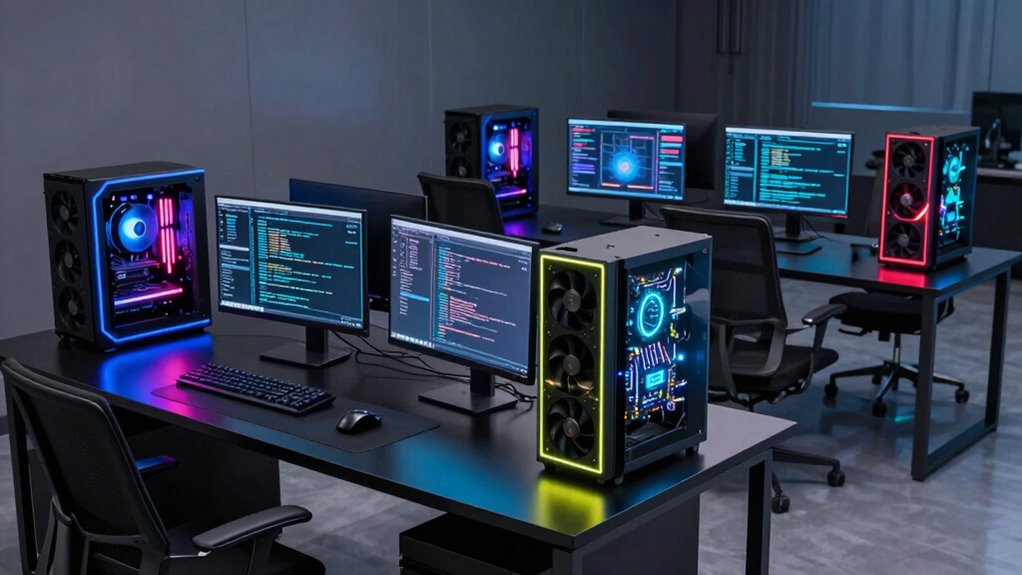

If you’re looking to boost your AI projects in 2026, I recommend considering the top GPU workstations like the AMD Radeon Pro W7800 and W7900, along with NVIDIA’s RTX PRO 6000. High-end options like the 7920 Tower with dual Xeons and V100 GPUs are also excellent choices. Mobile solutions like the Lenovo ThinkPad P16 offer portability without sacrificing power. Keep exploring, and you’ll uncover the best setup tailored to your needs.
Key Takeaways
- High-performance GPUs like NVIDIA RTX PRO 6000 and AMD Radeon Pro W7900 deliver unmatched compute power for AI workloads.
- Workstations with large GPU memory (up to 96GB) support complex models and large datasets efficiently.
- Scalable platforms with multiple PCIe 5.0 slots and extensive RAM enable extensive AI project deployments.
- Advanced connectivity options such as Thunderbolt, USB4, and high-speed LAN facilitate seamless data transfer and integration.
- Mobile AI workstations and integrated solutions provide portability without compromising on AI processing capabilities.
| AMD Radeon™ Pro W7800 Graphics Card | 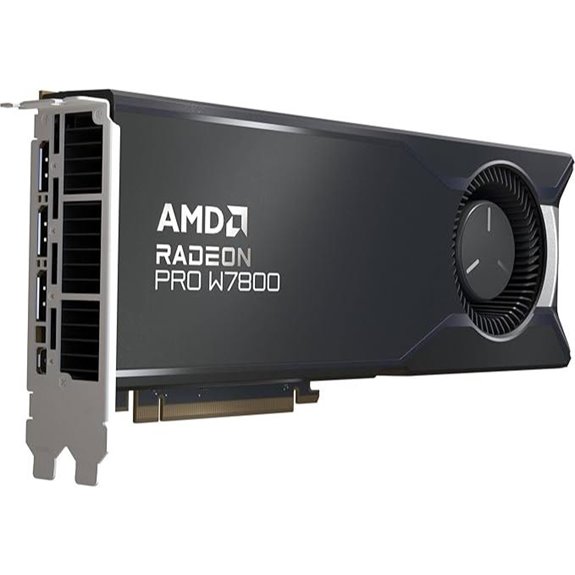 | Creative Powerhouse | GPU Type: AMD Radeon™ Pro W7800 | Memory Capacity: 32GB GDDR6 | Power Consumption: 260W TDP | VIEW LATEST PRICE | See Our Full Breakdown |
| AMD Radeon Pro W7900 Graphics Card (48GB GDDR6) |  | High-End Performance | GPU Type: AMD Radeon Pro W7900 | Memory Capacity: 48GB GDDR6 | Power Consumption: 295W TDP | VIEW LATEST PRICE | See Our Full Breakdown |
| NVD RTX PRO 6000 Workstation Graphics Card |  | AI-Ready Elite | GPU Type: NVIDIA RTX PRO 6000 (Blackwell) | Memory Capacity: 96GB DDR7 ECC | Power Consumption: Up to 600W (peak power) | VIEW LATEST PRICE | See Our Full Breakdown |
| High-End 7920 Tower Workstation with Xeon & GPU | 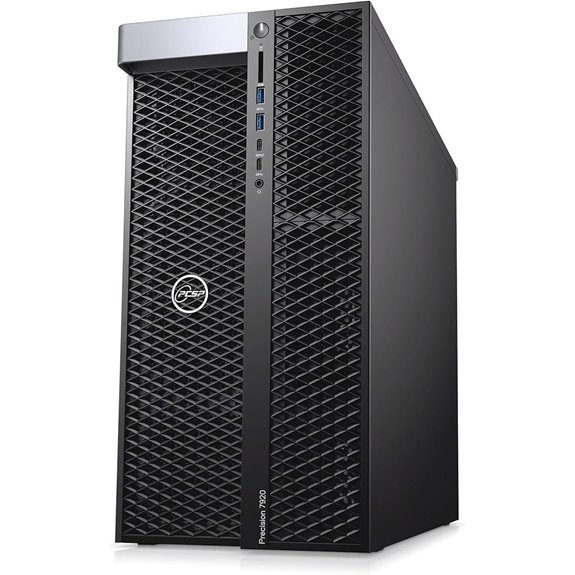 | Ultimate Workstation | GPU Type: NVIDIA Quadro P2000 (integrated in workstation) | Memory Capacity: 5GB GDDR5 (GPU), 1.5TB RAM (workstation) | Power Consumption: 1400W PSU (system) | VIEW LATEST PRICE | See Our Full Breakdown |
| Graphics Card V100 32GB SXM2 GPU W/Pcie Adapter & 6+2 Pin for AI Computing | 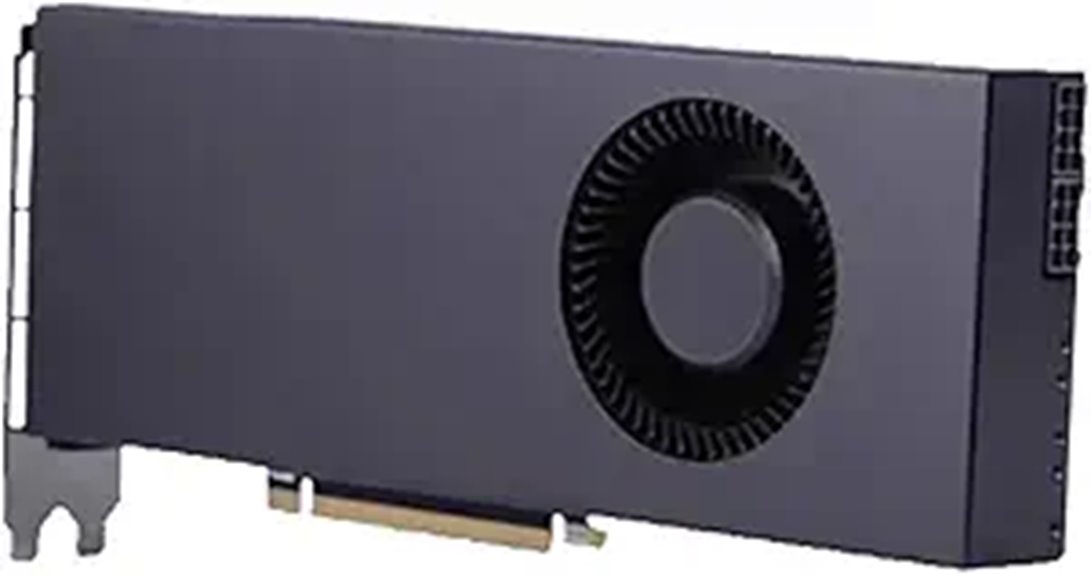 | Deep Learning Leader | GPU Type: NVIDIA Tesla V100 32GB SXM2 | Memory Capacity: 32GB HBM2 | Power Consumption: Power not specified | VIEW LATEST PRICE | See Our Full Breakdown |
| MINISFORUM MS-S1 MAX AI Workstation PC | 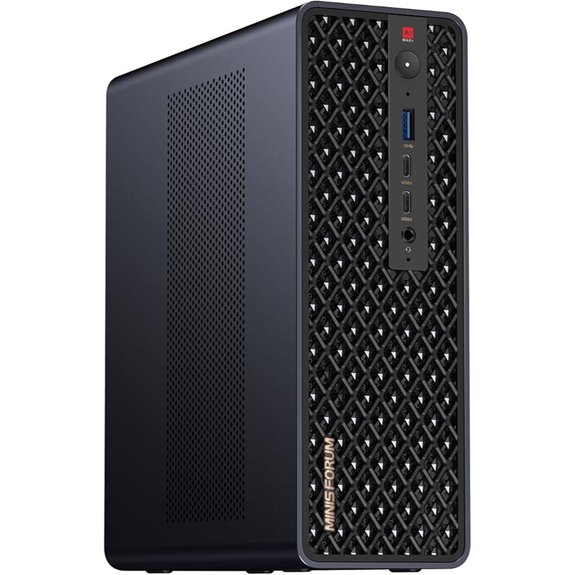 | Compact AI Power | GPU Type: AMD Ryzen AI Max+ 395 APU (integrated GPU) | Memory Capacity: 128GB LPDDR5x UMA RAM | Power Consumption: 320W (power supply) | VIEW LATEST PRICE | See Our Full Breakdown |
| High-End 7920 Tower Workstation with Xeon & GPU | | Heavy-Duty Performer | GPU Type: NVIDIA Quadro P2000 (integrated in workstation) | Memory Capacity: 768GB DDR4 (workstation) | Power Consumption: Power not specified | VIEW LATEST PRICE | See Our Full Breakdown |
| ASUS ProArt Z890-CREATOR WIFI Motherboard | 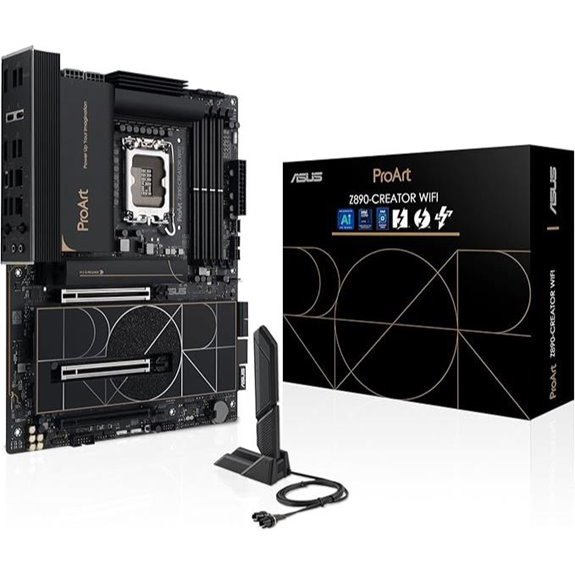 | Creator-Focused | GPU Type: No GPU specified (motherboard support) | Memory Capacity: Not applicable (motherboard) | Power Consumption: Not applicable | VIEW LATEST PRICE | See Our Full Breakdown |
| PCIe 5.0 X16 Riser Cable 50cm Black | 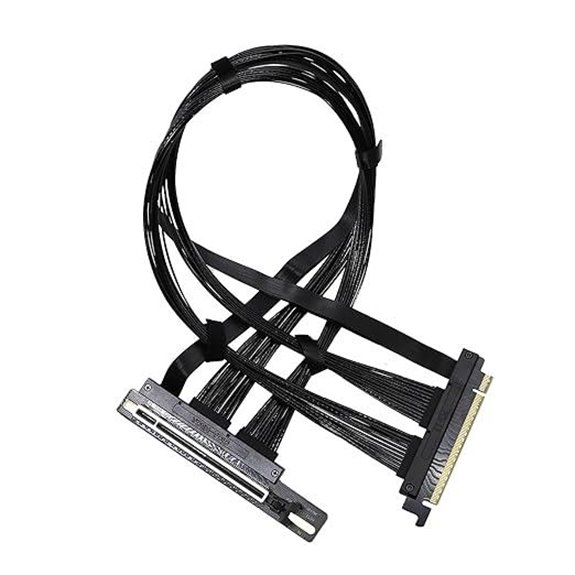 | High-Speed Connectivity | GPU Type: No GPU specified (PCIe riser cable) | Memory Capacity: Not applicable (riser cable) | Power Consumption: Not applicable | VIEW LATEST PRICE | See Our Full Breakdown |
| Lenovo ThinkPad P16 Gen 2 Mobile Workstation Laptop | 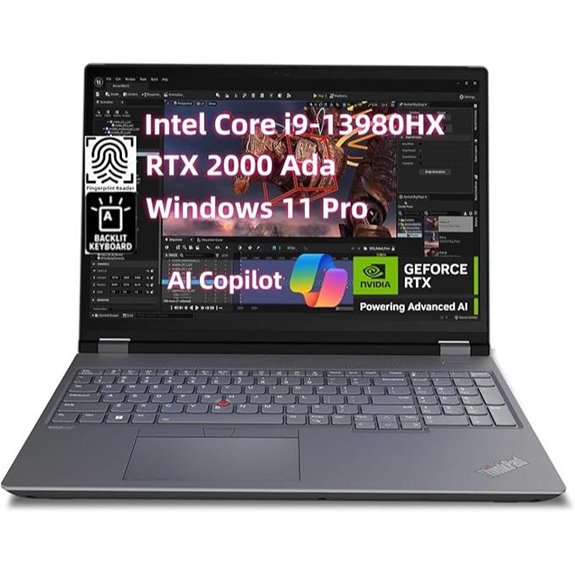 | Mobile Powerhouse | GPU Type: NVIDIA RTX 2000 Ada Generation | Memory Capacity: 128GB DDR5 RAM | Power Consumption: Power not specified | VIEW LATEST PRICE | See Our Full Breakdown |
| ASUS Pro WS TRX50-SAGE Workstation Motherboard |  | Future-Ready Platform | GPU Type: NVIDIA RTX 9000 series (assumed from context) | Memory Capacity: 32GB HBM2 (GPU memory) | Power Consumption: Power not specified | VIEW LATEST PRICE | See Our Full Breakdown |

More Details on Our Top Picks
-

AMD Radeon™ Pro W7900, Professional Graphics Card, Workstation, AI, 3D Rendering, 48GB GDDR6, AV1, 61 TFLOPS, 96CUS, 295W TDP, 8K, 1x Mini DisplayPort, 3 x DisplayPort™ 2.1
96 CU Compute Units, 2 AI Accelator per CU and 61 TFLOPS FP32 - to accelerate demanding workloads.
As an affiliate, we earn on qualifying purchases.
AMD Radeon™ Pro W7800 Graphics Card
If you’re looking for a workstation GPU that handles demanding AI workloads with ease, the AMD Radeon™ Pro W7800 is an excellent choice. With 70 Compute Units and 2 AI Accelerators per CU, it delivers 45 TFLOPS FP32 performance, making complex computations faster. Its 32GB GDDR6 memory guarantees high-speed responsiveness for large datasets. Supporting up to four 4K displays or a single 8K at 60Hz, it’s perfect for high-resolution tasks. Compatibility with major APIs and software like Maya, Unreal Engine, and DaVinci Resolve makes it versatile for creative and technical workflows. The 260W TDP balances power and efficiency for demanding workstation environments.
- GPU Type:AMD Radeon™ Pro W7800
- Memory Capacity:32GB GDDR6
- Power Consumption:260W TDP
- Display/Output Support:Supports 4K, 8K, 12K, AV1 displays
- API Compatibility:OpenCL, DirectX, OpenGL, Vulkan
- Application Support:3ds Max, Maya, After Effects, Premiere, Unity, Unreal
- Additional Feature:Supports high-refresh-rate displays
- Additional Feature:Extensive application compatibility
- Additional Feature:4K to 12K display support
-

NVD RTX PRO 6000 Blackwell Professional Workstation Edition Graphics Card for AI, Design, Simulation, Engineering - 96GB DDR7 ECC Memory - 4th Gen RT/5th Gen Tensor Core GPU - OEM Packaging
[NVIDIA Blackwell Streaming Multiprocessor] The new SM features increased processing throughput, and new neural shaders that integrate neural...
As an affiliate, we earn on qualifying purchases.
AMD Radeon Pro W7900 Graphics Card (48GB GDDR6)
The AMD Radeon Pro W7900 Graphics Card stands out for professionals demanding top-tier AI performance, thanks to its powerful 96 compute units and 61 TFLOPS FP32 throughput. With 48GB of GDDR6 memory, it handles large datasets and complex models with ease. Its support for 4K to 12K displays, including AV1 encoding, ensures crisp visuals for immersive projects. Connectivity via DisplayPort™ 2.1 and extensive API support like OpenCL, DirectX, and Vulkan make it highly adaptable. Designed for demanding tasks, this GPU excels in AI, 3D rendering, and video editing, making it a powerhouse for professional workstations in 2026.
- GPU Type:AMD Radeon Pro W7900
- Memory Capacity:48GB GDDR6
- Power Consumption:295W TDP
- Display/Output Support:Supports 4K, 8K, 12K, AV1 displays
- API Compatibility:OpenCL, DirectX, OpenGL, Vulkan
- Application Support:Same as #1, plus DaVinci Resolve, Houdini
- Additional Feature:DisplayPort™ 2.1 support
- Additional Feature:48GB GDDR6 memory
- Additional Feature:Optimized for immersive content
-

PCSP High-End Precision 7920 Tower Workstation | 2X Intel Xeon Platinum 8160 (48 Cores, 96 Threads) | 1TB NVMe + 4TB HDD | Quadro P2000 5GB | Windows 11 Pro | 384GB DDR4 | Renewed PC Desktop Computer
EXTREME MULTI-CORE PERFORMANCE – Dual Intel Xeon Platinum 8160 CPUs deliver a total of 48 cores and 96...
As an affiliate, we earn on qualifying purchases.
NVD RTX PRO 6000 Workstation Graphics Card
For AI professionals and demanding designers, the NVD RTX PRO 6000 stands out with its massive 96GB DDR7 ECC memory, enabling large-scale model training and complex simulations without bottlenecks. Its NVIDIA Blackwell architecture, featuring 4th Gen RT cores and 5th Gen Tensor cores, delivers up to three times the performance of previous generations, supporting fast AI processing with FP4 precision. The GPU’s innovative neural shaders and DLSS 4 ensure lifelike visuals and smooth frame pacing. With PCIe Gen 5 support, double airflow cooling, and high-resolution outputs via DisplayPort 2.1, it handles multi-application workflows effortlessly, making it an ideal choice for power users in AI and design.
- GPU Type:NVIDIA RTX PRO 6000 (Blackwell)
- Memory Capacity:96GB DDR7 ECC
- Power Consumption:Up to 600W (peak power)
- Display/Output Support:Supports high-res outputs up to 8K/16K via DisplayPort 2.1
- API Compatibility:DLSS, CUDA, OpenCL, DirectX, Vulkan
- Application Support:AI, deep learning, rendering, simulation
- Additional Feature:96GB DDR7 ECC memory
- Additional Feature:Supports PCIe Gen 5
- Additional Feature:Multi-instance GPU capability
High-End 7920 Tower Workstation with Xeon & GPU
Powerful multitasking and heavy workload handling define the High-End 7920 Tower Workstation, making it an ideal choice for AI professionals who demand top-tier performance. Equipped with dual Intel Xeon Platinum 8160 CPUs, it offers 48 cores and 96 threads, perfect for multitasking, rendering, and AI modeling. With up to 1.5TB of DDR4 RAM, it handles large datasets and complex simulations effortlessly. The NVIDIA Quadro P2000 GPU ensures professional-grade graphics, supporting multi-monitor setups. Fast storage options, a reliable build, and thorough connectivity make this workstation a versatile powerhouse for engineers, data scientists, and creative professionals tackling demanding AI projects.
- GPU Type:NVIDIA Quadro P2000 (integrated in workstation)
- Memory Capacity:5GB GDDR5 (GPU), 1.5TB RAM (workstation)
- Power Consumption:1400W PSU (system)
- Display/Output Support:Supports 4K and 5K multi-monitor setups
- API Compatibility:Supports professional APIs (unspecified)
- Application Support:Professional CAD, visualization
- Additional Feature:Dual Xeon Platinum CPUs
- Additional Feature:Up to 1.5TB RAM
- Additional Feature:Certified professional workstation
Graphics Card V100 32GB SXM2 GPU W/Pcie Adapter & 6+2 Pin for AI Computing
If you’re building a high-performance AI workstation, the NVIDIA Tesla V100 32GB SXM2 GPU with Pcie Adapter and 6+2 Pin connectors stands out because of its exceptional deep learning capabilities. Its Tensor Core technology delivers unmatched speed and accuracy for complex AI tasks. With 32 GB of HBM2 memory, it handles large datasets effortlessly, making it ideal for neural network training, analytics, and scientific computations. The GPU supports multi-GPU setups via NVLink, ensuring scalability for enterprise-level projects. Plus, it’s designed for energy efficiency, reducing operational costs without sacrificing performance, making it a powerful choice for demanding AI workloads.
- GPU Type:NVIDIA Tesla V100 32GB SXM2
- Memory Capacity:32GB HBM2
- Power Consumption:Power not specified
- Display/Output Support:Not specified (focus on AI)
- API Compatibility:Not specified
- Application Support:Deep learning, AI, scientific computing
- Additional Feature:32GB HBM2 memory
- Additional Feature:Supports NVLink multi-GPU
- Additional Feature:Optimized for AI deep learning
MINISFORUM MS-S1 MAX AI Workstation PC
The MINISFORUM MS-S1 MAX AI Workstation PC stands out with its integrated AMD Ryzen AI Max+ 395 APU, which combines Zen 5 architecture and high clock speeds to deliver exceptional processing power. With up to 5.1GHz, 16 cores, and 32 threads, it handles demanding AI workloads efficiently. Its built-in RDNA 3.5 GPU and NPU provide 50 TOPS, supporting complex AI tasks. The 128GB LPDDR5x RAM guarantees low latency for large-scale inference and multimedia projects. Its flexible expansion options, including PCIe x16 and dual M.2 slots, along with robust cooling and connectivity, make it ideal for intensive AI research and enterprise deployment.
- GPU Type:AMD Ryzen AI Max+ 395 APU (integrated GPU)
- Memory Capacity:128GB LPDDR5x UMA RAM
- Power Consumption:320W (power supply)
- Display/Output Support:Supports multiple high-res outputs via PCIe 5.0
- API Compatibility:Supports AI frameworks, CUDA, OpenCL
- Application Support:AI inference, 3D, video editing
- Additional Feature:AMD Ryzen AI Max+ 395 APU
- Additional Feature:128GB RAM shared memory
- Additional Feature:Supports AI large models
High-End 7920 Tower Workstation with Xeon & GPU
For AI professionals and heavy-duty workstation users, the PCSP Precision 7920 Tower offers unmatched processing power with its dual Intel Xeon Platinum 8160 processors. With 48 cores and 96 threads running up to 3.7GHz, it handles complex tasks like AI, machine learning, rendering, and simulation effortlessly. Its 768GB of DDR4 RAM ensures massive memory capacity, while the 1TB NVMe SSD and 4TB HDD provide fast storage options. The NVIDIA Quadro P2000 GPU supports multi-monitor 4K/5K setups, and the robust 1400W power supply guarantees stability. Designed for 24/7 mission-critical use, this workstation is a powerhouse for demanding workloads.
- GPU Type:NVIDIA Quadro P2000 (integrated in workstation)
- Memory Capacity:768GB DDR4 (workstation)
- Power Consumption:Power not specified
- Display/Output Support:Supports 4K/5K multi-monitor setups
- API Compatibility:Supports professional APIs (unspecified)
- Application Support:CAD, rendering, AI workflows
- Additional Feature:768GB DDR4 RAM
- Additional Feature:136TB storage capacity
- Additional Feature:Certified for mission-critical
ASUS ProArt Z890-CREATOR WIFI Motherboard
Designed for professional creators and AI developers, the ASUS ProArt Z890-CREATOR WIFI motherboard offers cutting-edge features that guarantee peak performance and future-proofing. It supports the Intel Core Ultra Processor Series 2 across multiple generations, with an LGA 1851 socket built for future AI computing needs. The motherboard features robust power delivery with multiple stages and premium components, ensuring stability under heavy workloads. It supports PCIe 5.0 for next-gen GPUs, along with five M.2 slots and high-speed data transfer options. With WiFi 7, dual Thunderbolt ports, and advanced system management tools, this board is ideal for demanding AI projects and creative workflows.
- GPU Type:No GPU specified (motherboard support)
- Memory Capacity:Not applicable (motherboard)
- Power Consumption:Not applicable
- Display/Output Support:Supports PCIe 5.0, external displays via Thunderbolt
- API Compatibility:PCIe 5.0, Thunderbolt, network APIs
- Application Support:Creative, AI, professional workflows
- Additional Feature:Supports PCIe 5.0
- Additional Feature:Dual Thunderbolt 5 ports
- Additional Feature:ProArt Creator Hub
PCIe 5.0 X16 Riser Cable 50cm Black
A PCIe 5.0 X16 riser cable, 50cm in length, offers the high-speed data transfer and flexibility essential for building advanced AI workstations. Its design features a right angle, left angle, and straight options, making installation versatile. Built with low-loss twinax cables and aluminum shielding, it guarantees stable, high-performance connections up to 1 meter on compatible systems. Supports PCIe Gen5, Gen4, and Gen3, with no BIOS adjustments needed for lower generations. It delivers full pin connectivity with 164 pins and 216 conductors, supporting 75W power delivery without extra cables. This cable is ideal for GPU setups, AI servers, and high-performance computing environments.
- GPU Type:No GPU specified (PCIe riser cable)
- Memory Capacity:Not applicable (riser cable)
- Power Consumption:Not applicable
- Display/Output Support:Not applicable (riser cable)
- API Compatibility:PCIe 5.0, compatible with major GPUs
- Application Support:AI, high-performance computing
- Additional Feature:Flexible twinax design
- Additional Feature:Supports 75W power
- Additional Feature:No BIOS adjustments needed
Lenovo ThinkPad P16 Gen 2 Mobile Workstation Laptop
If you’re seeking a portable yet powerful workstation capable of handling demanding AI workloads, the Lenovo ThinkPad P16 Gen 2 stands out with its robust 13th Gen Intel Core i9 processor and NVIDIA RTX 2000 Ada Generation GPU. It packs 128 GB DDR5 RAM and a 4 TB PCIe Gen4 SSD, ensuring fast data processing and ample storage. The 16-inch WUXGA IPS display offers vibrant colors and clarity, ideal for detailed work. Connectivity options include Wi-Fi 6E, Bluetooth, and NFC, while security features like a fingerprint reader enhance protection. With Windows 11 Pro and a 170W power adapter, this laptop balances mobility and high performance perfectly.
- GPU Type:NVIDIA RTX 2000 Ada Generation
- Memory Capacity:128GB DDR5 RAM
- Power Consumption:Power not specified
- Display/Output Support:Supports high-res displays up to 8K/16K
- API Compatibility:CUDA, DirectX, Vulkan, OpenCL
- Application Support:AI training, rendering, visualization
- Additional Feature:13th Gen Intel Core i9
- Additional Feature:16″ WUXGA display
- Additional Feature:4TB PCIe SSD
ASUS Pro WS TRX50-SAGE Workstation Motherboard
The ASUS Pro WS TRX50-SAGE motherboard stands out as an ideal choice for AI professionals demanding maximum processing power and scalability. It supports AMD socket sTR5 with up to 96-core CPUs, including Ryzen Threadripper PRO 9000 and 7000 series, perfect for intensive AI workloads. The motherboard can handle up to 1TB of ECC DDR5 memory and is overclocking-ready, boosting performance. Its robust 20-phase power design, thermal management features, and extensive connectivity—three PCIe 5.0 x16 slots, USB4 ports, and high-speed LAN—ensure stability and future-proofing. This makes it a solid backbone for high-performance AI workstations.
- GPU Type:NVIDIA RTX 9000 series (assumed from context)
- Memory Capacity:32GB HBM2 (GPU memory)
- Power Consumption:Power not specified
- Display/Output Support:Supports high-resolution outputs (assumed from GPU series)
- API Compatibility:CUDA, DirectX, Vulkan
- Application Support:High-end AI, HPC, scientific workloads
- Additional Feature:Supports AMD Threadripper PRO
- Additional Feature:96-core CPU support
- Additional Feature:Server-grade IPMI management
Factors to Consider When Choosing a GPU Workstation for AI
When selecting a GPU workstation for AI, I focus on key factors like GPU performance metrics, memory capacity, and compatibility with my software. I also consider display support and the power and cooling needs to guarantee stability during intensive tasks. These points help me choose a system that’s reliable, efficient, and tailored to my AI workload.
GPU Performance Metrics
Choosing the right GPU workstation for AI hinges on understanding key performance metrics that directly impact processing power and efficiency. TFLOPS, for example, measure raw computational capacity—higher values mean faster processing of complex tasks. Memory capacity is vital too; larger GPUs with more GDDR6 or GDDR7 memory handle bigger datasets and models during training and inference. The number and type of cores—CUDA, Tensor, or AI accelerators—determine how well the GPU handles parallel processing and AI-specific operations. Bandwidth and memory speed, like 2.4 TB/s with GDDR7, influence how quickly data moves within the GPU. Ultimately, support for advanced features such as ray tracing or neural shaders enhances performance in specialized AI and visualization tasks. These metrics help select a GPU that matches your workload demands.
Memory Capacity Needs
Adequate GPU memory is essential for training large AI models because it determines how much data and complex neural networks your GPU can handle simultaneously. High-end workloads often require 32GB or more to process extensive datasets without bottlenecks. Memory capacity directly impacts the ability to store intermediate training data, reducing reliance on slow disk access and boosting performance. When planning your workstation, consider future growth in model size and data complexity to guarantee your system remains capable over time. For multi-GPU setups or extensive parallel processing, total system memory should be scaled accordingly to prevent bottlenecks. Choosing a GPU with sufficient memory means smoother training, fewer interruptions, and the ability to handle more ambitious AI projects now and in the future.
Display and Output Support
Selecting a GPU workstation for AI work involves guaranteeing it can handle your display and output needs effectively. You’ll want support for high-resolution displays like 4K, 8K, or even higher, depending on your visual fidelity requirements. It’s also vital that the system can manage multiple monitors simultaneously, often needing support for two, three, or more outputs. Check if the GPU supports advanced standards like DisplayPort 2.1 or HDMI 2.1, which provide higher bandwidth and faster refresh rates. Features like Display Stream Compression (DSC) are essential for ultra-high-resolution displays at high refresh rates. In the end, verify that the output ports are compatible with your current monitors and future upgrades, including HDR and uncompressed HDR formats, to guarantee seamless visual performance.
Compatibility With Software
To guarantee your AI workflows run smoothly, you need to verify that the GPU supports the essential software APIs like CUDA, OpenCL, DirectX, or Vulkan, which are critical for your applications. Compatibility with these APIs ensures your software frameworks can leverage the GPU’s full potential. Additionally, check that the GPU’s driver and firmware are compatible with the latest versions of your AI development tools. It’s also important to confirm that hardware features like Tensor Cores or AI accelerators are supported and optimized for your models. Make sure the GPU’s software ecosystem includes the necessary SDKs, libraries, and plugins compatible with your platforms. Finally, verify compatibility with your operating system and workstation hardware to prevent integration issues during deployment.
Power & Cooling Requirements
Power and cooling requirements are crucial factors that can make or break the performance and stability of a GPU workstation for AI. A robust power supply is essential, especially since high-performance GPUs often need 295W or more to run efficiently. Without sufficient power, performance drops, or hardware could even fail. Effective cooling solutions, such as advanced airflow or liquid cooling, are equally important to prevent thermal throttling during intensive workloads. GPUs with higher TDP ratings generate more heat, so a workstation needs a cooling system capable of dissipating that heat effectively. Proper airflow management within the chassis helps prolong hardware lifespan and maintain peak performance. Additionally, scalability in power and cooling is essential when considering multi-GPU setups, which considerably increase heat output and power demands.
Frequently Asked Questions
How Does GPU Compatibility Impact AI Workload Performance?
GPU compatibility directly impacts AI workload performance because mismatched or outdated GPUs can bottleneck processing speed and efficiency. I’ve seen how using compatible, modern GPUs accelerates training times and improves model accuracy, while incompatible hardware causes crashes or slowdowns. When I choose a GPU, I make certain it’s compatible with my system and software, so I can run complex algorithms smoothly and get results faster.
What Are the Best Cooling Solutions for High-Performance GPU Workstations?
Think of your GPU like a race car engine—cooling is its lifeblood. I recommend liquid cooling systems for maximum performance, as they effectively dissipate heat and keep temperatures stable during intense AI workloads. High-quality air coolers with large, quiet fans work well too, but liquid solutions provide superior thermal management. Whatever you opt for, keeping your GPU cool ensures it runs faster, longer, and more reliably, boosting your AI projects.
Which GPUS Offer the Best Value for AI Training at Different Budgets?
If you’re looking for the best value GPUs for AI training, I’d recommend starting with the NVIDIA RTX 3060 Ti or AMD Radeon RX 6700 XT for budget-friendly options, offering solid performance without breaking the bank. For mid-range, the RTX 4070 Ti provides excellent power-to-price ratio, while the NVIDIA A100 or RTX 4090 are top-tier choices if your budget allows for high-end performance.
How Do Power Supply Requirements Vary Among Top AI GPU Workstations?
Power supply needs vary quite a bit among top AI GPU workstations, depending on the GPUs and other components involved. I’ve found that high-end setups with multiple powerful GPUs often require 750W to 1200W or more, ensuring stable power delivery. It’s essential to choose a reliable, efficient PSU that can handle peak loads without risking performance drops or hardware damage. Always check each workstation’s recommended wattage before building or buying.
What Are Future-Proofing Considerations for GPU Workstations in AI?
Future-proofing your AI GPU workstation is like planting a tree—you want it to grow tall and strong for years. I focus on scalability, choosing systems with upgradeable GPUs and ample RAM. I also consider future software demands and energy efficiency. Staying ahead means investing in versatile hardware and keeping an eye on emerging tech trends, so your setup remains relevant and powerful as AI advances.
Conclusion
In the race to conquer AI, these workstations are truly the ultimate weapons—capable of transforming your ideas into reality faster than you ever thought possible. With these powerhouses, you’ll crush deadlines, shatter limits, and leave competitors in the dust. Trust me, once you release one of these monsters, there’s no going back—your AI projects will soar to heights you never dreamed of. Get ready to dominate the future with unstoppable force!