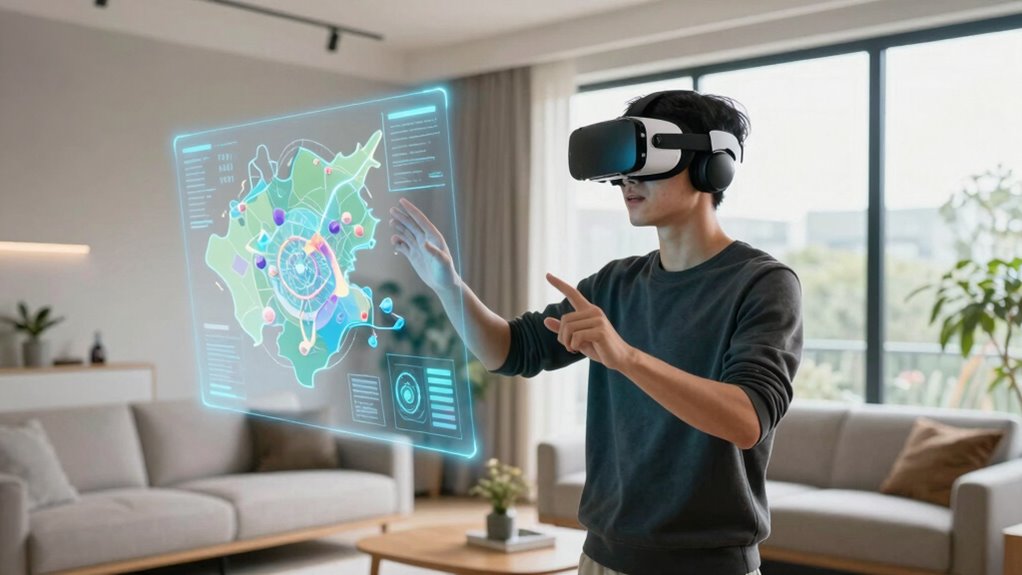
Mixed reality is more practical than earlier VR because it blends digital content directly with your physical environment, allowing you to interact naturally and in real time. You can manipulate virtual objects as if they’re part of your actual surroundings, making workflows faster and more intuitive. It also keeps you aware of your physical space, enhancing safety and usability across various tasks. As technology advances, mixed reality becomes even more seamless and reliable—stick with us to discover how it continues to evolve.
Key Takeaways
- Integrates digital content with the real environment for seamless, contextual interactions.
- Enables real-time manipulation and responsiveness without controllers, improving workflow efficiency.
- Maintains user awareness of surroundings, enhancing safety and usability during practical tasks.
- Supports diverse applications like design, healthcare, and manufacturing with precise spatial anchoring.
- Benefits from technological advancements in sensors and spatial tracking for more immersive and reliable experiences.
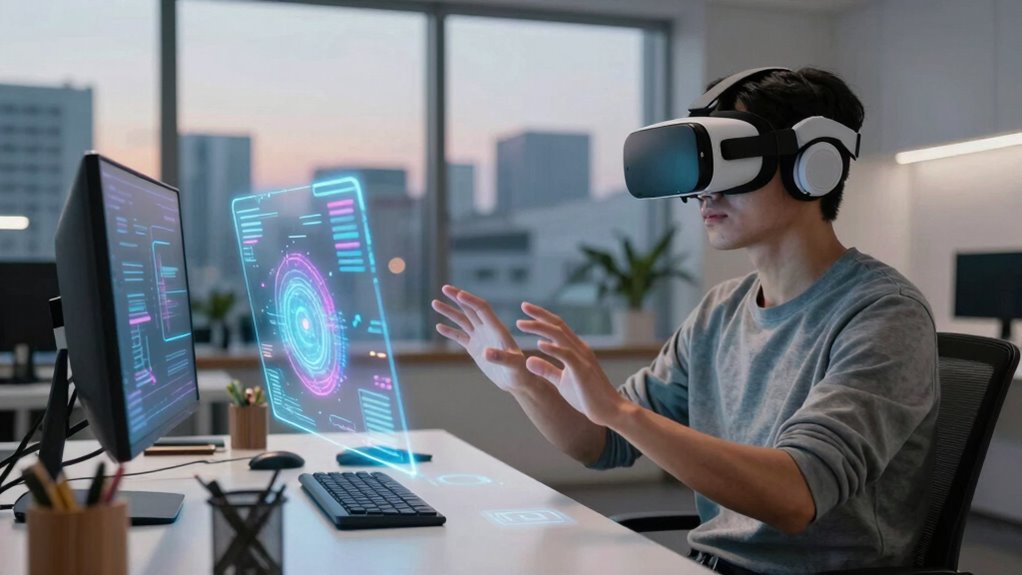
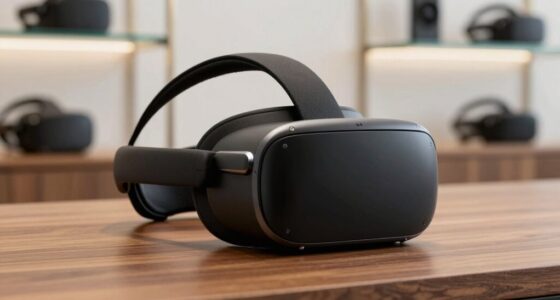
Have you ever wondered how mixed reality differs from virtual reality? The key difference lies in how each immerses you in digital environments. Virtual reality fully transports you into a computer-generated world, shutting out your real surroundings. In contrast, mixed reality blends digital content with your physical environment, creating an augmented overlay that enhances what you see and interact with. This blend allows you to stay connected to the real world while engaging with virtual objects seamlessly integrated into your environment.
Mixed reality combines digital content with the physical world, enhancing real environments with seamless virtual interactions.
One of the greatest advantages of mixed reality over earlier VR systems is the ability to enable real-time interaction. Instead of isolating you in a completely virtual space, mixed reality allows you to manipulate digital elements as if they were part of your real surroundings. For example, you can pick up a virtual tool, move it around, and see how it interacts with real objects in your environment. This immediate and responsive interaction is made possible by advanced sensors and cameras that track your movements and surroundings constantly. The augmented overlay ensures that digital content remains anchored in your real-world space, maintaining spatial consistency and realism.
This real-time interaction also makes mixed reality more practical for diverse applications, from design and education to healthcare and manufacturing. Imagine working on a complex project where you can see virtual models overlaid onto physical prototypes, adjusting and fine-tuning designs with your hands. This direct manipulation speeds up workflows and reduces errors, unlike earlier VR setups that often relied on controllers and lacked the tactile feedback you need for precise work. The ability to see and interact with digital information in your real environment simplifies training, collaboration, and decision-making processes, making mixed reality a versatile tool across industries. Additionally, the sensor technology used in mixed reality devices continuously improves to enhance accuracy and responsiveness.
Furthermore, the augmented overlay in mixed reality enhances safety and usability. Since you’re not cut off from the physical world, you can move naturally without feeling disoriented or isolated. You stay aware of your surroundings, which is essential in scenarios like machinery operation, navigation, or medical procedures. This contrasts with traditional VR, where users often need designated spaces and extensive safety measures to prevent accidents. As the technology advances, immersive environments are becoming more adaptable and accessible for everyday use. Moreover, ongoing developments in spatial tracking contribute to making mixed reality experiences more seamless and reliable. Additionally, the integration of neural interface technology is promising to further improve the responsiveness and intuitiveness of mixed reality experiences.
As an affiliate, we earn on qualifying purchases.
Frequently Asked Questions
How Does Mixed Reality Improve User Interaction Compared to Traditional VR?
Mixed reality improves your interaction by combining augmented interfaces with real-world environments, making tasks more intuitive. You can see and manipulate digital objects within your physical space, thanks to enhanced spatial awareness. Unlike traditional VR, which isolates you, mixed reality allows seamless integration with your surroundings, enabling more natural communication, collaboration, and learning. This practicality makes it ideal for professional, educational, and entertainment applications.
Can Mixed Reality Be Used Effectively in Professional Training?
Yes, you can use mixed reality effectively in professional training. It enables augmented collaboration, allowing trainees and instructors to interact seamlessly within a shared virtual environment. Real-time analytics track performance, providing instant feedback to enhance learning. This immersive approach makes complex skills easier to grasp, boosts engagement, and improves retention. Overall, mixed reality offers a practical, innovative method to elevate training programs across various industries.
What Are the Hardware Differences Between Mixed Reality Headsets and VR Headsets?
You’ll notice that mixed reality headsets differ from VR headsets mainly in hardware compatibility and device ergonomics. Mixed reality devices often feature transparent displays, allowing you to see the real world, while VR headsets block your view with immersive screens. They are usually designed for better comfort, with lighter weight and adjustable straps, making extended use easier. These hardware differences enhance practicality, blending digital content seamlessly with your physical environment.
How Does Mixed Reality Impact Safety During Immersive Experiences?
Imagine you’re in a mixed reality experience, and suddenly, you see a virtual obstacle. Safety protocols are built in, alerting you to avoid real-world hazards. This integration enhances safety during immersive experiences by enabling risk mitigation through real-time environmental awareness. Mixed reality’s ability to blend virtual and physical worlds helps prevent accidents, making your experience safer and more controlled compared to traditional VR, where you might not be aware of your surroundings.
Is Mixed Reality More Cost-Effective Than Earlier VR Systems?
Mixed reality is more cost-effective than earlier VR systems because of better hardware affordability and thorough cost analysis. You spend less on advanced equipment, as mixed reality devices often combine virtual and real-world elements into a single, versatile system. Additionally, you save on space and maintenance costs, making mixed reality a practical choice for businesses and consumers alike. Overall, it’s a smarter investment that delivers enhanced experiences without breaking the bank.

RayNeo Air 3s AR/XR Glasses – 201" 120Hz FHD HueView Display for Movie&Game
- Enhanced Color Accuracy: 98% DCI-P3, ΔE <2, vibrant colors
- Immersive 201-inch Display: Large screen for movies and games
- High Contrast and Detail: 200,000:1 contrast, 145% sRGB
As an affiliate, we earn on qualifying purchases.
As an affiliate, we earn on qualifying purchases.
Conclusion
You might be surprised to learn that by 2025, the mixed reality market is projected to reach $125 billion, showcasing its growing practicality. Unlike earlier VR, mixed reality blends digital and real worlds seamlessly, making tasks like training, design, and collaboration more effective. This integration means you can interact with virtual objects as if they’re real, offering a more natural and immersive experience. As technology advances, mixed reality is set to become even more essential in everyday life.
spatial tracking sensors for mixed reality
As an affiliate, we earn on qualifying purchases.
As an affiliate, we earn on qualifying purchases.
As an affiliate, we earn on qualifying purchases.