
📊 Full opportunity report: Making Sense Of Your Advisor’s Guidance After An Inheritance on IdeaNavigator AI — validation score, market gap, and execution plan.

Get the latest gadgets delivered free — and shop member deals
- Fast, free delivery on millions of items
- Access to Prime Big Deal Days deals on October 6–7
- Prime Video, Amazon Music and more included
TL;DR
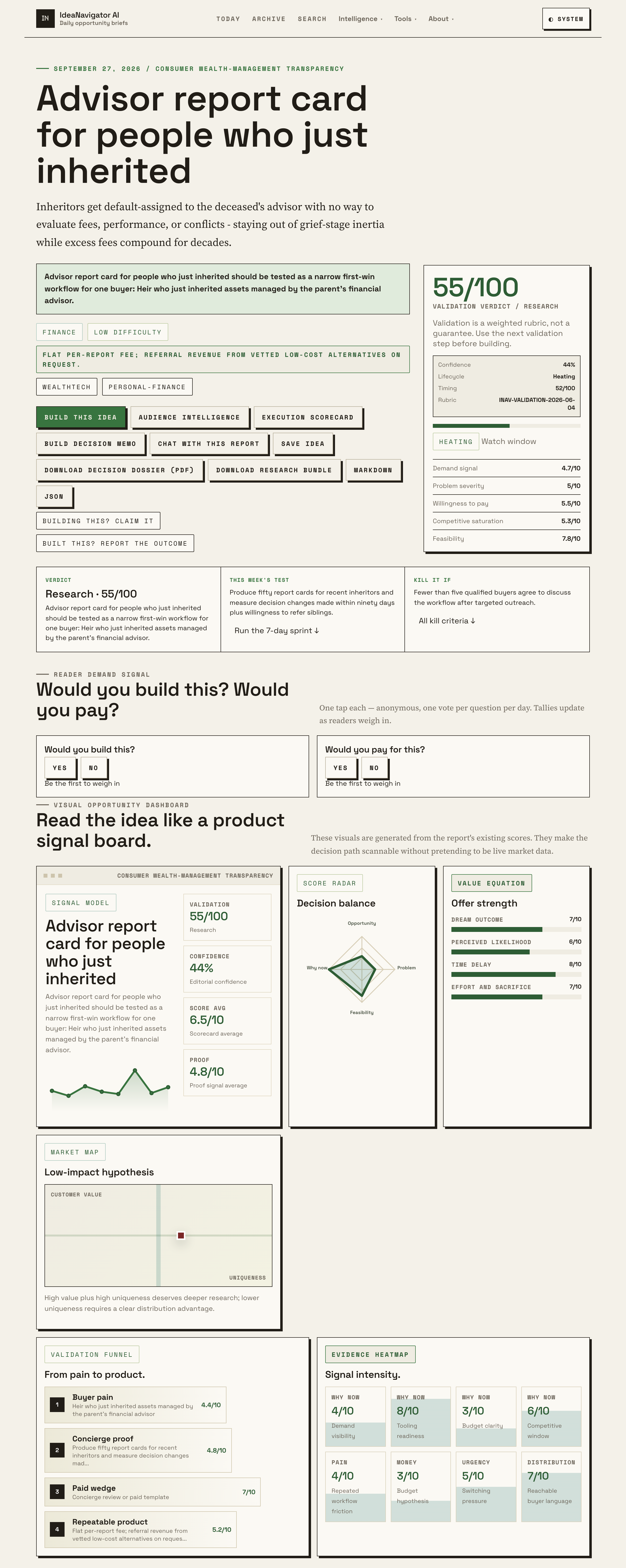
IdeaNavigator AI has proposed testing a paid “advisor report card” for people who inherit assets managed by a parent’s financial advisor. The concept would analyze statements and public disclosures, then offer stay, negotiate or switch guidance; no service launch, user results or measured outcomes are reported.
IdeaNavigator AI has proposed an “advisor report card” for people who inherit assets managed by a parent’s financial advisor, outlining a service that would analyze account statements and public disclosures before suggesting whether to stay, negotiate or switch. The proposal frames the product as a narrow test for recent inheritors; it does not report that the service has launched or that its recommendations have been validated.
The proposed user would enter an advisor’s name and upload financial statements. The report card would combine information from regulatory records and disclosed conflicts with an estimate of the account’s actual all-in fees. It would also compare the advisor with alternatives and provide scripts for discussing fees or a possible move. These are proposed features, not confirmed capabilities of an existing product.
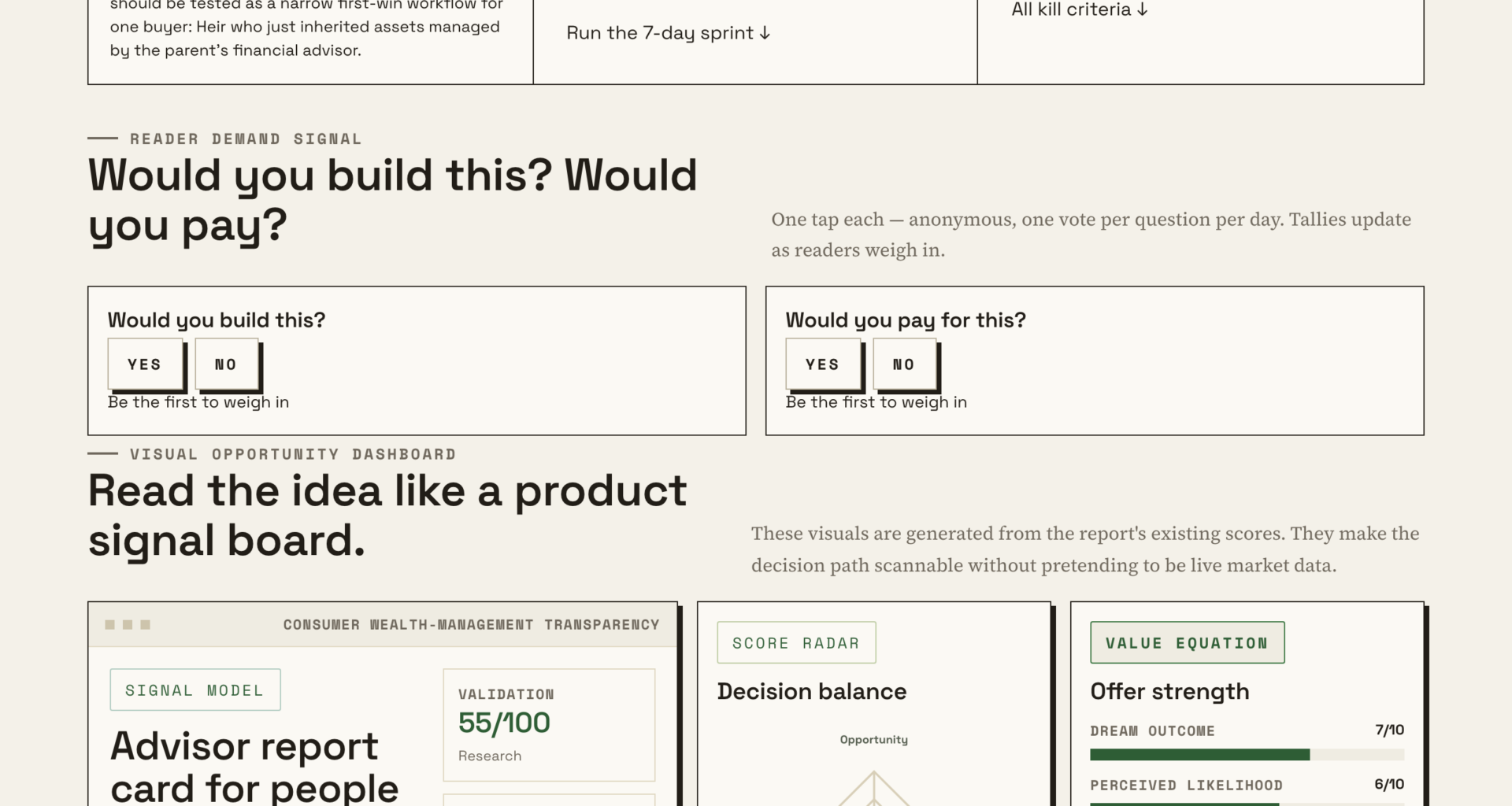
The business model would charge a flat fee per report, with referral revenue from lower-cost alternatives if a customer asks for them. IdeaNavigator AI proposes validating demand by producing 50 report cards for recent inheritors, then tracking whether recipients change their decisions within 90 days and whether they would refer siblings. No pilot results, price, launch date or referral partners are given.
The concept identifies a specific moment of vulnerability: an heir may remain with the deceased person’s advisor by default while coping with a loss and handling unfamiliar assets. The proposal argues that a report could make fees, performance and conflicts easier to assess. It does not provide data establishing how often heirs are assigned an advisor, how many remain due to inertia or how much they might save.
A Review at the Point of Inheritance
The idea focuses on a consequential financial decision that can arise alongside estate administration and bereavement. If heirs keep an advisor without independently reviewing the relationship, the costs and investment choices could affect their finances over time. A readable comparison of fees and disclosures might give them a starting point for asking questions, negotiating or seeking another opinion.
That potential value depends on the accuracy and clarity of the analysis. An estimate drawn from statements must account for the way charges are disclosed, while comparisons between advisors need to reflect differences in services, investments and client circumstances. A report that presents its recommendation as definitive could mislead users if those factors are not explained. The proposal does not describe its methodology, review process or safeguards around referrals.
The planned 90-day measure would offer an early signal of whether reports lead to action, while sibling referrals could indicate whether users find them useful. Neither measure alone would establish that a switch improved an heir’s financial position. The proposal supplies a test plan, not evidence of consumer outcomes.
From Wealth Transfer to Product Test
IdeaNavigator AI grounds the opportunity in the transfer of inherited wealth over the coming decade, describing it as involving trillions of dollars. The proposal gives no estimate, time series or supporting data for that figure, so it should be treated as the rationale presented for the concept rather than a quantified finding established in the proposal.
The concept points to public advisor information, including Form ADV and fee disclosures, as material a service could use. It also proposes using large language models to parse documents. It does not specify which records would be collected, how information would be checked against account statements, or how the system would handle missing or inconsistent disclosures.
The proposed scope is deliberately specific: an heir who has just inherited assets already managed by a parent’s advisor. IdeaNavigator AI recommends beginning with that group rather than addressing the broader consumer wealth-management market. Its next step is a small validation effort, not a reported rollout.
How the Report Would Be Checked
No product launch or pilot outcome is reported. The proposal does not state the report’s price, when testing would begin, which alternatives would be included, or what evidence would qualify an advisor comparison as fair. It also leaves open how the service would verify fee calculations, handle incomplete statements, explain conflicts and protect sensitive financial documents.
The proposal describes the wealth transfer as involving trillions but supplies no underlying estimate or timeframe beyond “this decade.” It also does not quantify how often heirs keep a parent’s advisor by default or establish that grief is a primary cause. Those points remain part of the business case rather than demonstrated findings.
A 50-Report Validation Pilot
The next step outlined by IdeaNavigator AI is to produce 50 reports for recent inheritors. The proposed measures are whether recipients make a decision change within 90 days and whether they would refer siblings. The proposal does not say whether the pilot is funded, who would run it, or how a decision change would be defined.
If the test proceeds, its results could show whether heirs will pay for an independent review and whether the report prompts conversations or changes. Further details would be needed to judge the quality of its fee estimates and comparisons, and whether any referral revenue affects the alternatives shown. No timetable or findings are currently available.
Source: IdeaNavigator AI
Key Questions
Has the advisor report card launched?
No launch is reported. IdeaNavigator AI presents it as a proposed product and outlines a potential validation test.
What would the proposed report assess?
It would analyze an advisor’s regulatory history and disclosed conflicts, estimate fees from account statements, compare alternatives and offer stay, negotiate or switch guidance.
How would the service make money?
The proposal suggests a flat fee per report and referral revenue from lower-cost alternatives when users request them. No price or referral partners are specified.
How would IdeaNavigator AI test demand?
It proposes producing 50 reports for recent inheritors and tracking decision changes within 90 days, along with willingness to refer siblings. Results have not been reported.
Source: IdeaNavigator AI
Fall Picks
fall essentials
As an affiliate, we earn on qualifying purchases.