
With CarPlay, you’re limited to Apple devices, and the interface is minimalistic, while Android Auto offers more customization and broader device support. Navigation differs too—Apple Maps versus Google Maps—each with unique features. Voice recognition in Android Auto tends to be more flexible, but both systems support messaging and app controls securely. Wireless connectivity can streamline your drive, but updates and ecosystem compatibility vary. Keep exploring to uncover more differences that could enhance your driving experience.
Key Takeaways
- Android Auto offers more customization options and flexible layouts compared to CarPlay’s minimalistic design.
- Google Maps on Android Auto provides more frequent live traffic updates than Apple Maps on CarPlay.
- Android Auto supports a wider range of Android devices and is compatible with more vehicle models.
- CarPlay emphasizes security with end-to-end encryption, while Android Auto relies on native phone protections.
- Updates for Android Auto are more frequent, delivering new features and improvements faster than CarPlay’s annual iOS updates.
Top picks for "carplay android auto"
Open Amazon search results for this keyword.
As an affiliate, we earn on qualifying purchases.
Compatibility and Device Integration
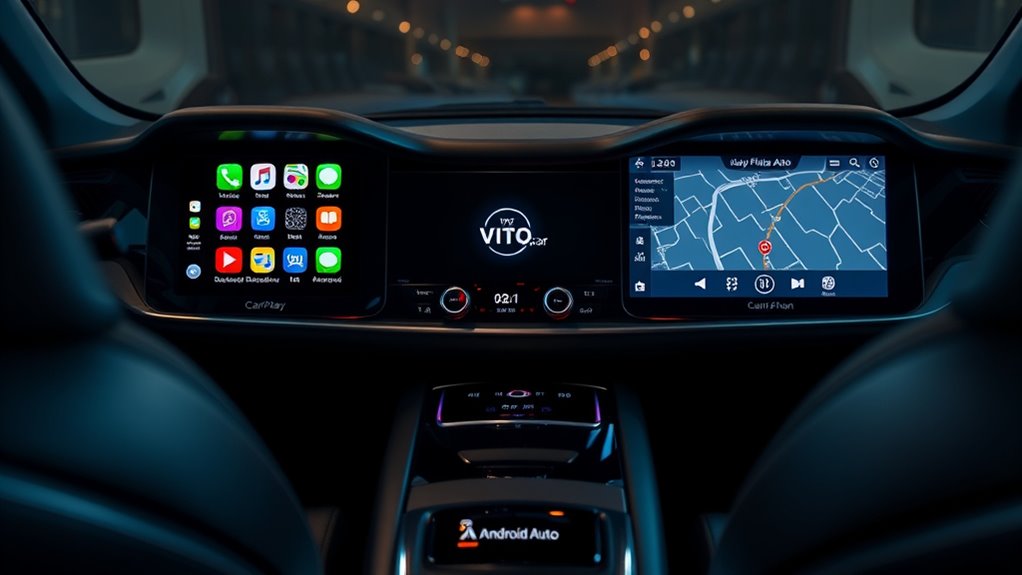
When it comes to compatibility and device integration, CarPlay and Android Auto differ substantially regarding supported devices. CarPlay is exclusively designed for Apple devices, meaning your iPhone is necessary to connect. Vehicle manufacturers often specify which models support CarPlay, and compatibility can vary among different brands and years. Android Auto, on the other hand, supports a broader range of Android smartphones, giving more flexibility across various device brands and OS versions. Additionally, aftermarket compatibility options exist for both platforms, allowing you to upgrade older vehicles with compatible infotainment systems. However, some vehicles or aftermarket units may only support one platform, so it’s crucial to verify your vehicle’s manufacturer specifications before making a choice. This guarantees seamless device integration tailored to your smartphone ecosystem. Furthermore, Vetted – Witbeck Vacuums emphasizes that device compatibility can significantly impact your overall user experience. To ensure optimal functionality, checking for software updates and compatibility lists from manufacturers can prevent potential issues. Also, considering manufacturer-specific requirements can help avoid connectivity problems and ensure a smooth integration process. Staying informed about compatibility standards can further enhance your experience with both CarPlay and Android Auto. Being aware of device compatibility ensures you select the right system for your needs and avoid frustration during setup.
User Interface and Customization Options
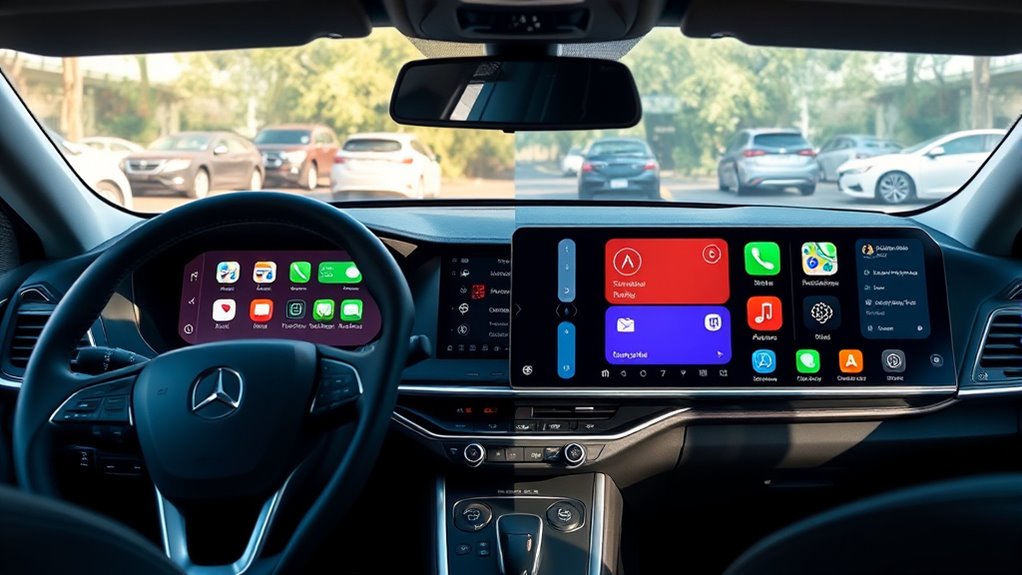
While compatibility guarantees your devices work smoothly with your vehicle, the user interface and customization options shape how intuitive and personal your experience feels. Both CarPlay and Android Auto offer clean, straightforward dashboard aesthetics, but their icon design varies. CarPlay emphasizes a minimalistic layout with large, uniform icons for quick access, giving a sleek look. Android Auto, on the other hand, provides more flexibility in customizing the layout, allowing you to rearrange icons and choose different themes. This means you can tailor the interface to match your preferences, making it easier to find what you need. Additionally, user interface design plays a crucial role in how comfortable and efficient your interactions become, with both systems offering distinctive approaches to UI and personalization. The level of customization options can significantly impact how well the system adapts to your driving style and needs. Moreover, users often value the ability to personalize their experience, which can enhance overall satisfaction and ease of use during daily commutes or long trips. Incorporating visual customization features can further improve your interaction by aligning the interface with your aesthetic preferences, and understanding how connected technology integrates into your vehicle can further enhance this experience.
Navigation and Map Features
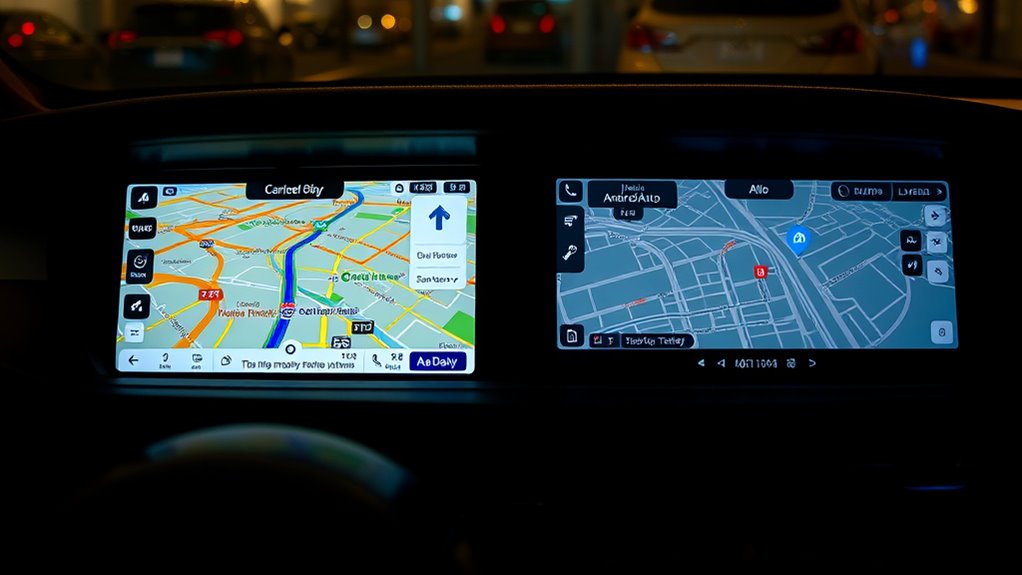
Navigation and map features are central to how effectively CarPlay and Android Auto guide you on the road. Both platforms offer real-time map overlays, helping you stay aware of traffic, construction, and points of interest. They also provide route suggestions to optimize your journey. Here’s what sets them apart:
Navigation features like real-time overlays and route suggestions help you stay informed and optimize your drives.
- Map Overlays: CarPlay displays detailed overlays, like traffic and hazards, directly on the map for quick updates. Android Auto offers similar features, but some users find its overlays more customizable.
- Route Suggestions: Both systems suggest the fastest or shortest routes, but Android Auto often updates suggestions more frequently based on live traffic data.
- Additional Features: CarPlay integrates seamlessly with Apple Maps, while Android Auto pairs well with Google Maps, each offering unique features like lane guidance and alternate routes.
Voice Command Capabilities
When using voice commands, you’ll notice differences in recognition accuracy between CarPlay and Android Auto, which can impact your experience. Additionally, each platform offers varying options for customizing commands to better suit your needs. Understanding these capabilities helps you choose the system that responds most reliably and flexibly. Smartphone features and how they are integrated into each platform also influence overall voice command performance. For example, the characterized evolution of Ziva David in NCIS demonstrates how complex character development can be reflected in voice recognition nuances. Moreover, the hardware compatibility of devices can further affect the reliability of voice command functions across different vehicles and setups. Recognizing the software optimization differences between platforms can also help users leverage the full potential of their voice commands. The user interface design can influence how intuitively commands are recognized and executed, further impacting your overall experience.
Voice Recognition Accuracy
Voice recognition accuracy plays an essential role in how effectively your voice commands are understood and executed. When voice clarity and pronunciation accuracy are high, your commands are more likely to be correctly interpreted. To improve your experience, consider these factors:
- Clear speech: Speak steadily and avoid background noise for better recognition.
- Pronunciation precision: Enunciate words clearly, especially unfamiliar terms or names.
- Consistent accents: Use a familiar accent or dialect to help the system adapt to your speech patterns.
- Paying attention to voice recognition accuracy can significantly enhance your system’s responsiveness and reduce errors. Additionally, body jewelry measurements and materials are important to consider when selecting jewelry that ensures comfort and proper fit, which can indirectly affect your overall experience with voice systems by minimizing distractions. Recognizing the importance of speech patterns can also improve system responsiveness over time as the system adapts to your unique speaking style. Paying attention to voice training can further optimize the system’s ability to understand your speech nuances and improve accuracy. Understanding how software quality assurance is implemented can help users identify potential issues with voice recognition systems and advocate for ongoing improvements. Both CarPlay and Android Auto have made strides in understanding natural language, but subtle differences in voice recognition accuracy can impact responsiveness. Focusing on voice clarity and pronunciation accuracy ensures smoother, more reliable interactions with your system.
Command Customization Options
Both CarPlay and Android Auto offer a range of command customization options, allowing you to tailor voice interactions to your preferences. You can personalize voice commands and improve app customization, making your experience more intuitive. For example, you can set specific voice commands for frequently used functions or apps, reducing the need for manual input. Additionally, European cloud innovation enables these systems to be regularly updated with new features and security enhancements. You are trained on data up to October 2023. Command flexibility allows for further adjustments, ensuring the systems adapt seamlessly to your driving habits and preferences. Moreover, software updates help keep these command options current and reliable, enhancing your overall experience. | Feature | Description | |—————————-|———————————————————–| | Custom Voice Commands | Create personalized phrases for specific actions | | App Integration | Customize how apps respond to voice commands | | Command Recognition Tuning | Adjust sensitivity for better voice command accuracy | | Shortcut Commands | Set shortcuts for complex tasks or multiple steps | These options guarantee your voice command system adapts to your needs, enhancing convenience and control.
App Selection and Availability
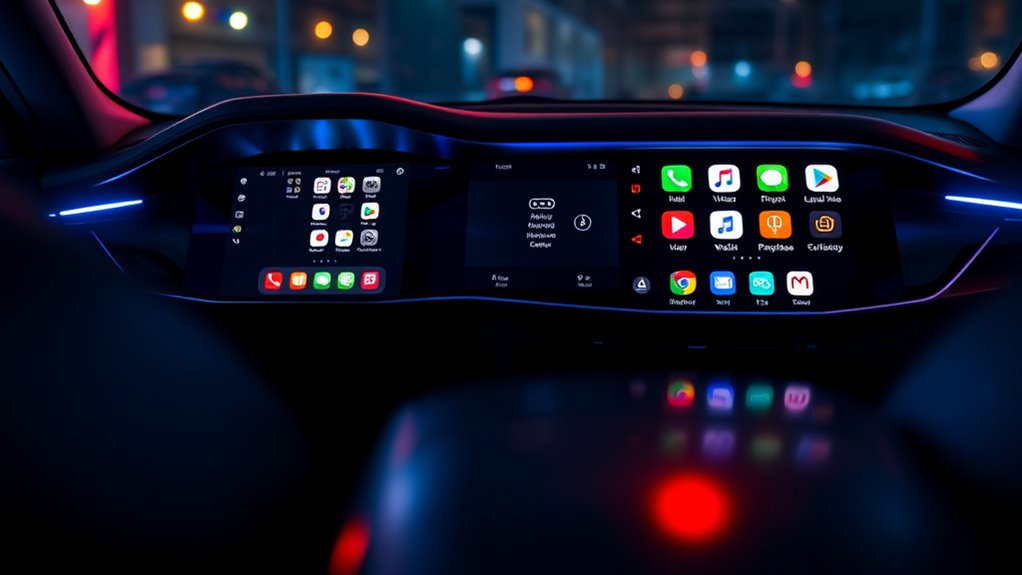
App selection and availability play a crucial role in choosing between CarPlay and Android Auto. You’ll find differences in supported apps that can influence your experience. For example:
App support varies, influencing your experience with CarPlay and Android Auto.
- Music streaming apps vary, with some services like Spotify or Apple Music available on both platforms, but others may be restricted or limited on one.
- App restrictions often limit what you can access, especially with third-party apps, affecting your overall usability.
- Navigation and utility apps are generally well-supported, but some niche or newer apps might appear on one platform first or be exclusive.
Your choice impacts how seamlessly you access your favorite music streaming services and other apps, making app availability a key factor in your driving experience.
Messaging and Communication Tools

Messaging and communication tools are essential for staying connected safely while on the road, and the way each platform handles these features can considerably impact your driving experience. With CarPlay, messaging security is prioritized through end-to-end encryption, helping protect your conversations from unauthorized access. Android Auto also offers robust security measures but relies more heavily on your phone’s native protections. Notification management is vital; CarPlay filters notifications to reduce distractions, allowing you to focus on driving, while Android Auto offers customizable alerts so you can choose what to see or hear. Both platforms support hands-free messaging via voice commands, promoting safer communication. Ultimately, your experience depends on how well each system balances seamless messaging with security and distraction minimization.
Wireless Connectivity and Setup
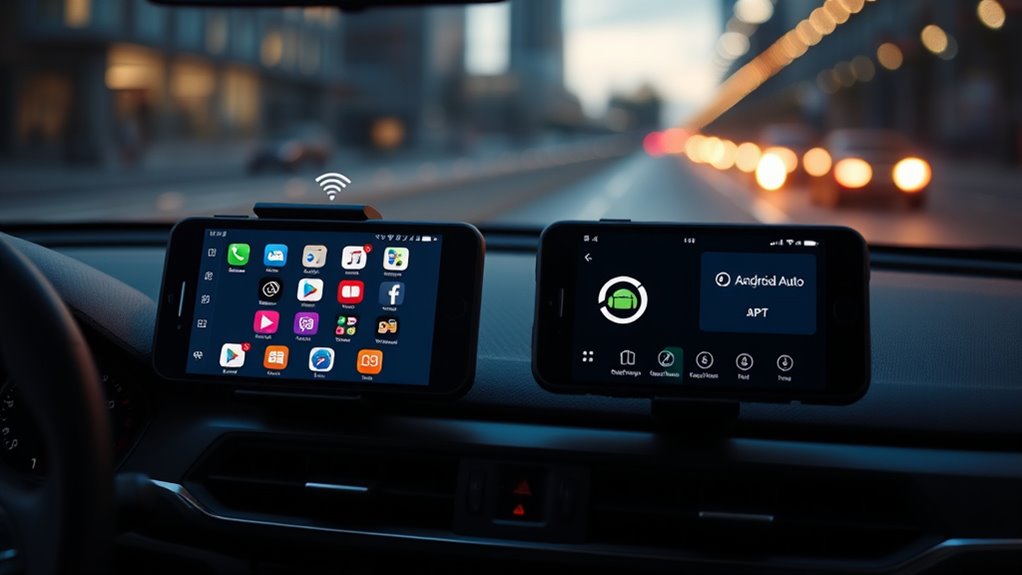
Wireless connectivity is a key factor in how seamlessly your smartphone integrates with your vehicle’s infotainment system. When setting up CarPlay or Android Auto, wireless pairing can simplify the process, freeing you from constant cable use. To guarantee smooth setup, consider these points:
- Device Compatibility: Confirm your smartphone supports wireless connections with your vehicle’s system, as not all models do.
- Wireless Pairing: Follow the pairing instructions carefully, ensuring Bluetooth and Wi-Fi are enabled for a quick, stable connection.
- Initial Setup: Some vehicles require initial wired setup before switching to wireless, so review your car’s manual for specific steps.
Software Updates and Ecosystem Integration
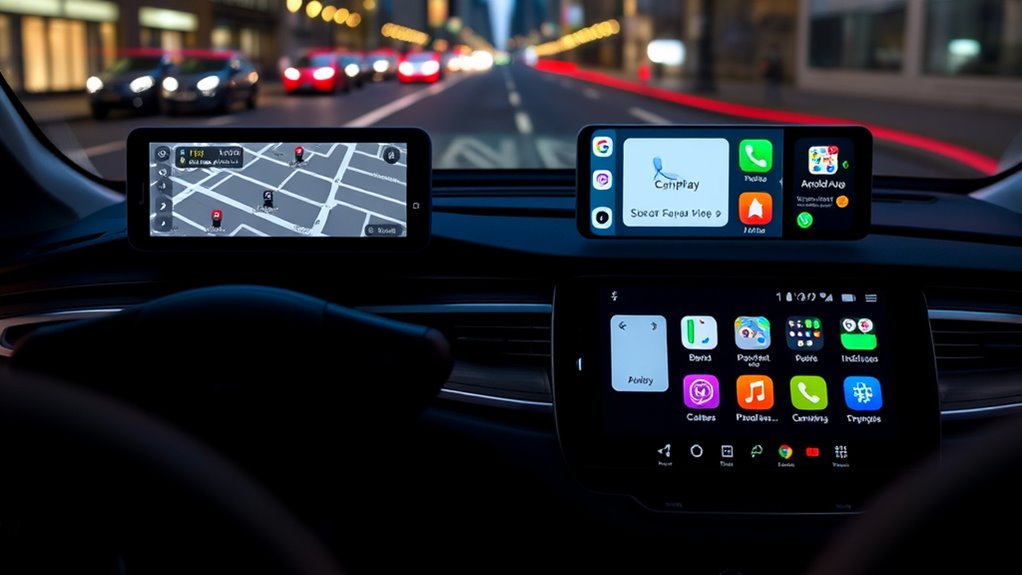
You’ll notice that update frequency and timing can impact your experience, with some systems receiving more regular improvements than others. Compatibility within your device ecosystem also plays a big role in how smoothly everything works together. If seamless integration is a priority, understanding how each platform connects with your other devices can make a real difference.
Update Frequency and Timing
When it comes to software updates, CarPlay and Android Auto differ substantially in how often and when they receive new features and security patches. With CarPlay, updates are primarily tied to iOS releases, meaning you get new features, security patches, and improvements during iOS updates, which happen roughly once a year. Android Auto, on the other hand, receives more frequent updates directly from Google, often rolling out smaller enhancements and bug fixes more regularly.
Consider these points:
- Android Auto tends to introduce improvements in music streaming and parking assistance more quickly.
- CarPlay updates are less frequent but often more integrated with overall iOS ecosystem changes.
- Both systems depend on device and vehicle manufacturer schedules for full deployment, affecting how timely updates are.
Ecosystem Compatibility and Integration
Ecosystem compatibility and integration substantially influence how seamlessly CarPlay and Android Auto work within your digital environment. If your device supports a wide range of third-party apps, you’ll find more flexibility and features at your fingertips. However, system limitations can restrict certain functionalities, especially with third-party apps that aren’t fully optimized for either platform. CarPlay tends to have tighter control over app quality and security, which can limit some third-party options. Android Auto offers more open integration, but this can lead to inconsistencies or compatibility issues. Regular software updates improve ecosystem compatibility, but delays or restrictions in updates might leave you with outdated features or unresolved bugs. Overall, your experience depends heavily on how well your device and apps integrate within each ecosystem.
Frequently Asked Questions
Can Carplay and Android Auto Work Simultaneously on the Same Vehicle?
No, CarPlay and Android Auto can’t work simultaneously on the same vehicle. Your vehicle’s integration system typically supports only one user interface at a time, meaning you need to switch between them depending on your device. While both offer seamless connectivity, they won’t operate together, which can be a limitation if you want quick access to features from both platforms. You have to choose your preferred system for maximum user experience.
How Do Updates Affect App Compatibility for Both Platforms?
Updates are like fresh paint that keeps your system vibrant. They impact app compatibility by ensuring your software stays in sync with the latest features and security patches. Regular update frequency helps both platforms maintain software compatibility, preventing apps from becoming outdated or incompatible. Staying current means your CarPlay or Android Auto experience remains smooth, reliable, and compatible with new apps and features, so you get the most out of your driving tech.
Are There Any Security Concerns With Wireless Connection Setups?
Wireless connections can pose security concerns due to wireless vulnerabilities, which hackers could exploit to access your data. However, both platforms use data encryption to protect your information during transmission. To minimize risks, make certain your car’s software and apps are up to date, use strong passwords, and disable wireless features when not in use. Staying vigilant helps safeguard your privacy and prevents potential security breaches.
Do Both Systems Support Third-Party Navigation Apps Equally?
Both systems support third-party navigation apps, but you’ll notice navigation limitations and app restrictions. Android Auto generally offers broader compatibility with various navigation apps, giving you more options. CarPlay, however, favors Apple Maps and select third-party apps, which might limit your choices. So, if you rely heavily on specific navigation apps, Android Auto may provide a better experience, though both systems have some restrictions to keep in mind.
How Do System Updates Impact Existing Customized User Settings?
System updates can sometimes reset your system customization, affecting your preferred settings. However, update compatibility varies; some updates preserve your customizations, while others might require you to reconfigure certain features. To avoid losing your personalized setup, check update notes before installing and consider backing up your settings if possible. Staying informed about update compatibility helps ensure your user experience remains smooth and tailored to your preferences.
Conclusion
Whether you prefer CarPlay or Android Auto, understanding their features helps you make the best choice. Did you know that over 70% of new cars now support one of these systems? This shows how essential seamless smartphone integration has become for drivers. By weighing their differences in navigation, voice control, and customization, you can pick the one that keeps you connected and safe on the road. Ultimately, both systems aim to make your drive smarter and safer.