TL;DR

Get the latest gadgets delivered free with Prime
- Fast, free delivery on millions of items
- Prime Video, Amazon Music and more included
- Member-only deals all year
The Quantum Kid has released an episode filmed inside Microsoft’s quantum lab in Lyngby, Denmark, showing how the company makes and tests Majorana chips. The tour explains the manufacturing behind Microsoft’s topological-qubit approach, but the episode does not resolve ongoing questions about whether the devices demonstrate genuinely topological behavior.
The Quantum Kid has released a new episode filmed inside Microsoft’s quantum lab in Lyngby, Denmark, following 10-year-old host Kai as Microsoft Quantum executive Lauri Sainiemi explains how the company fabricates and tests chips for its Majorana-qubit program. The tour gives viewers a look at the hardware behind Microsoft’s effort to develop topological qubits, an approach intended to make quantum information less vulnerable to errors.
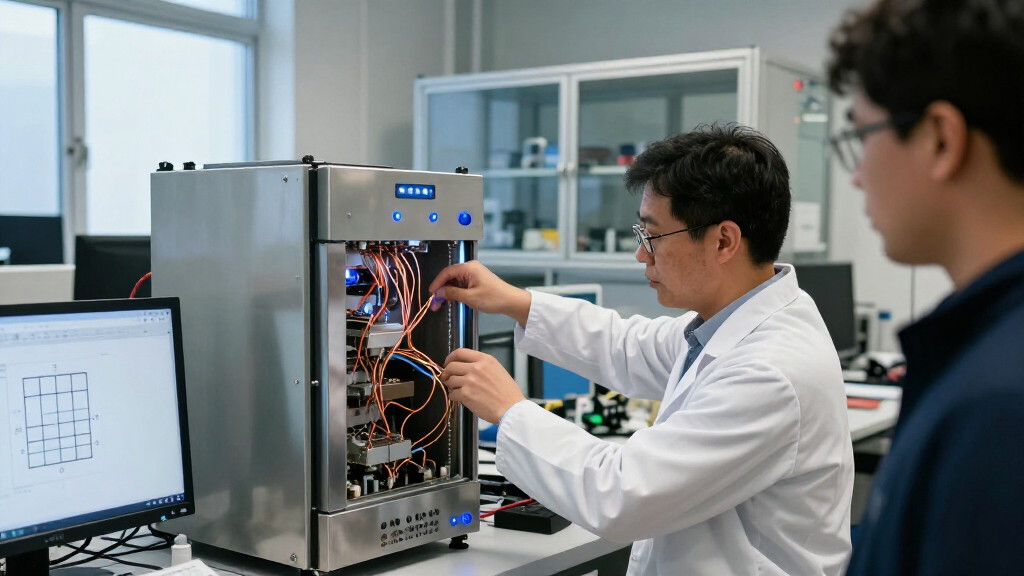
Produced by Tesseract Quantum in collaboration with Microsoft, the episode follows Kai through three parts of the Lyngby site: a materials lab, a clean room and a cryostat lab. Sainiemi, Microsoft Quantum’s vice president of fabrication, guides him through the process. The report describes Lyngby as Microsoft’s largest quantum site and says that, following an expansion in 2025, it can fabricate the full core of the company’s Majorana chips.
At the start of the process, molecular beam epitaxy machines grow material layers one atom at a time inside an ultra-high vacuum. The layers combine a semiconductor and a superconductor to create what Microsoft calls a topoconductor. In a clean room, that material is patterned into tiny nanowire devices. Finished chips are then placed in gold-colored cryostats, which cool them to temperatures near absolute zero so researchers can test the quantum effects on which the proposed qubits depend.
The episode presents this manufacturing sequence as the practical foundation for Microsoft’s topological-qubit strategy. The company’s theory is that Majorana zero modes could form at the ends of specially engineered superconducting nanowires, allowing quantum information to be stored across a device rather than concentrated in one vulnerable location. That protection is a design goal; the tour itself is not a scientific demonstration that the approach has solved quantum error problems.
How the Lyngby Lab Supports Microsoft’s Bet
The episode makes a technically complex research program more visible by showing the manufacturing work behind it. Making nanoscale devices from carefully controlled material layers and testing them at extremely low temperatures are central to Microsoft’s effort to build a different kind of quantum computer. The lab tour helps explain why fabrication is not just a supporting task: material quality and device construction may affect whether the proposed quantum states can be created and measured reliably.
The broader stakes are significant for the field. Quantum processors are sensitive to noise, and error correction is a major challenge for many approaches. Microsoft’s topological strategy is designed to reduce some errors at the hardware level, which could change the amount of additional error correction needed if it works as intended. But a compelling manufacturing story is not, by itself, proof of a scalable or fault-tolerant computer. The scientific case depends on evidence that the devices exhibit the predicted topological properties and can support reliable operations.
For viewers, the episode offers an accessible account of what researchers actually do: grow materials, pattern devices and cool them to near absolute zero. For the quantum industry, it also places attention on a high-profile program whose technical claims and long-term prospects remain closely watched.
Products Worth Considering

Samsung Galaxy Tab A11 (2026) – 8.7 90Hz Android Tablet, 64GB/4GB Wi‑Fi, Octa-core MediaTek Helio G99, Dual Dolby Speakers, 20W Fast Charger

Apple AirPods Pro 3 Wireless Earbuds with Active Noise Cancellation

Bose TV Speaker (2nd Gen) Compact Soundbar
As an affiliate, we earn on qualifying purchases.
From Majorana’s Prediction to Chipmaking
The name traces to Italian physicist Ettore Majorana, who in 1937 predicted a particle that would be its own antiparticle. Microsoft’s program concerns Majorana zero modes, proposed exotic quantum states in engineered materials—not a claim that the original particle prediction has been directly realized in these chips. The company’s approach seeks to encode information in a way that is less exposed to local disturbances.
The episode arrives after Microsoft’s June 2026 announcement of Majorana 2, its second-generation chip. Microsoft said the device improves qubit reliability 1,000-fold compared with Majorana 1 and reported average parity lifetimes of about 20 seconds, attributing the results to a new lead-based material stack. Those figures and their characterization are company claims as presented in the source report. Microsoft has also moved its stated target for a scalable quantum computer to 2029; a target is not a guarantee that the system will be ready by then.
The Quantum Kid is a YouTube channel and video podcast produced by the Swiss educational nonprofit Tesseract Quantum. The show uses questions from Kai to explain quantum technology and has featured researchers and technology leaders. The new episode was filmed by Bifrost Productions and made with Microsoft’s collaboration.
“Majorana 2 improves qubit reliability 1,000-fold over Majorana 1.”
— Microsoft, as reported by The Quantum Insider
Questions About Topological Evidence Remain
The source report says physicists continue to debate how to confirm that Microsoft’s devices are truly topological. The episode shows the fabrication and testing environment, but it does not independently establish that the chips host the states required for the company’s approach or that those states protect information as intended.
Details of the evidence behind Microsoft’s reported reliability improvement and parity lifetimes are not fully set out in the supplied report. It also does not provide independent assessments of those figures, define the complete comparison methodology, or establish how the devices perform as part of a larger fault-tolerant system. Microsoft’s 2029 goal remains a stated target, and whether it can be met is not yet clear.
Testing the Chips and the 2029 Goal
The immediate next step for Microsoft’s team is continued testing of devices fabricated in Lyngby, including whether measurements support the topological behavior the design depends on. The company’s stated longer-term milestone is a scalable quantum computer targeted for 2029. Progress toward that goal will depend on technical results beyond the lab visit, including evidence that qubits can be operated reliably and scaled into a useful system. The source report gives no specific date for a subsequent technical milestone or independent review.
Key Questions
What does the new Quantum Kid episode show?
It follows 10-year-old Kai through Microsoft’s Lyngby quantum lab as Lauri Sainiemi explains how Majorana chips are made, from growing material layers to patterning devices and testing them in cryostats.
What is a Majorana qubit?
It is Microsoft’s proposed type of topological qubit, based on Majorana zero modes in engineered materials. The intended design would spread quantum information across a device to make it less susceptible to local disturbances.
Does the lab tour prove Microsoft has built a working topological qubit?
No. The episode shows fabrication and testing facilities, but the source report says physicists continue to debate how to confirm that the devices are truly topological.
What has Microsoft said about Majorana 2?
Microsoft said in June 2026 that Majorana 2 improves qubit reliability 1,000-fold over Majorana 1 and has average parity lifetimes of about 20 seconds. These are company-reported figures in the source material.
When does Microsoft expect a scalable quantum computer?
Microsoft has stated a target of 2029. The date is a company goal, not a confirmed delivery date.
Source: thequantuminsider.com