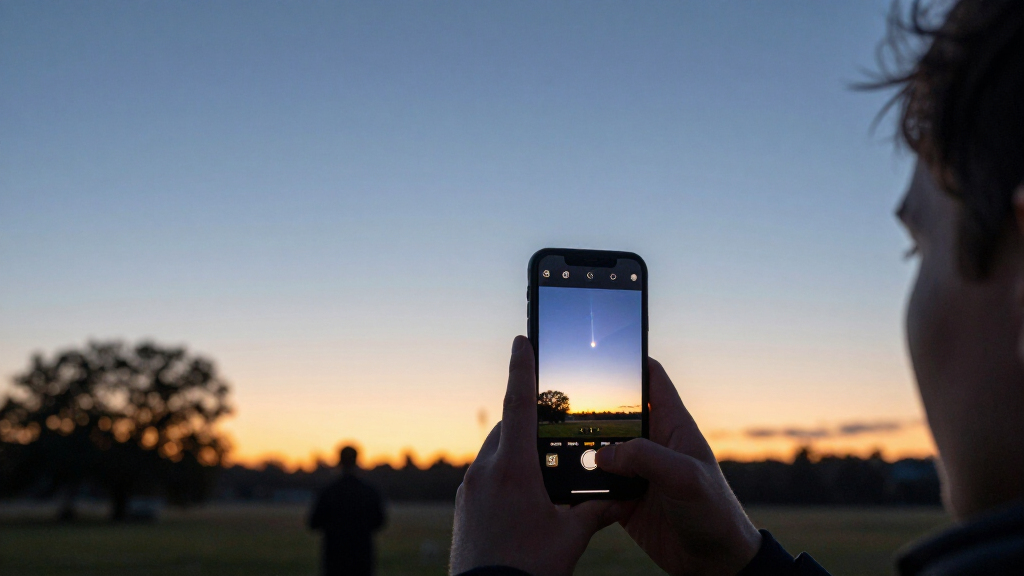

🔍 Read the full analysis: The Role Of Held Light In This AI Comet Scene on ThorstenMeyerAI.com

Get the latest gadgets delivered free with Prime
- Fast, free delivery on millions of items
- Prime Video, Amazon Music and more included
- Member-only deals all year
TL;DR
OORT is an AI-built web exhibition about the fictional comet P/2043 K1 Vesper. Its star trails accumulate with time spent on the page, while scrolling and other controls animate an imagined comet vigil; the comet and observatory are fictional, not astronomical discoveries.
OORT — Comet Vigil for P/2043 K1 Vesper is an AI-built online exhibition that makes a visitor’s time on its page visible through slowly lengthening star trails. The fictional observatory and comet are not real astronomical subjects; the piece matters as an example of interactive web art using elapsed time, scrolling and local browser storage to make waiting part of the work.
The exhibition’s central device is a canvas star field: seeded stars trace curved paths around a point below the screen, and the arcs lengthen over time. The source says the animation resumes from the same local sky when a visitor returns on that device, with elapsed time preserved in local storage. The paths use a logarithmic curve intended to make early changes apparent while allowing a longer visit to continue shaping the scene.
A second instrument uses scroll progress to move the imagined comet through an inline SVG. Its ion tail points away from the sun, while its dust tail curves along the imagined orbit; both respond to a shared progress value. A range control adjusts a defocus view and associated brightness estimate. Visitors can also hold a control to open a simulated shutter, which records a timestamp without claiming that the comet has been seen.
The page’s visual language draws on a dark-adapted observatory: black backgrounds, cyan for the ion tail and readings, amber-red for actions, and pale dust-toned text. The source says animation pauses when the page is hidden and that users with reduced-motion settings receive a still version. The exhibition is listed as room 170 of 175 in the FABLE/175 collection, and its footer links to the prompt that guided its creation.
How Waiting Shapes the Artwork
OORT’s main idea is that time spent viewing can alter the work, rather than merely precede it. By accumulating trails and retaining elapsed time locally, the page gives visitors a visible record of attention. That shifts the interaction away from the usual pattern of clicking through content toward staying with a changing scene.
The shutter interaction extends the idea without presenting a fabricated astronomical result. Its timestamp records a visitor’s act of looking, while the comet remains unseen within the fiction. That distinction matters: the design uses observatory conventions and astronomy-inspired graphics, but it does not report a detection or offer real ephemeris data. Readers should treat the experience as AI-built art, not an astronomy tool.
The source also presents the project as a technical study in browser-based visual design. It describes seeded canvas drawing, SVG motion, reduced-motion behavior and pausing animation when a tab is hidden. Those features connect the artwork’s theme to its implementation, though the source does not provide independent testing or performance measurements.
As an affiliate, we earn on qualifying purchases.
The Fiction Behind P/2043 K1
The project frames P/2043 K1 Vesper as a comet watched by an imagined community over decades. Its surrounding copy refers to invented observing logs, a long wait and a supposed last sighting in 1608. These are elements of the exhibition’s fiction, not verified historical or astronomical records.
The room is hosted at the FABLE/175 collection and identified in the supplied material as room 170 of 175. The source says the site exposes its original art-direction prompt through a footer link and has a separate design guide describing the visual and technical approach. It attributes the brief to Claude Fable 5 and says the room was executed by the FABLE/175 pipeline; those are descriptions supplied by the project, not independently verified accounts of authorship or process.
“The page makes duration part of the artwork instead of treating it as time spent before the content.”
— The OORT exhibition description
browser-based star trail visualization
As an affiliate, we earn on qualifying purchases.
As an affiliate, we earn on qualifying purchases.
What the Exhibition Does Not Verify
The source identifies the comet, observatory, community and observing history as fictional. It gives no real orbital measurements or independent astronomical data for P/2043 K1 Vesper, and the experience should not be read as evidence that such a comet exists. The supplied material also does not specify when the room went live.
The descriptions of local persistence, reduced-motion behavior and animation pausing are project-provided explanations. The source includes no independent browser testing, accessibility audit, performance results or detailed technical documentation in the material provided here. It is also unclear whether the local elapsed-time record behaves the same across browsers or devices; the description says the sky is consistent on a given device, not that state synchronizes between devices.
As an affiliate, we earn on qualifying purchases.
Explore the Room and Its Guide
Readers can visit the live OORT room and its linked design guide to inspect the changing sky, controls and project notes directly. The source also points to the wider FABLE/175 collection of 175 rooms. No release schedule, update plan or further development milestone is announced in the supplied material.
As an affiliate, we earn on qualifying purchases.
Key Questions
Is P/2043 K1 Vesper a real comet?
No. The source describes P/2043 K1 Vesper as fictional, as well as the observatory and its watching community. The exhibition is an artwork, not an astronomical report.
What does the star-trail effect do?
A seeded canvas field draws curved trails that lengthen with elapsed time. According to the project description, the page saves elapsed time locally so the scene can resume on the same device.
Does the shutter interaction show a comet sighting?
No. Holding the control opens a simulated shutter and records a timestamp. The exhibition explicitly frames this as a record of attention; it does not claim the visitor has seen the fictional comet.
Does the page account for reduced-motion preferences?
The source says visitors whose devices request reduced motion receive a still version, and that animation pauses when the page is hidden. Those are project-provided descriptions; no independent accessibility test is included in the material.
Source: ThorstenMeyerAI.com
Halloween Picks
halloween
As an affiliate, we earn on qualifying purchases.