📊 Full opportunity report: Industry 4.0 Meets VR: Transforming Manufacturing Workforce Training on IdeaNavigator AI — validation score, market gap, and execution plan.

Get the latest gadgets delivered free with Prime
- Fast, free delivery on millions of items
- Prime Video, Amazon Music and more included
- Member-only deals all year
TL;DR

Manufacturing companies are piloting VR training modules on standalone headsets to improve safety and onboarding efficiency amid labor shortages. Early tests focus on high-risk procedures with promising results, potentially transforming workforce development.
Manufacturers are currently testing virtual reality (VR) training modules on standalone headsets as a solution to address labor shortages and skills gaps, with early pilots showing promising improvements in onboarding speed and hazard recognition. This development signals a significant shift in industrial workforce training, especially for mid-to-large manufacturing plants responsible for high-risk procedures.
The initiative focuses on deploying VR modules for critical safety procedures, such as lockout/tagout and forklift safety, delivered via affordable standalone headsets like Mercedes-Benz’s new electric motor manufacturing push and Pico. These modules are paired with cloud dashboards that track worker progress, scoring hazard recognition, and measuring time-to-competency. The goal is to replace or supplement traditional classroom and on-floor training, which is often slow, inconsistent, and risky on live equipment.
Manufacturers face a pressing challenge: the U.S. manufacturing sector had approximately 409,000 unfilled positions in August 2025, with projections indicating a need for 3.8 million new workers by 2033. The rapid onboarding enabled by VR training aims to fill this gap efficiently, reducing safety incidents and lowering costs associated with high turnover and training delays.
Hardware costs for VR headsets have decreased significantly, with models like Meta Quest and Pico becoming affordable enough for widespread deployment without large capital investments. Learn more about industry impacts of electric vehicle manufacturing. This technology shift coincides with a growing immersive enterprise training market, estimated to reach USD 14.55 billion in 2025, with a CAGR of about 20%. Early pilots involve shipping a handful of headsets to a single plant, delivering focused modules, and tracking performance metrics to assess effectiveness. For more on manufacturing innovation, see Mercedes-Benz’s new electric motor manufacturing push.
Potential Impact on Manufacturing Workforce Development
This shift to VR-based training could dramatically improve onboarding efficiency, safety compliance, and hazard awareness, reducing incident rates and training costs across the manufacturing sector. Early results suggest that VR modules can accelerate the time it takes new hires to reach competency, which is critical given the current labor shortages. If successful, this approach could standardize training across plants, improve safety records, and lower the financial burden of accidents and high turnover.
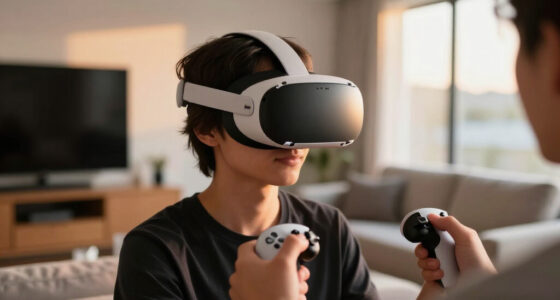
Meta Quest VR headset for enterprise training
As an affiliate, we earn on qualifying purchases.
As an affiliate, we earn on qualifying purchases.
Growing Need for Innovative Training Solutions in Manufacturing
The manufacturing industry has faced persistent labor shortages and a widening skills gap, compounded by an aging workforce and increased safety regulations. Traditional training methods—classroom sessions and on-the-floor demonstrations—are costly, inconsistent, and pose safety risks when conducted on live machinery. The urgency to modernize training has accelerated with the labor market tightness, especially in the U.S., where unfilled positions reached over 400,000 in August 2025.
Meanwhile, technological advances in XR hardware and cloud streaming have made immersive training more accessible and affordable. The emergence of standalone VR headsets, which do not require expensive PCs or external sensors, has lowered the barrier for deployment in industrial settings. Early pilot programs are testing these new tools on high-risk procedures, aiming to demonstrate measurable improvements before broader adoption.
Pico standalone VR headset for manufacturing
As an affiliate, we earn on qualifying purchases.
As an affiliate, we earn on qualifying purchases.
Uncertainties Around Long-Term Effectiveness and Adoption
It is not yet clear whether the initial improvements observed in pilot programs will translate into sustained benefits across different manufacturing environments. The effectiveness of VR training in diverse procedures, its scalability, and integration with existing HR systems remain to be validated through longer-term studies. Additionally, the willingness of manufacturers to adopt this new technology at scale depends on cost, ease of deployment, and demonstrated ROI, which are still being assessed.
VR safety training modules for industrial use
As an affiliate, we earn on qualifying purchases.
As an affiliate, we earn on qualifying purchases.
Next Steps for Pilot Expansion and Validation
Manufacturers plan to run 60-90 day pilot programs focusing on specific high-risk procedures, measuring key metrics such as time-to-competency, hazard recognition scores, and supervisor assessments. Success will be defined by statistically significant improvements and a commitment from plant management to expand VR training to additional procedures and facilities. These pilots will inform broader deployment strategies and potential integration with existing training programs.
VR headsets for workforce onboarding
As an affiliate, we earn on qualifying purchases.
As an affiliate, we earn on qualifying purchases.
Key Questions
How does VR training compare to traditional methods in manufacturing?
Early pilots suggest VR can reduce onboarding time and improve hazard recognition, but comprehensive comparative studies are ongoing to confirm these benefits across different procedures and plants.
What are the costs involved in deploying VR training modules?
The initial setup involves purchasing standalone headsets like Meta Quest or Pico, plus subscription fees for the platform and content library. Custom scenario development is also available, with costs varying based on scope.
Are there safety or technical concerns with using VR in manufacturing environments?
Since VR modules are delivered via standalone headsets, safety concerns are minimal, mainly related to physical space and user comfort. Technical issues are being addressed through ongoing pilot testing and hardware improvements.
Will VR replace all traditional training methods?
It is unlikely VR will replace all traditional methods, but it is expected to complement them, especially for high-risk, complex procedures where standardization and repeatability are critical.
When can manufacturers expect wider adoption of VR training?
If pilots demonstrate clear benefits, broader adoption could occur within the next 1-2 years, contingent on successful validation and cost-effectiveness.
Source: IdeaNavigator AI
Halloween Picks
halloween
As an affiliate, we earn on qualifying purchases.