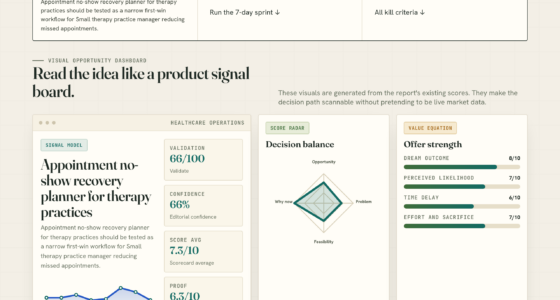
📊 Full opportunity report: 5 Gut Symptoms That Deserve A Place On Your Wellness Radar on IdeaNavigator AI — validation score, market gap, and execution plan.

Get the latest gadgets delivered free with Prime
- Fast, free delivery on millions of items
- Prime Video, Amazon Music and more included
- Member-only deals all year
TL;DR

IdeaNavigator AI proposes testing a subscription monitor that filters fast-moving wellness coverage for operators and turns relevant items into short decision briefs. Its example is an article about five gastrointestinal symptoms, but the proposal offers no medical reporting or evidence about those symptoms.
IdeaNavigator AI has proposed testing a subscription monitor that tracks fast-moving wellness developments and summarizes relevant items for operators who need to make timely decisions. The example is an article titled “5 Gastrointestinal Symptoms You Should Never Ignore,” but the proposal does not provide medical details about the symptoms or identify a health announcement behind the article.
According to IdeaNavigator AI’s proposal, the monitor would watch RSS and similar feeds, then filter items for a specific audience: operators who must act on developments in their field. Each selected item would become a brief covering what changed, why it matters and what to do. The proposal describes this as a focused first workflow rather than a broad news service.
IdeaNavigator AI says an RSS item received a signal score of 88 out of 100. The material gives no scoring method, date, comparison baseline or details about the item behind that score. The number is presented as a signal for exploring the idea, not evidence that the proposed service works or that the underlying health story is urgent.
The proposal suggests a subscription business model. To test demand, it recommends hand-delivering a brief and two additional fast-moving developments to five people matching the intended operator profile during one week. The stated measures are whether a recipient changes a decision or forwards a brief to a colleague.
Testing Demand for Faster Wellness Briefs
IdeaNavigator AI’s proposal identifies a practical information problem: relevant developments can be scattered across news, forums and filings, making them difficult to identify quickly. A role-filtered brief could help a professional focus on developments connected to their work, if the filter is accurate and the summaries are useful.
The test described in the proposal is small and behavioral. Whether any of five recipients acts on or forwards the briefs could offer an initial indication of usefulness, but it would not establish broad demand, willingness to pay or the accuracy of automated selection. Those questions would matter before turning the concept into a subscription product.
Because the example concerns gastrointestinal symptoms, the distinction between news monitoring and medical guidance matters to readers. IdeaNavigator AI’s proposal is about finding and summarizing developments; it does not provide symptom descriptions, clinical evidence, or advice about when to seek care.
A Narrow First Workflow
IdeaNavigator AI frames the concept as a narrow first-win workflow for one buyer: an operator who needs to respond to developments in their field. The example title supplies a possible wellness item for the monitor to process, while the intended product would decide whether that item matters to a particular role and produce a short brief.
The proposal argues that developments move quickly enough for a same-day, role-filtered read to be more useful than a generic weekly roundup. That is the proposal’s stated case for timing; the supplied material includes no user research, product performance data or comparison of reading times.
The Health Story Is Unspecified
As described in IdeaNavigator AI’s proposal, the example article’s author, publication date, five symptoms and supporting evidence are not identified. The material also does not identify an underlying medical development, so the example cannot establish that any new health finding has been reported.
Several product questions remain open: how the monitor would judge relevance, verify claims, handle conflicting coverage, and distinguish medical advice from reporting. The 88/100 score is unexplained, and IdeaNavigator AI provides no evidence about the proposed audience’s response or willingness to pay.
A Five-Person Demand Test
IdeaNavigator AI proposes delivering a brief and two additional items to five people matching the target operator profile during one week. The test would track whether recipients change a decision or share a brief with a colleague.
The supplied material reports no test results, launch schedule or product release. Any subsequent claim about demand would need to be based on observed recipient behavior and clearer details about how the service selects and checks health-related information.
Source: IdeaNavigator AI proposal
Key Questions
What is the proposed product?
IdeaNavigator AI proposes a subscription monitor that filters wellness developments for a defined professional audience and turns relevant items into short decision briefs.
Does the proposal explain the five gastrointestinal symptoms?
No. IdeaNavigator AI names an article about five symptoms as an example, but provides no symptom list or medical evidence.
What does the 88/100 score mean?
IdeaNavigator AI says an RSS item received a signal score of 88 out of 100, but does not explain the scoring method, date or comparison basis.
How would the idea be tested?
IdeaNavigator AI suggests delivering a brief and two more developments to five target users over one week, then observing whether anyone changes a decision or forwards a brief.
Source: IdeaNavigator AI
Halloween Picks
halloween
As an affiliate, we earn on qualifying purchases.