
Car charging ports in your vehicle include USB‑A and USB‑C, with USB‑C offering faster data transfer and higher power for charging. USB‑A is mainly for accessories, while USB‑C can support quick charging and wireless adapters. Standards like PD (Power Delivery) enable higher wattage for faster charging, and PPS (Programmable Power Supply) fine-tunes power delivery for efficiency. Exploring these options helps you optimize your charging experience more effectively.
Key Takeaways
- USB-A ports are mainly for data transfer and accessories, not suitable for vehicle charging.
- USB-C ports support faster data transfer and higher power delivery for efficient charging.
- Power Delivery (PD) allows USB-C ports to deliver higher wattage, enabling rapid charging of devices.
- Programmable Power Supply (PPS) technology in USB-C enables dynamic voltage adjustments for optimized fast charging.
- Compatibility between ports and standards like PD and PPS ensures faster, more efficient vehicle and device charging.
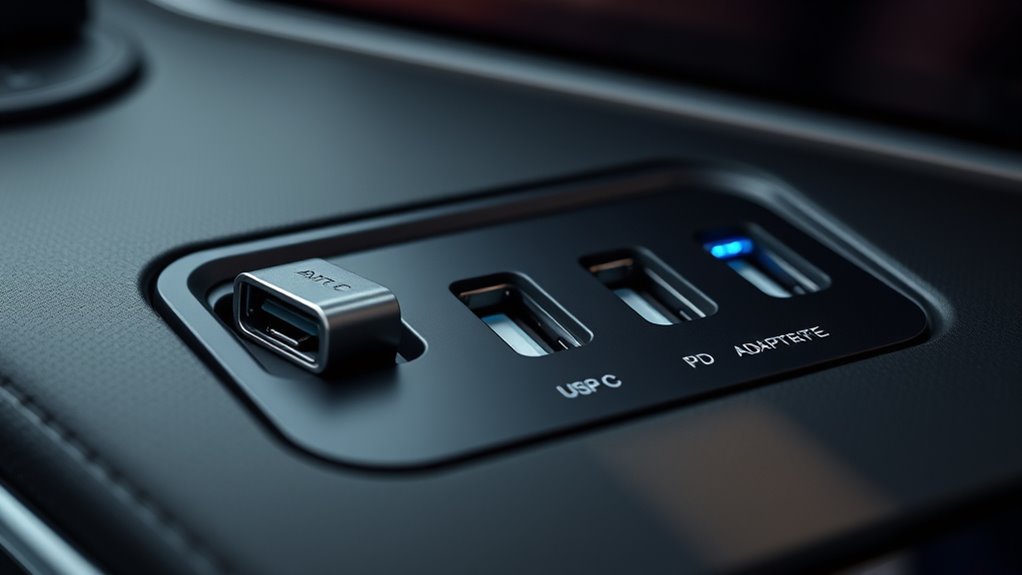
As electric vehicles become more common, understanding car charging ports is essential for any EV owner. With a variety of options available, it’s important to know what each port type offers and how they fit into your charging needs. You’ll find that some ports support wireless charging, making it even easier to power up without plugging in, while others adhere to fast charging standards that markedly reduce charging times. Knowing the differences helps you choose the right charging method for your lifestyle, whether you’re stopping for a quick top-up or a longer recharge.
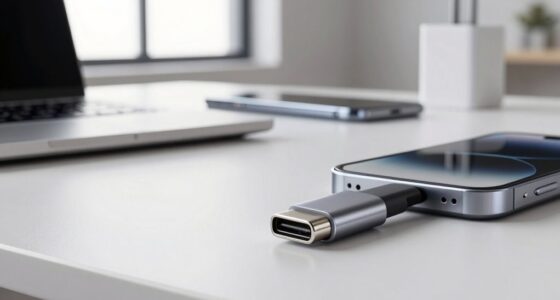
USB-A ports are familiar from everyday devices, but in EVs, they serve primarily for data transfer and powering accessories rather than charging the vehicle itself. They’re less common for charging purposes now, as newer ports provide faster and more efficient options. USB-C, on the other hand, has become the standard for many modern cars. This port offers faster data transfer and higher power delivery, capable of charging your vehicle more quickly when paired with compatible chargers. USB-C’s versatility also supports features like wireless charging adapters, allowing you to set your phone or compatible device to charge wirelessly while you’re on the go, reducing clutter and making charging more convenient.
USB-C ports enable faster charging and data transfer, supporting wireless adapters for added convenience.
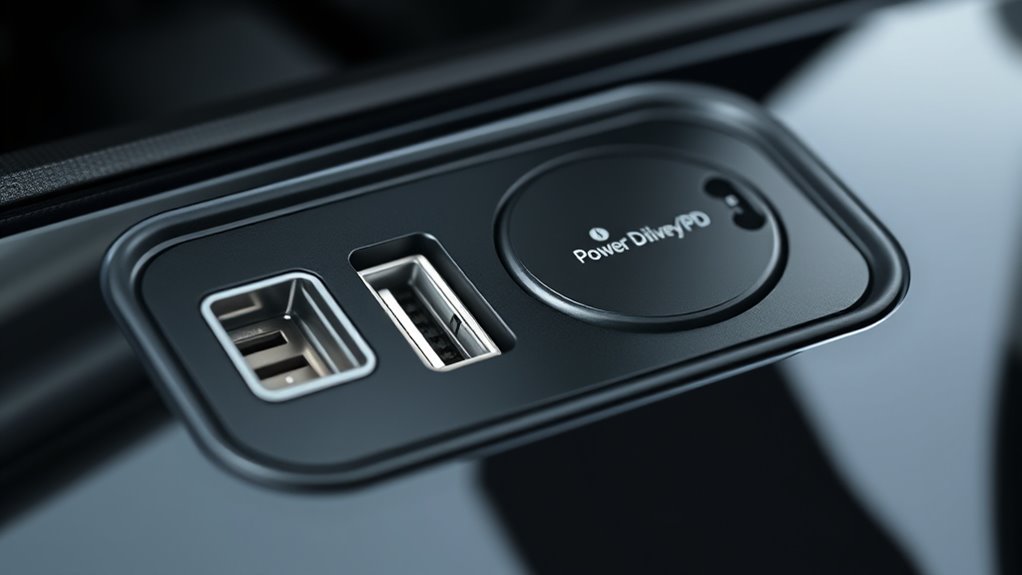
Pushing the limits further, Power Delivery (PD) technology is integrated into many USB-C ports, allowing for higher wattage transfer. With PD, you can charge your EV faster, especially when using compatible charging stations that support this protocol. It’s essential to match your vehicle’s charging port with the right standards and hardware to maximize efficiency. Fast charging standards, such as CHAdeMO, CCS (Combined Charging System), or Tesla’s proprietary connectors, are designed specifically for electric vehicles. These standards enable rapid charging, often providing 80% charge in just 30 to 40 minutes, making long-distance travel much more feasible.
Beyond wired connections, wireless charging is gaining traction in the EV world. Using induction technology, wireless charging pads can be embedded in parking spots or garages, allowing you to simply park over a pad to charge your vehicle. While wireless charging isn’t yet as fast as some wired fast charging standards, ongoing developments are closing that gap. This method offers unparalleled convenience, eliminating the need for physical plugs and cables, especially in home or public charging stations. Additionally, understanding various charging standards is crucial for compatibility and optimal charging performance.

Car Charger USB C, 3-Port 67W Dual USB-C & USB-A Car Phone Charger Accessories Power Adapter Fast Charging Cigarette Lighter for iPhone 17/16/15/14/13/12/11 Pro Max, iPad, Galaxy S26/S25/S24, Android
67W 3-Port Car Charger USB C Fast Charge: KENHAO 67 Watt Cigarette lighter USB charger support PD 37W…
As an affiliate, we earn on qualifying purchases.
As an affiliate, we earn on qualifying purchases.
Frequently Asked Questions
Can I Charge Multiple Devices Simultaneously With One Port?
Yes, you can do multi-device charging with one port if it supports port compatibility with multi-port adapters or splitters. These devices let you connect multiple devices to a single port, enabling simultaneous charging. Make sure the port supports enough power output for multiple devices to avoid slow charging. Check the specifications to verify your port can handle the total power requirement of all devices you’ll connect.
Are All Car Charging Ports Compatible With Every Smartphone?
Not all car charging ports are compatible with every smartphone. Some phones support wireless charging, while others rely on USB-C or USB-A ports with car power adapters. Check your device’s charging requirements and make certain your car’s port matches. For added convenience, consider using wireless charging pads or compatible car power adapters that support fast charging standards like PD or PPS, ensuring your smartphone charges efficiently on the go.
How Do PPS and PD Protocols Differ in Charging Speed?
Think of PPS as a tailor and PD as a general contractor in charging standards. PPS (Programmable Power Supply) adjusts voltage and current dynamically, offering faster, more efficient charging when your device supports it. PD (Power Delivery) provides a broader power range with a fixed protocol. While both boost charging speed, PPS’s adaptability often results in quicker, optimized power delivery, especially for compatible devices seeking rapid, safe charge.
Do I Need Special Cables for Fast Charging via USB-C?
You don’t necessarily need special cables for fast charging via USB-C, but charger cable compatibility is key. To access fast charging speeds, make sure your cable supports the relevant charging port standards like USB-C Power Delivery (PD) or PPS. Using a cable that matches these standards ensures safe, efficient power transfer. Always verify that your cable and charger are compatible to avoid slow charging or potential damage.
Are There Safety Concerns Using High-Wattage Charging Ports?
Using high-wattage charging ports isn’t inherently unsafe if your device has built-in safety features. Juxtapose the power surge risk with voltage stability and overcurrent protection—these mechanisms prevent damage and overheating. As long as you use certified cables and ports, you benefit from secure charging. Trust in safety measures, but avoid cheap, unverified chargers to minimize potential risks. Properly designed ports keep your device safe during fast charging.

USB Type C Cable,(2-Pack 3FT) USB C Charger Cable Car Carplay Cable Nylon Braided Fast Charging Sync Cord Compatible iPhone 17 Air/16 Pro Max Samsung Galaxy S10 Plus,Google Pixel 2(Gray)
[FAST CHARGING & DATA-SYNC (USB 2.0)]: Supports safe high-speed charging 3.1A and data syncing speed up to (480Mb/s).resistor…
As an affiliate, we earn on qualifying purchases.
As an affiliate, we earn on qualifying purchases.
Conclusion
Understanding car charging ports is like revealing a secret map to faster, more efficient charging. Whether you’re plugging into USB-A, USB-C, PD, or PPS, knowing their differences helps you stay powered up on the go. Think of these ports as the gears of a well-oiled machine—each one plays a crucial role in keeping your devices alive. Mastering them guarantees your journey never stalls, turning every charging moment into a smooth ride toward endless connectivity.

Wireless Car Charger, MOKPR Auto-Clamping Car Mount 15W/10W/7.5W Fast Charging Air Vent Car Phone Mount Compatible with iPhone 15/14/13/13 Pro/12 Pro Max/12 pro/12/11/10 Series, Samsung Galaxy Series
【Auto-Precise Alignment Charging】This wireless car charger mount is built-in advanced sensor, just place your phone in after power…
As an affiliate, we earn on qualifying purchases.
As an affiliate, we earn on qualifying purchases.

AIMILER Level 2 Electric Vehicle (EV) Charger(WIFI APP/Plug-play), 32A, 25ft Cable ETL Certified, 220V-240V NEMA 14-50P Plug EVSE w/ J1772 Connector, Portable EV Car Charging Stations for Home Level 2
❤ [Equipped with Nema 14-50 plug 240V, Compatible with 110-120V Nema 5-15p to 14-50r EV Adapter(Not packaged) or…
As an affiliate, we earn on qualifying purchases.
As an affiliate, we earn on qualifying purchases.