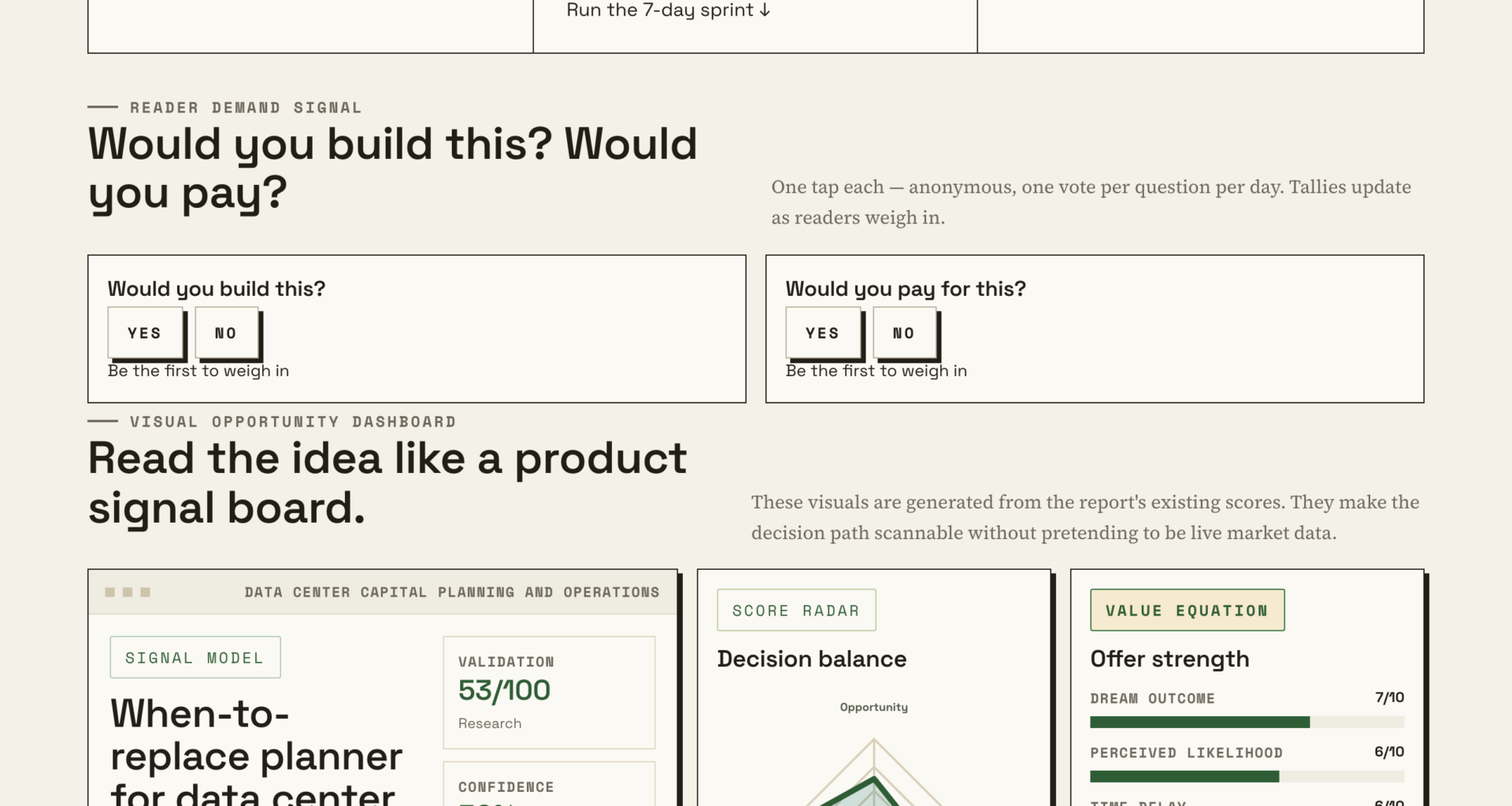
📊 Full opportunity report: How To Determine The Right Time To Replace Data Center Hardware on IdeaNavigator AI — validation score, market gap, and execution plan.

Get the latest gadgets delivered free — and shop member deals
- Fast, free delivery on millions of items
- Access to Prime Big Deal Days deals on October 6–7
- Prime Video, Amazon Music and more included
TL;DR

A new approach for data center facilities teams helps identify the right time to replace hardware, balancing energy costs, failure risks, and efficiency gains. This tool uses asset data to generate prioritized replacement recommendations.
Data center facilities teams now have a new tool to determine the optimal timing for replacing hardware, addressing long-standing challenges of relying on spreadsheets and gut feeling. This development aims to improve decision-making around server, UPS, and cooling system replacements by leveraging asset data to balance costs, energy efficiency, and failure risks.
The new replacement planner ingests an asset list from a facility, including data on equipment age, power consumption, and maintenance costs. It then generates a ranked list of assets based on a calculated score comparing the costs of keeping aging hardware versus replacing it with newer, more efficient units. This approach aims to help facilities managers avoid costly failures and capital waste by providing data-driven recommendations.
According to IdeaNavigator AI, the minimum viable product (MVP) involves reviewing the ranked list with the capacity manager and measuring agreement with current replacement plans. Validation occurs by comparing the tool’s recommendations against existing asset registers and observing decision changes.
Why Data-Driven Replacement Planning Matters
This development is significant because it addresses the increasing difficulty of making replacement decisions amid rising energy costs and hardware density. Traditional methods—relying on spreadsheets or intuition—are less effective as equipment ages and becomes more costly to maintain. The new tool offers a systematic, quantifiable approach that can lead to better capital allocation, reduced downtime, and improved energy efficiency in data centers.
As data centers continue to grow in scale and complexity, adopting data-driven maintenance and replacement strategies is expected to become a competitive advantage, helping operators lower operational costs and meet sustainability goals.
data center server replacement hardware
As an affiliate, we earn on qualifying purchases.
As an affiliate, we earn on qualifying purchases.
Growing Need for Effective Hardware Replacement Strategies
Data centers face increasing pressure to optimize equipment lifecycle management due to rising energy prices and hardware density. Traditionally, facilities teams have relied on manual assessments, which often lead to either premature replacements or delayed maintenance resulting in failures. Recent market trends highlight the need for more precise, data-supported decision tools.
Efforts to develop such tools are gaining traction, with companies exploring software solutions that analyze asset data to recommend optimal replacement timing. The concept of a ‘when-to-replace’ planner is emerging as a practical first step in automating and improving capital planning processes.
“The replacement planner offers a structured way to weigh the costs of aging hardware against the benefits of new, efficient equipment.”
— an anonymous researcher
As an affiliate, we earn on qualifying purchases.
Unconfirmed Aspects of the Replacement Planner Validation
It is not yet clear how widely the replacement planner will be adopted or how accurately it will predict failures and savings in diverse data center environments. The validation process is ongoing, and real-world results are still being collected to confirm its effectiveness.
data center cooling system upgrade
As an affiliate, we earn on qualifying purchases.
As an affiliate, we earn on qualifying purchases.
Next Steps for Deployment and Validation
The next phase involves testing the replacement planner with multiple data center facilities, comparing recommendations with existing plans, and measuring decision changes. Further development will focus on refining the scoring algorithms and integrating real-time asset monitoring data to enhance accuracy.
energy-efficient data center equipment
As an affiliate, we earn on qualifying purchases.
As an affiliate, we earn on qualifying purchases.
Key Questions
How does the replacement planner determine which hardware to replace?
The planner analyzes asset data, including age, power draw, and maintenance costs, then ranks equipment based on a score that considers rising energy costs and failure risks versus the benefits of newer hardware.
Is this replacement tool suitable for all types of data center hardware?
The initial version focuses on servers, UPS units, and cooling systems, but future iterations may expand to other equipment based on user feedback and validation results.
What are the main benefits of using this data-driven approach?
It helps facilities teams avoid premature replacements, reduce downtime, lower energy costs, and make more informed capital investment decisions.
When will the replacement planner be generally available?
The tool is currently in testing and validation stages; a broader release is expected once pilot results confirm its effectiveness, but no specific timeline has been announced.
How does this tool compare to traditional replacement planning methods?
Unlike spreadsheets or gut-feel approaches, it provides a systematic, data-driven ranking based on asset-specific metrics, improving decision accuracy and consistency.
Source: IdeaNavigator AI
Evergreen bestsellers Picks
bestsellers
As an affiliate, we earn on qualifying purchases.