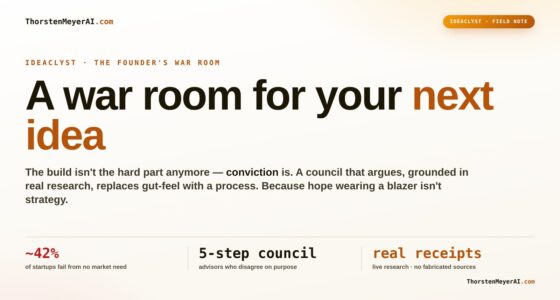

📊 Full opportunity report: Outcome-First Decisions: The Friction Is The Feature on ThorstenMeyerAI.com — validation score, market gap, and execution plan.

Get the latest gadgets delivered free with Prime
- Fast, free delivery on millions of items
- Prime Video, Amazon Music and more included
- Member-only deals all year
TL;DR
Outcome-First Decisions introduces an AI tool that refines business choices by demanding clear verdicts, proof tests, and immediate actions. It aims to reduce wasted effort and build a calibrated decision record. Its approach shifts focus from planning to validated action.
The Outcome-First Decisions skill, launched recently as an open-source tool, is designed to help entrepreneurs and teams make faster, more validated decisions by requiring Outcome-First Decisions verdicts, proof tests, and immediate actions. It refuses to endorse plans lacking specific evidence, aiming to cut down on wasted months of building based on fuzzy assumptions.
This AI-driven skill intercepts the common decision-making trap where promising ideas turn into costly failures after months of development. It works by transforming fuzzy business hypotheses into three concrete outcomes: a verdict (such as worth doing, test first, change, defer, or drop), a proof test that can be run within a week, and three specific actions to execute immediately.
The tool emphasizes the importance of evidence, especially the distinction between opinions and actual paying customers. It employs a ‘Buyer Evidence Ladder’—ranking evidence from opinion to repeat purchase—to ensure decisions are grounded in reliable data. The verdicts are designed to be honest, with no room for vague enthusiasm, only validated commitment.
It also adapts to industry-specific contexts via overlays—for SaaS, healthcare, e-commerce, and others—enabling tailored proof tests and default scoreboards. In emergency situations like cash flow crises, it simplifies to three urgent actions and a verdict to stabilize the business quickly.
Beyond immediate decision-making, the skill tracks decision accuracy over time, calibrating the user’s judgment by comparing predicted outcomes with actual results, thus improving decision quality long-term.
The Friction Is the Feature
Most tools help you do more. This one helps you do less — and proves the “less” is the part that earns. It turns a fuzzy decision into a verdict, a one-week proof test, and three actions for today.
Missing one? It doesn’t cheer you forward — it asks the smallest question that fills the gap. When the evidence is an opinion, the answer is “test first,” not a 12-week plan. That’s $250 to learn the truth instead of three months.
A click is not a customer. A “great idea” is not revenue. The skill reads where your evidence sits and designs the cheapest test that moves you up exactly one rung.
So your next “80%” gets discounted accordingly — and the rungs you habitually skip get flagged. You’re not just deciding; you’re building a calibrated instrument out of your own track record.
- Triggered by runway, missed payroll, a lost biggest customer.
- A one-line verdict and three actions with hour-level deadlines.
- The dollar number below which the business closes.
- Scoring tables and framework talk disappear — busywork in an emergency.
- Every active bet with its evidence rung, capacity cost, and kill date.
- At most two unproven bets at once. No bet without a kill date.
- Killed capacity reallocated by name, not vaguely “freed up.”
- Numbers carry provenance — no verdict rides on a half-remembered figure.
mkdir -p ~/.claude/skills && unzip outcome-first-decisions.zip -d ~/.claude/skills/
The honest tradeoff: it will not flatter you. Thin evidence, it says so; an idea that should die, it says so plainly. If you want reassurance, it’s the wrong tool. If you want fewer, better-aimed bets and a verdict you can defend — the friction is the feature.
Independent commentary, produced with AI assistance under human editorial oversight. The views are the author’s own and may change. Outcome-First Decisions is a decision-support tool, not business, financial, legal, or investment advice; its verdicts are one input to your own judgment, not a guarantee of outcomes, and dollar figures are illustrative. Software provided under its stated open-source licence, as-is, without warranty. Product, model, and company names are trademarks of their respective owners; mention does not imply endorsement.
How Outcome-First Decisions Reshapes Business Validation
This approach shifts the focus from elaborate planning and vague validation to concrete, testable commitments, reducing wasted months and resources. It encourages a culture of rapid, evidence-based decision-making, which can lead to faster growth and better risk management. The long-term calibration of decision confidence also helps entrepreneurs develop more reliable judgment, potentially improving success rates over time.
By emphasizing immediate actions and honest verdicts, the method could influence startup methodologies, investment decisions, and internal team processes, making validation more disciplined and less subjective.
decision-making software for startups
As an affiliate, we earn on qualifying purchases.
As an affiliate, we earn on qualifying purchases.
The Evolution of Business Decision Tools and Validation Methods
Traditional validation tools often encourage optimism and vague commitments, leading to extended cycles of planning without concrete testing. Recent developments in AI and decision science have aimed to make validation more disciplined, but many tools still focus on doing more rather than doing less with better results.
The Outcome-First Decisions skill builds on this trend by prioritizing decisive, testable commitments and integrating industry-specific overlays, a feature that aligns with emerging best practices in lean startup and agile methodologies. Its emphasis on immediate actions and calibrated judgment reflects a broader shift toward evidence-based, rapid decision cycles in entrepreneurship and product development.
“Most ideas are plausible until tested; this tool forces you to confront reality early, saving months of wasted effort.”
— Thorsten Meyer, creator of the skill
As an affiliate, we earn on qualifying purchases.
Unanswered Questions About Long-Term Effectiveness
It is not yet clear how well this decision framework performs across diverse industries or over extended periods. The long-term impact on success rates and decision calibration requires further empirical validation. Additionally, user adoption and integration into existing workflows remain to be seen, especially in larger organizations with entrenched processes.
As an affiliate, we earn on qualifying purchases.
Next Steps for Adoption and Empirical Validation
Further pilot studies and user feedback will determine how effectively the tool improves decision quality and reduces wasted effort. Developers plan to gather data on decision accuracy over time and refine industry overlays. Broader adoption in startups and possibly larger companies will test its scalability and practical impact. Expect updates as real-world results emerge.
evidence-based decision making tools
As an affiliate, we earn on qualifying purchases.
As an affiliate, we earn on qualifying purchases.
Key Questions
How does the tool determine the verdict for a decision?
The tool evaluates evidence using the Buyer Evidence Ladder, ranking from opinion to repeat purchase, and assigns a verdict based on whether evidence justifies moving forward, testing, or dropping the idea.
Can this tool be integrated into existing project management workflows?
Yes, since it is an open-source skill, it can be integrated with various productivity and decision-tracking tools, although specific integrations are still under development.
What kinds of decisions is this tool best suited for?
It is designed for early-stage business validation, product feature prioritization, and urgent crisis decisions, where rapid, evidence-based judgment is critical.
Does this approach replace traditional planning methods?
Not necessarily; it emphasizes making validated decisions quickly and testing assumptions early, complementing rather than replacing comprehensive planning when appropriate.
Source: ThorstenMeyerAI.com
Fall Picks
fall essentials
As an affiliate, we earn on qualifying purchases.