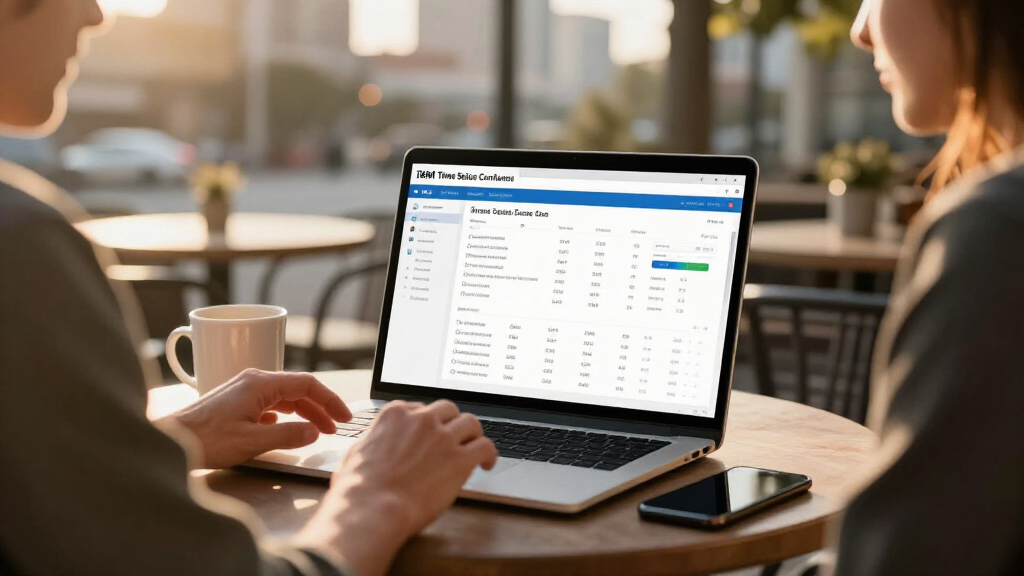

🔍 Read the full analysis: The Future Of AI: Real-Time Data Insights With IBM Time Series And Confluent on ThorstenMeyerAI.com

Get the latest gadgets delivered free with Prime
- Fast, free delivery on millions of items
- Prime Video, Amazon Music and more included
- Member-only deals all year
TL;DR
IBM and Confluent have introduced IBM Granite Time Series foundation models into Early Access on Confluent Cloud, allowing enterprises to perform real-time forecasting and anomaly detection directly on streaming data. The integration simplifies deployment, requiring no additional configuration, and aims to transform how time series data is used across industries.
IBM and Confluent have launched IBM Granite Time Series foundation models into Early Access on Confluent Cloud, enabling enterprises to perform real-time forecasting, anomaly detection, and optimization directly on streaming data within Apache Flink. This development marks a significant step toward making advanced time series analytics accessible without requiring extensive data science resources, potentially reshaping operational decision-making across industries.
The joint announcement confirms that IBM Granite Time Series models are now available in Early Access on Confluent Cloud, initially on AWS, with plans to extend to Confluent Platform for on-premises and hybrid deployments. These models can be called directly from Flink SQL, allowing inference to occur where data flows, without the need for separate machine learning platforms or data warehouses. The integration is described as zero-configuration, with Confluent managing infrastructure, scaling, and runtime operations, simplifying deployment for users.
According to IBM and Confluent, the models support a range of functions including forecasting, anomaly detection, similarity search, classification, gap-filling, and optimization on live business signals. The approach aims to democratize time series analytics by removing traditional barriers—such as the need for bespoke models built by data science teams—thus enabling domain experts like demand planners and process engineers to utilize these models independently.
IBM reports that their deployed models have achieved productivity gains of 5 to 10 times in pilot projects across sectors like manufacturing, cement, steel, pulp and paper, food, and telecommunications, as detailed in the original analysis. IBM states that each point of accuracy improvement can translate into millions of dollars in value, with over 44 million downloads of the Granite Time Series models to date. The models’ real-time inference capability is designed to support critical operational decisions, such as detecting equipment drift or predicting outages, by providing timely insights directly within streaming pipelines.
Transforming Time Series Analytics with Streaming Inference
This development signifies a shift in how businesses approach time series data, moving from slow, model-specific forecasting to real-time, scalable insights. By enabling inference directly within data streams, companies can react faster to operational signals, reduce costs, and improve accuracy without extensive data science involvement. This approach could lower barriers for a broad range of industries, from manufacturing to retail, to adopt advanced predictive analytics, ultimately leading to more agile and efficient operations.
As an affiliate, we earn on qualifying purchases.
Background on Time Series Forecasting Challenges
Traditionally, time series forecasting has relied on bespoke models built by specialized data science teams, often requiring months of development per model. This process limits the number of signals that can be forecasted, leading most business streams to operate with safety margins and excess inventory, which incurs additional costs. The advent of foundation models trained on diverse signals offers a new paradigm—generalized models that can be applied across multiple use cases with minimal customization.
Prior to this announcement, real-time inference on streaming data was often handled through custom integrations, with significant overhead and complexity. IBM’s earlier deployments demonstrated productivity gains and improved decision-making, but widespread adoption remained limited by infrastructure and expertise barriers. The partnership with Confluent aims to address these issues by embedding models directly into data pipelines, making advanced analytics accessible at scale.
“By integrating IBM Granite Time Series models directly into Confluent Cloud, we are enabling businesses to perform real-time forecasting and anomaly detection without the need for specialized data science teams.”
— Thorsten Meyer, IBM
As an affiliate, we earn on qualifying purchases.
Limitations and Unanswered Questions about the Launch
Since the offering is currently in Early Access, details remain limited regarding its stability, performance benchmarks, and full feature scope. It is unclear when the support for Confluent Platform on on-premises and hybrid environments will be available, or what the specific pricing and licensing models will entail. Additionally, independent validation of the claimed productivity gains and accuracy improvements has not yet been published, leaving some questions about real-world performance.
As an affiliate, we earn on qualifying purchases.
Upcoming Milestones and Expansion Plans
The immediate next step is the broader rollout on Confluent Cloud on AWS, with the models available in Early Access. The companies have indicated plans to extend support to Confluent Platform for on-premises and hybrid deployments, though no specific timeline has been provided. Future updates are expected to include performance benchmarks, user case studies, and possibly expanded model capabilities, as feedback from early adopters is integrated.
As an affiliate, we earn on qualifying purchases.
Key Questions
What are IBM Granite Time Series models used for?
They are used for real-time forecasting, anomaly detection, similarity search, classification, gap-filling, and optimization on streaming business signals.
Can I deploy these models on my own infrastructure now?
Currently, the models are available in Early Access only on Confluent Cloud on AWS. Support for on-premises and hybrid environments via Confluent Platform is planned but not yet available.
How does the integration improve operational decision-making?
By enabling inference directly within data streams, organizations can detect issues or forecast outcomes instantly, reducing response times and operational costs.
Are there any limitations or risks in using these models now?
As the offering is in Early Access, stability, scalability, and performance are still being tested. Independent validation and detailed performance metrics are not yet available.
What industries are most likely to benefit from this development?
Manufacturing, telecommunications, supply chain, retail, and any sector relying on time-sensitive operational signals are prime candidates for adopting this technology.
Primary source: Hugging Face · via ThorstenMeyerAI.com
Halloween Picks
halloween
As an affiliate, we earn on qualifying purchases.