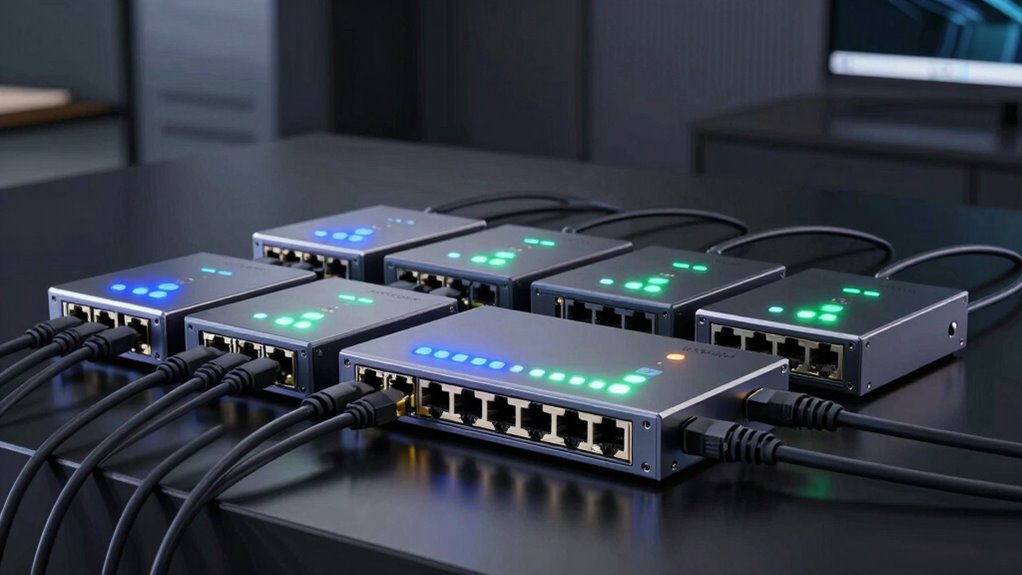

If you’re looking to power your security cameras effectively in 2026, I recommend checking out some top PoE switches like the REOLINK 8-Port, TP-Link LS108GP, and YuanLey 16-Port models. These switches support various PoE standards and offer enough power for multiple cameras, even in demanding environments. They also feature durable construction and flexible installation options. Keep exploring so you can find the perfect match for your security setup and future-proof your system.
Key Takeaways
- Look for switches supporting IEEE802.3af/at/bt standards for safe and reliable PoE power delivery to cameras.
- Prioritize models with high total power budgets (e.g., 150W–300W) for supporting multiple high-power devices.
- Choose rugged, IP-rated switches with durable enclosures suitable for outdoor or industrial environments.
- Ensure switches offer gigabit speeds and extend mode for long-distance transmission up to 820 ft.
- Consider management features, warranty, and scalability options for future-proof security system expansion.
| Mini Industrial 3-Port Gigabit PoE Switch with Booster | 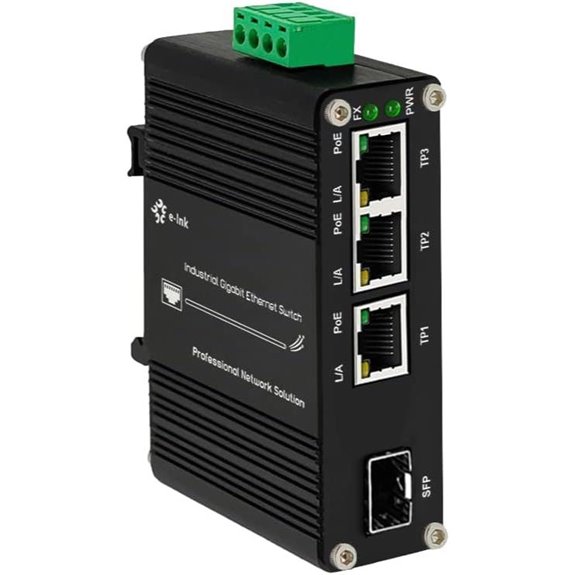 | Rugged High-Performance | Number of Ports: 3 RJ45 + 1 SFP | Power Budget: 90W total | PoE Standards Supported: IEEE802.3af/at | VIEW LATEST PRICE | See Our Full Breakdown |
| REOLINK 8-Port PoE Switch with Uplink | 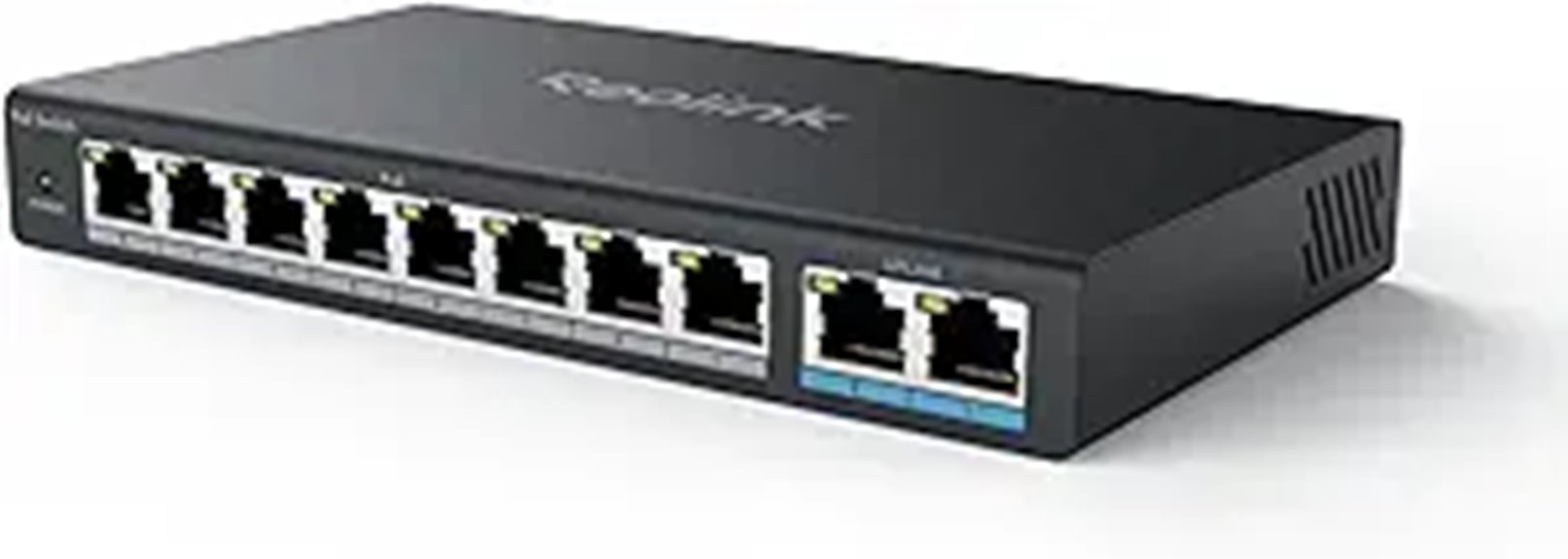 | Ideal for Security Setups | Number of Ports: 8 PoE ports + 2 uplink ports | Power Budget: 120W total | PoE Standards Supported: IEEE802.3af/at | VIEW LATEST PRICE | See Our Full Breakdown |
| TP-Link LS108GP 8-Port PoE Gigabit Ethernet Switch | 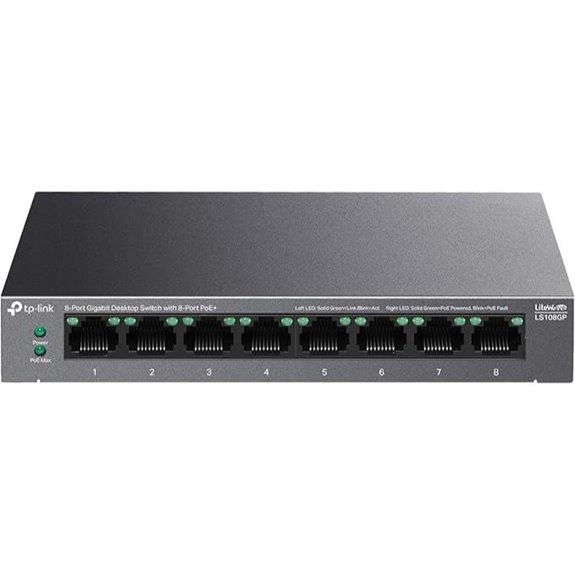 | Compact and Reliable | Number of Ports: 8 PoE ports | Power Budget: 65W total | PoE Standards Supported: 802.3af/at | VIEW LATEST PRICE | See Our Full Breakdown |
| TP-Link TL-SG1218MP 16-Port Gigabit PoE Switch | 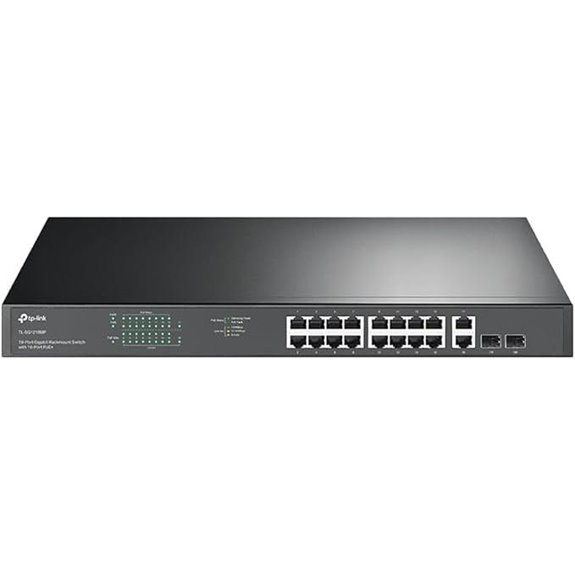 | Enterprise-Grade Power | Number of Ports: 16 PoE ports + 2 non-PoE ports + 2 SFP | Power Budget: 250W total | PoE Standards Supported: 802.3af/at | VIEW LATEST PRICE | See Our Full Breakdown |
| 16-Port PoE Switch with 300W Power and Gigabit Uplink | 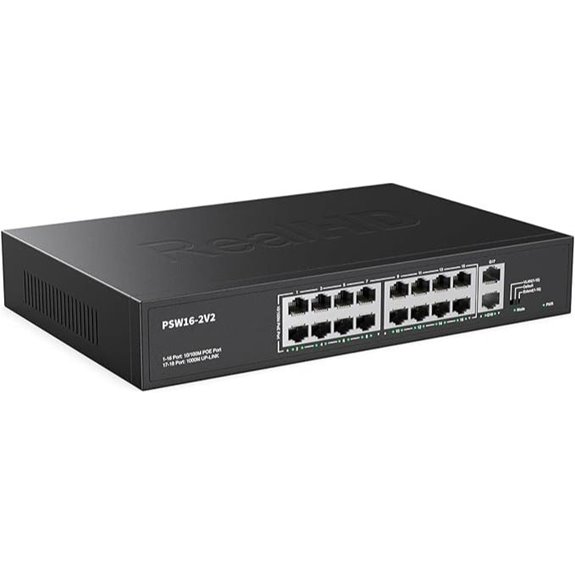 | High Power Capacity | Number of Ports: 16 PoE ports + 2 uplink ports | Power Budget: 300W total | PoE Standards Supported: 802.3af/at | VIEW LATEST PRICE | See Our Full Breakdown |
| YuanLey 16-Port PoE Switch with 2 Gigabit Uplink |  | Cost-Effective Solution | Number of Ports: 16 PoE ports + 2 Gigabit uplink ports | Power Budget: 250W total | PoE Standards Supported: IEEE 802.3af/at | VIEW LATEST PRICE | See Our Full Breakdown |
| LINOVISION 8-Port Gigabit PoE++ Switch with 120W Power |  | Advanced Power Delivery | Number of Ports: 8 PoE ports + 2 Gigabit uplink ports | Power Budget: 120W total | PoE Standards Supported: IEEE 802.3af/at/bt (not fully standard) | VIEW LATEST PRICE | See Our Full Breakdown |
More Details on Our Top Picks
-
B0BWHKQ5N9
Amazon Product B0BWHKQ5N9
As an affiliate, we earn on qualifying purchases.
Mini Industrial 3-Port Gigabit PoE Switch with Booster
If you’re searching for a reliable, rugged PoE switch capable of handling harsh industrial environments, the Mini Industrial 3-Port Gigabit PoE Switch with Booster is an excellent choice. It features hardened RJ45 ports supporting 10/100/1000 Mbps speeds and complies with IEEE802.3af/at standards, delivering up to 30W per port. The built-in voltage booster enables operation over DC12V-48V to DC48V, ensuring stable power delivery. With dual redundant power inputs, overload protection, and a durable aluminum case rated IP40, it’s designed for tough conditions. Its versatility makes it perfect for IP cameras, VoIP phones, and industrial networks.
- Number of Ports:3 RJ45 + 1 SFP
- Power Budget:90W total
- PoE Standards Supported:IEEE802.3af/at
- Uplink Ports:SFP port (dual-mode)
- Mounting Options:DIN-rail and wall mount
- Construction & Design:Aluminum, IP40, industrial-grade
- Additional Feature:Dual redundant power inputs
- Additional Feature:Operating temperature range
- Additional Feature:SFP port dual-mode support
-
B0CWJMRTWY
Amazon Product B0CWJMRTWY
As an affiliate, we earn on qualifying purchases.
REOLINK 8-Port PoE Switch with Uplink
The REOLINK 8-Port PoE Switch with Uplink stands out as an excellent choice for small to medium-sized security setups, thanks to its reliable power management and straightforward plug-and-play design. It offers 8 PoE ports and 2 Gigabit uplink ports, supporting seamless integration with REOLINK NVRs or directly with cameras and routers. With intelligent power management, it prevents overloads by shutting off lower-priority ports when power exceeds 120W. Its durable metal casing, compact size, and versatile mounting options make installation easy. Data transfer speeds reach up to 1000 Mbps, ensuring fast and stable network connectivity for your security devices.
- Number of Ports:8 PoE ports + 2 uplink ports
- Power Budget:120W total
- PoE Standards Supported:IEEE802.3af/at
- Uplink Ports:2 Gigabit uplink ports
- Mounting Options:Wall or desktop
- Construction & Design:Metal casing, compact
- Additional Feature:Intelligent power management
- Additional Feature:Wall or desktop mounting
- Additional Feature:Auto device detection
-
B0897WD95L
Amazon Product B0897WD95L
As an affiliate, we earn on qualifying purchases.
TP-Link LS108GP 8-Port PoE Gigabit Ethernet Switch
Designed for small-scale surveillance setups, the TP-Link LS108GP stands out with its 8 PoE+ ports that deliver up to 30W each, making it an excellent choice for powering multiple IP cameras simultaneously. Its compact metal design fits easily on a desk or wall, and the fanless construction guarantees silent operation. With a total power budget of 65W and Extend Mode, it can transmit power over distances up to 820 feet. The switch offers up to 16 Gbps throughput, supports plug-and-play setup, and features PoE auto recovery. It’s reliable, efficient, and ideal for small offices or home security systems.
- Number of Ports:8 PoE ports
- Power Budget:65W total
- PoE Standards Supported:802.3af/at
- Uplink Ports:No dedicated uplink ports
- Mounting Options:Desktop or wall mount
- Construction & Design:Metal, fanless, silent
- Additional Feature:Extend Mode transmission
- Additional Feature:PoE Auto Recovery feature
- Additional Feature:Silent fanless design
TP-Link TL-SG1218MP 16-Port Gigabit PoE Switch
For those seeking a reliable and high-performance PoE switch for their security camera network, the TP-Link TL-SG1218MP stands out with its 16 PoE+ ports capable of delivering up to 30W per port. With a total power budget of 250W, it efficiently powers IP cameras, VoIP phones, and other devices. Its full gigabit ports ensure fast data transfer, while the plug-and-play setup simplifies installation. Built with a sturdy metal case and professional heat dissipation, it’s designed for demanding environments. Plus, the industry-leading 3-year warranty and free support make it a dependable choice for expanding security systems.
- Number of Ports:16 PoE ports + 2 non-PoE ports + 2 SFP
- Power Budget:250W total
- PoE Standards Supported:802.3af/at
- Uplink Ports:2 Gigabit SFP ports
- Mounting Options:Rack-mountable or desktop
- Construction & Design:Metal, professional heat dissipation
- Additional Feature:Advanced QoS support
- Additional Feature:Industry-leading 3-year warranty
- Additional Feature:Rack-mountable sturdy case
16-Port PoE Switch with 300W Power and Gigabit Uplink
If you’re looking to power multiple IP cameras or network devices efficiently, a 16-port PoE switch with 300W power and gigabit uplinks offers a robust solution. It features 16 ports, including 4 PoE+ ports supporting up to 30W per port, and 2 gigabit uplink ports for high-speed connections. Its compact, rack-mountable design with a durable metal casing makes it suitable for various environments. The switch supports 802.3af/at standards, PoE power detection, and extended transmission up to 250 meters in Extend Mode. Plus, its fan-less operation guarantees silent performance, perfect for both office and industrial settings.
- Number of Ports:16 PoE ports + 2 uplink ports
- Power Budget:300W total
- PoE Standards Supported:802.3af/at
- Uplink Ports:2 Gigabit uplink ports
- Mounting Options:Rack-mountable or desktop
- Construction & Design:Metal casing, compact
- Additional Feature:VLAN port isolation
- Additional Feature:Extend Mode up to 250m
- Additional Feature:LED status indicators
YuanLey 16-Port PoE Switch with 2 Gigabit Uplink
The YuanLey 16-Port PoE Switch with 2 Gigabit Uplink stands out as an excellent choice for network setups needing reliable, high-power connections for multiple IP cameras. It offers 16 PoE/PoE+ ports supporting up to 250W total power, with each port delivering up to 30W. The switch features two Gigabit uplink ports, providing a combined bandwidth of 12Gbps, ensuring fast data transfer. Its durable metal construction and efficient heat dissipation make it suitable for various environments. With plug-and-play operation and VLAN isolation, it simplifies setup while enhancing security. Overall, this switch combines power, speed, and durability for robust camera network performance.
- Number of Ports:16 PoE ports + 2 Gigabit uplink ports
- Power Budget:250W total
- PoE Standards Supported:IEEE 802.3af/at
- Uplink Ports:2 Gigabit uplink ports
- Mounting Options:Metal case, likely desktop or rack
- Construction & Design:Metal, industrial-grade
- Additional Feature:Wide operating temperature
- Additional Feature:Supports VLAN isolation
- Additional Feature:Industrial-grade heat dissipation
LINOVISION 8-Port Gigabit PoE++ Switch with 120W Power
With its built-in 120W power supply supporting four BT 90W ports, the LINOVISION 8-Port Gigabit PoE++ Switch is ideal for deploying multiple high-power IP cameras and PoE devices simultaneously. It features four gigabit PoE++ ports, supporting IEEE 802.3af/at/bt standards, allowing safe and reliable power delivery. Its fanless, full-metal design guarantees silent operation and durability, suitable for both home and commercial use. The switch also includes two uplink ports and an SFP port for flexible networking. With plug-and-play functionality and PoE Extend Mode for long-distance transmission, it provides a high-performance, reliable, and compact solution for your security system.
- Number of Ports:8 PoE ports + 2 Gigabit uplink ports
- Power Budget:120W total
- PoE Standards Supported:IEEE 802.3af/at/bt (not fully standard)
- Uplink Ports:1 Gigabit SFP port
- Mounting Options:Enclosure suitable for desktop or wall
- Construction & Design:Metal, fanless, durable
- Additional Feature:PoE Extend Mode support
- Additional Feature:Four-step PoE power-up
- Additional Feature:Fanless durable metal case
Factors to Consider When Choosing Poe Switches for Cameras
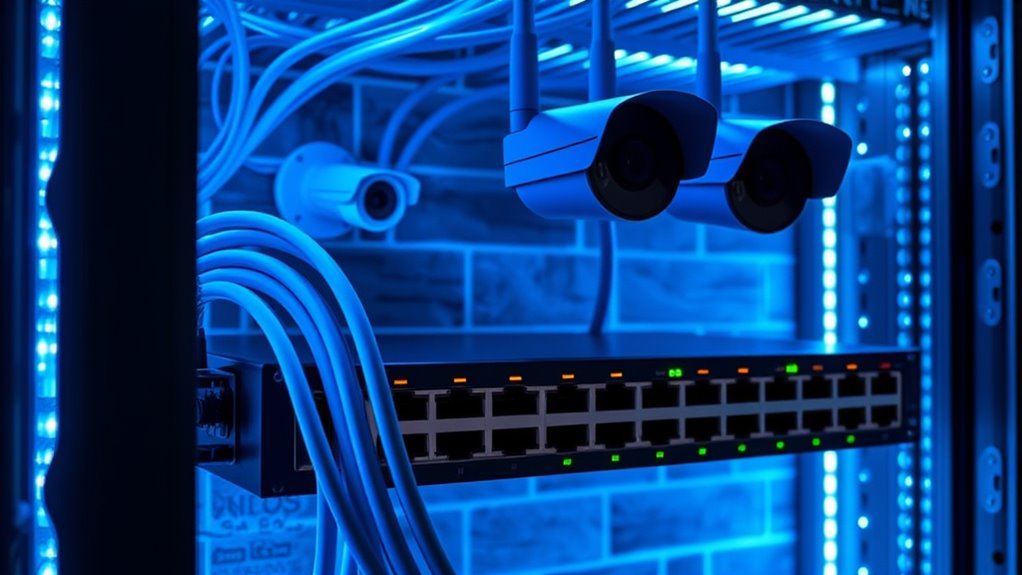
When choosing a PoE switch for your cameras, I consider several key factors to guarantee ideal performance. These include power capacity, the number and type of ports, transmission range, durability for the environment, and compatibility standards. Focusing on these points helps me select a switch that meets my specific security and installation needs.
Power Capacity Needs
Choosing the right PoE switch requires ensuring its total power budget can handle all connected cameras and devices. I always check that the switch’s total power capacity matches the combined wattage needs of my cameras. For standard PoE (IEEE 802.3af/at), up to 30W per port is typical, but high-power cameras or PTZ models may require more, so I look for switches supporting PoE+ or PoE++ standards to meet those demands. I also consider features like power prioritization and dynamic power management, which help distribute power efficiently during peak loads. It’s wise to select a switch with a sufficient power budget to accommodate future expansion, ensuring I won’t need to replace it later as my security system grows.
Port Quantity and Type
The number of ports on a PoE switch directly affects how many cameras and devices I can connect at once, making it a crucial factor in my selection process. I need enough ports to support my current setup and room for expansion. Many switches have a mix of PoE and non-PoE ports, so I check that all my essential connections support power delivery. I also look at the standards—IEEE 802.3af, 802.3at, or 802.3bt—as they determine power output and compatibility with different cameras. Gigabit or faster ports are essential for high-resolution, real-time streams. Some switches even feature combo ports or SFP slots for fiber optic connections, giving me flexibility for larger or more complex camera networks.
Data Transmission Range
The length of time a PoE switch can transmit data directly impacts how I set up my camera network, especially for large or spread-out areas. Standard switches support up to 100 meters (328 feet), which is usually enough for most installations without signal issues. However, if I need to cover longer distances, I look for switches with Extend Mode, capable of reaching up to 250 meters (820 feet). Keep in mind, extending the range often reduces data speeds from gigabit to 10/100 Mbps, so I balance distance with performance needs. For large-scale setups, choosing switches with higher power budgets and extended range capabilities is essential to guarantee reliable connectivity and sufficient power delivery, no matter where my cameras are located. Proper planning around data transmission range guarantees a stable and efficient security system.
Environmental Durability
When selecting PoE switches for outdoor or industrial camera setups, environmental durability becomes a critical factor. I look for switches with an IP40 or higher protection grade to guarantee they resist dust and solid particles, which is essential in harsh environments. An operating temperature range from -40°C to 80°C or more guarantees reliable performance in extreme weather conditions. Enclosures made of durable materials like aluminum or metal boost resistance against corrosion, impacts, and environmental wear. Lightning protection features, such as surge protection of 6KV or higher, safeguard against power spikes from thunderstorms or electrical faults. Additionally, rugged switches often minimize or eliminate fans, preventing dust ingress and ensuring silent, maintenance-free operation outdoors. These factors help ensure long-lasting, dependable security systems.
Compatibility Standards
Choosing a PoE switch that matches your camera setup requires paying close attention to compatibility standards like IEEE 802.3af (PoE) and IEEE 802.3at (PoE+). These standards guarantee your cameras receive safe, reliable power and prevent damage to non-PoE devices. PoE (802.3af) supplies up to 15.4W per port, while PoE+ (802.3at) offers up to 30W, supporting more power-hungry cameras and accessories. Some advanced switches support IEEE 802.3bt (PoE++), delivering up to 90W per port for high-power devices. When choosing, always verify your camera’s power requirements against the switch’s maximum power output and standards compliance. Compatibility guarantees proper operation, safe power delivery, and future-proofing your security system.
Installation Flexibility
Installing a PoE switch for your cameras demands careful attention to its mounting options and physical design, guaranteeing it fits your space and setup. Look for switches that support multiple mounting options, like wall or DIN rail mounts, to adapt to different environments. Check the size and form factor to ensure it fits comfortably in your designated area, whether on a desktop, rack, or tight industrial space. It’s also essential to verify that the switch’s power and port configuration suits your needs, especially in complex setups. Compatibility with your existing network infrastructure minimizes adjustments during installation. Additionally, consider environmental specs such as temperature range and durability, which guarantee reliable operation in diverse conditions. These factors help make your installation seamless and flexible.
Budget and Pricing
Budget and pricing are key factors to contemplate when selecting a PoE switch for your cameras, as they directly influence your overall investment and future scalability. Basic models start around $50, but higher-capacity switches can exceed $300, depending on features and power capacity. The total power budget, like 90W versus 300W, substantially impacts cost and performance. Budget-friendly options may have fewer ports or lower power output per port, limiting expansion and device compatibility. Premium switches typically include advanced features such as extended transmission distances or enhanced management tools, which come at a higher price. When comparing costs, consider warranties, support, and potential future expansion to ensure you’re getting the best value for your investment without sacrificing necessary features.
Frequently Asked Questions
How Does Poe Switch Compatibility Affect Camera Installation?
PoE switch compatibility is essential because it guarantees your cameras receive the right power and data connection without issues. When I choose a switch, I check if it supports the camera’s power requirements and network standards. Incompatible switches can cause power failures or connection problems, making installation difficult. So, I always verify compatibility beforehand to guarantee smooth setup and reliable security footage.
What Is the Typical Lifespan of a Poe Switch?
A PoE switch usually lasts between 5 to 10 years, depending on usage and quality. I like to think of it as a sturdy bridge connecting my security cameras, built to withstand daily traffic and environmental stress. Regular maintenance and choosing high-quality switches can extend their lifespan. When well cared for, they keep my network secure and reliable, ensuring my surveillance system stays active and dependable for years.
Can Poe Switches Power Both Cameras and Access Points Simultaneously?
Yes, PoE switches can power both cameras and access points simultaneously. I’ve used them in my security setup, and they handle multiple devices effortlessly thanks to their power management features. Just make sure your switch has enough ports and power budget to support all your devices at once. This setup simplifies wiring and reduces clutter, making it a reliable, efficient way to keep everything powered and connected.
Are There Energy Efficiency Features in Modern Poe Switches?
Yes, modern PoE switches often come with energy efficiency features. I’ve seen models that automatically detect and adjust power consumption based on device needs, which helps save energy and reduces costs. Features like Energy-Efficient Ethernet (EEE) and smart power management are common, making these switches not only powerful but also environmentally friendly. If you’re looking to optimize your setup, I definitely recommend choosing a switch with these energy-saving capabilities.
How Does Port Speed Impact Camera Streaming Quality?
Port speed directly affects your camera streaming quality because higher speeds allow for smoother, higher-resolution video feeds. If your switch ports are slow, you might experience lag, pixelation, or dropped frames, especially with HD or 4K cameras. To guarantee ideal performance, I recommend using gigabit ports, which offer enough bandwidth to handle multiple high-quality streams simultaneously without compromising clarity or stability.
Conclusion
So, there you have it—your ticket to a perfectly powered security setup. Because, frankly, who wouldn’t want their cameras to have more juice than a toddler on sugar? Just remember, choosing the right PoE switch isn’t rocket science, unless you’re actually trying to launch a satellite. So pick wisely, or face the horror of blinking cameras and “technical difficulties”—tragedies only true tech enthusiasts can truly appreciate. Happy installing!