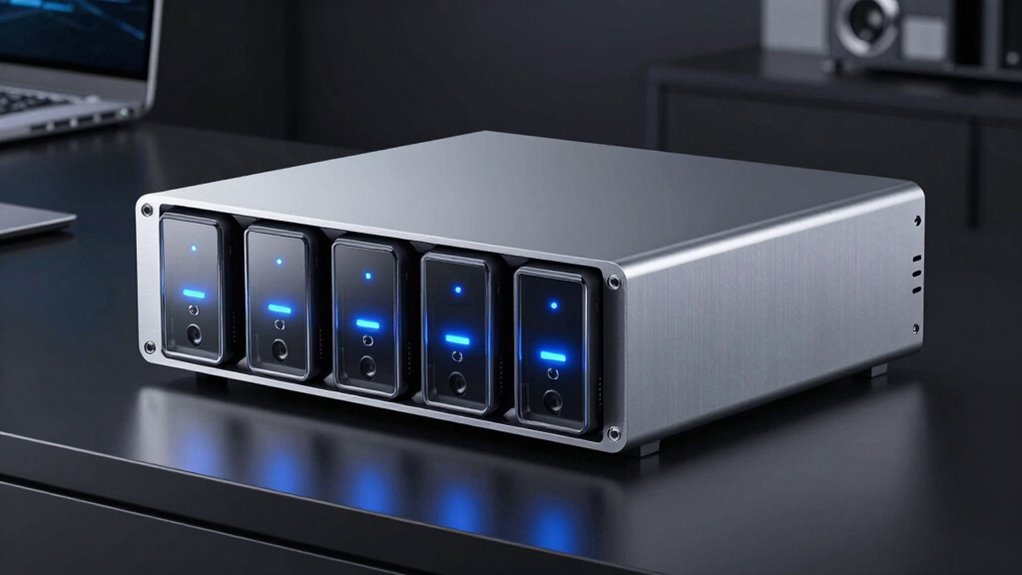

If you’re seeking reliable, high-capacity Thunderbolt 8-bay RAID enclosures, the choices can be overwhelming. The OWC ThunderBay 8 stands out for its flexible RAID options and massive storage potential, perfect for demanding workflows. The SanDisk Professional G-RAID Shuttle offers portability combined with high speed and removable drives, ideal for on-location work. Meanwhile, the OWC ThunderBay Flex brings expansion versatility with PCIe slots and support for multiple drive types, suited for advanced users needing customization. Each has unique tradeoffs: high price tags, size, or setup complexity. Here’s a detailed comparison to help you decide which fits your needs best.

Get the latest gadgets delivered free — and shop member deals
- Fast, free delivery on millions of items
- Access to Prime Big Deal Days deals on October 6–7
- Prime Video, Amazon Music and more included
Complete the kit



Key Takeaways
- The OWC ThunderBay 8 offers the highest maximum storage capacity with extensive RAID options, but at a premium price.
- SanDisk G-RAID Shuttle delivers excellent speed and removable drives, making it ideal for portable workflows, despite being bulkier.
- The ThunderBay Flex provides unparalleled drive support and expansion options but is heavy and more complex to set up.
- All models require Thunderbolt 3, limiting compatibility with older systems without adapters.
- Pricing varies significantly, so budget considerations are key depending on your workflow needs.
| OWC ThunderBay 8 Eight-Bay Thunderbolt Storage Enclosure with SoftRAID |  | Best Overall for Capacity and Flexibility | Drive Bays: 8 | Supported Drives: 2.5 or 3.5-inch SSDs/HDDs | Ports: Dual Thunderbolt 3 | VIEW ON AMAZON | See Our Full Breakdown |
| SanDisk Professional G-RAID Shuttle 8-Bay Thunderbolt 3 RAID Array with 160TB (8x 20TB) Removable HDD |  | Best for Portability and Speed | Capacity: 160TB | Number of Bays: 8 | Hard Drive Type: Removable Ultrastar HDD | VIEW ON AMAZON | See Our Full Breakdown |
| OWC ThunderBay 4 Thunderbolt 40Gb/s Four-Bay SATA Enclosure with SoftRAID |  | Best for High-Speed Performance in Compact Form | Hardware Interface: Thunderbolt 3 | Memory Storage Capacity: 4 TB | Supported Devices: Desktop, Laptop, Mac and Windows | VIEW ON AMAZON | See Our Full Breakdown |
| OWC ThunderBay Flex 8TB Storage/Dock/PCIe Expansion Enclosure |  | Most Versatile Expandability | Drive Bays: 8 | Supported Drives: SATA/SAS, U.2, M.2 NVMe | Capacity: Up to 144TB | VIEW ON AMAZON | See Our Full Breakdown |
| QNAP TS-873A-8G 8-Bay NAS |  | Best for Network-Integrated Storage | Processor: AMD Ryzen Embedded V1500B quad-core 2.2 GHz | RAM: 8GB DDR4 (expandable to 64GB) | Number of Bays: 8 | VIEW ON AMAZON | See Our Full Breakdown |
More Details on Our Top Picks
OWC ThunderBay 8 Eight-Bay Thunderbolt Storage Enclosure with SoftRAID
The OWC ThunderBay 8 is designed for users who need substantial storage combined with flexible RAID configurations. Its support for up to 1,152TB makes it a go-to for large media libraries, and SoftRAID software adds robust management options. Compared to other options, it excels in maximum capacity and RAID variety, including RAID 0/1/4/5/10 and Apple RAID. However, its premium price and reliance on Thunderbolt 3 limit compatibility with older systems. This pick makes the most sense for professionals who prioritize capacity and RAID flexibility above portability or budget.
Pros:- Massive storage capacity up to 1,152TB
- Flexible RAID options with SoftRAID software
- Daisy-chain capability for multiple units
- Plug-and-play with included Thunderbolt cable
Cons:- High cost compared to other options
- Requires Thunderbolt 3 port, limiting older system compatibility
Best for: High-capacity storage and flexible RAID configurations for professional workflows
Not ideal for: Users with limited budgets or older Thunderbolt 2 or USB-C systems
- Drive Bays:8
- Supported Drives:2.5 or 3.5-inch SSDs/HDDs
- Ports:Dual Thunderbolt 3
- Maximum Storage Capacity:up to 1,152TB
- RAID Support:RAID 0/1/4/5/10, Apple RAID, Windows Disk Manager
- Compatibility:Mac and Windows
Our verdict“Ideal for professionals needing maximum storage and RAID flexibility, despite its higher price and system requirements.”
SanDisk Professional G-RAID Shuttle 8-Bay Thunderbolt 3 RAID Array with 160TB (8x 20TB) Removable HDD
The SanDisk G-RAID Shuttle offers a compelling mix of high-speed data transfer and removable drives, making it perfect for on-location shoots or mobile workflows. It supports up to 160TB in RAID configurations—less than the OWC but still substantial—and boasts transfer speeds up to 2000MB/s. Its removable Ultrastar drives simplify maintenance and reliability, especially in demanding environments. However, its bulkier design reduces portability compared to smaller enclosures, and its high price may be a barrier for some. This model is best for professionals who need fast, portable storage with easy drive replacement.
Pros:- High data transfer speeds up to 2000MB/s
- Removable Ultrastar drives for reliability and maintenance
- Supports multiple RAID modes
- Robust build for demanding environments
Cons:- Bulkier and heavier than some alternatives
- Premium price may be prohibitive for some users
Best for: High-capacity, portable workflows for demanding environments
Not ideal for: Users seeking a lightweight, compact solution or on a tight budget
- Capacity:160TB
- Number of Bays:8
- Hard Drive Type:Removable Ultrastar HDD
- Connection:Thunderbolt 3, USB-C
- Max Read Speed:1900MB/s
- Max Write Speed:2000MB/s
- Power Delivery:Up to 85W
Our verdict“Excellent choice for mobile professionals requiring fast, reliable, and removable RAID storage.”
OWC ThunderBay 4 Thunderbolt 40Gb/s Four-Bay SATA Enclosure with SoftRAID
The OWC ThunderBay 4 provides impressive transfer speeds up to 1527MB/s and supports RAID configurations suited for demanding workflows, but it only has four bays. For users who need maximum speed in a smaller footprint, this is a compelling option, especially given its support for both SSDs and HDDs without adapters. Its aluminum design adds durability, though it’s relatively heavy and requires a Thunderbolt 3 port. While it doesn’t match the capacity of the 8-bay models, its speed and RAID management make it a strong choice for high-performance tasks where size matters less.
Pros:- Fast transfer speeds up to 1527MB/s
- Supports multiple RAID modes including SoftRAID
- Compatible with 2.5″ and 3.5″ drives
- Robust aluminum enclosure
Cons:- Limited to 4 bays, less capacity
- Heavy and requires Thunderbolt 3, limiting compatibility
Best for: High-speed workflows with limited drive capacity needs
Not ideal for: Users requiring large storage capacities or maximum expansion
- Hardware Interface:Thunderbolt 3
- Memory Storage Capacity:4 TB
- Supported Devices:Desktop, Laptop, Mac and Windows
- Hard Disk Form Factor:2.5 inches
- Data Transfer Rate:1527 MB/s
- Warranty:3-year SoftRAID subscription included
Our verdict“Best suited for users prioritizing speed and quality in a smaller setup, though with less overall storage capacity.”
OWC ThunderBay Flex 8TB Storage/Dock/PCIe Expansion Enclosure
The ThunderBay Flex stands out for its support of multiple drive types, including SATA, SAS, U.2, and NVMe, with a maximum capacity of 144TB. Its speed of up to 2750MB/s and front ports for USB-C, USB-A, SD, and CFexpress cards make it a flexible hub for media professionals. The PCIe x16 expansion slot allows for additional hardware, adding another layer of customization. However, it is heavy, large, and complex to set up, which may deter users seeking a straightforward solution. This model suits those needing extensive hardware support and expandability in a single enclosure.
Pros:- Supports multiple drive types and large capacities up to 144TB
- High-speed transfer up to 2750MB/s
- Multiple front ports for peripherals and card readers
- PCIe x16 expansion for additional hardware
Cons:- Heavy and large, requiring significant space
- Complex setup with RAID management software
- Limited RAID options for non-Mac users
Best for: Advanced users requiring drive type versatility and expansion options
Not ideal for: Users seeking a lightweight, simple plug-and-play device
- Drive Bays:8
- Supported Drives:SATA/SAS, U.2, M.2 NVMe
- Capacity:Up to 144TB
- Max Speed:2750MB/s
- Front Ports:USB-C, USB-A, SD 4.0, CFexpress
- Expansion Slot:PCIe x16
Our verdict“Best for power users needing maximum configurability and hardware support, despite its size and complexity.”
QNAP TS-873A-8G 8-Bay NAS
The QNAP TS-873A-8G provides a different approach by integrating network storage with its powerful AMD Ryzen processor. It offers a more comprehensive solution for users who want an 8-bay NAS with high-speed Ethernet, expandable RAM, and versatile connectivity. While it doesn’t rely solely on Thunderbolt, it supports multiple USB ports and network interfaces for flexible data access. It’s ideal for those who prefer a dedicated NAS setup over direct-attached storage but may be too complex for users unfamiliar with network configuration. It’s best for team environments or workflows relying on network access.
Pros:- Powerful AMD Ryzen processor for demanding tasks
- Expandable RAM up to 64GB
- Multiple high-speed Ethernet and USB ports
- Built-in network management features
Cons:- No included drives, increasing initial cost
- Complex setup for those unfamiliar with NAS systems
Best for: Network-centric workflows requiring NAS capabilities
Not ideal for: Users seeking direct-attached Thunderbolt-only storage
- Processor:AMD Ryzen Embedded V1500B quad-core 2.2 GHz
- RAM:8GB DDR4 (expandable to 64GB)
- Number of Bays:8
- Ethernet Ports:2 x 2.5 Gb
- USB Ports:3 x USB 3.2 Gen 2, 1 x USB 3.2 Gen 1
Our verdict“Ideal for users needing a network-connected 8-bay storage system with substantial processing power, at the expense of simplicity.”
How We Picked
To assemble this list, I focused on models that offer 8-bay Thunderbolt connectivity, prioritizing high capacity, speed, expandability, and user support. I compared their hardware specs, RAID flexibility, software features, and real-world tradeoffs like size, weight, and price. I also considered compatibility with both Mac and Windows, ensuring the options cater to different workflows. Each product was evaluated on its ability to serve different user types—from professionals requiring maximum capacity to those needing portability or advanced expandability.
Factors to Consider When Choosing Thunderbolt Raid Enclosures 8 Bay
Choosing the right 8-bay Thunderbolt RAID enclosure depends heavily on your specific workflow needs. Are you after maximum capacity, portability, expandability, or network integration? The key factors include drive support, speed, software compatibility, and physical size. Understanding these aspects can help you match a product that balances performance with your environment.
Capacity and RAID Flexibility
If maximum storage is your priority, the OWC ThunderBay 8 provides an impressive 1,152TB capacity with extensive RAID options, making it suitable for media pros managing large libraries. For users who prefer removable drives for reliability, the SanDisk G-RAID Shuttle offers up to 160TB with easy swapping. Keep in mind that larger capacities often come with higher costs and power consumption, so evaluate your storage needs carefully.
Speed and Performance
Speed is vital for demanding tasks like 4K editing or VR content creation. The OWC ThunderBay 4 supports speeds up to 1527MB/s, while the ThunderBay Flex can reach up to 2750MB/s—ideal for high-speed workflows. If portability with speed is essential, the SanDisk G-RAID Shuttle excels with speeds up to 2000MB/s, though its bulkier size affects mobility.
Expandability and Drive Support
The ThunderBay Flex stands out for its support of multiple drive types—including NVMe, SAS, and U.2—plus PCIe expansion, making it suitable for power users customizing their hardware. Conversely, the OWC ThunderBay 8 offers a more straightforward setup focused on RAID flexibility with standard drives, while the NAS option provides network access for collaborative environments.
Size, Weight, and Compatibility
If space and portability matter, the SanDisk G-RAID Shuttle is more portable despite its weight. The OWC ThunderBay 8 and Flex are larger and heavier, requiring dedicated space. Compatibility is also key: all enclosures support Thunderbolt 3, but older systems may need adapters, and NAS solutions like QNAP work over Ethernet, suitable for networked setups.
Frequently Asked Questions
Can I use these enclosures with both Mac and Windows?
Most of the recommended enclosures, including the OWC ThunderBay 8 and the SanDisk G-RAID Shuttle, support both Mac and Windows systems, often through included software or native drivers. However, some features like SoftRAID are optimized for Mac, so check compatibility if you rely heavily on specific software. Always verify system requirements before purchase to ensure seamless integration.
Are these enclosures suitable for 4K or 8K video editing?
Yes, especially models supporting speeds over 1500MB/s, such as the ThunderBay 4 and Flex, are well-suited for real-time 4K and even some 8K workflows. The SanDisk G-RAID Shuttle, with speeds up to 2000MB/s, also handles large video files effectively. For optimal performance, pair these enclosures with SSDs or high-speed HDDs, depending on your budget and capacity needs.
What are the main differences between the 8-bay models and the four-bay options?
The primary difference lies in capacity and expandability. 8-bay enclosures support larger total storage and more RAID configurations for redundancy and performance. The four-bay models, like the OWC ThunderBay 4, typically offer higher speeds due to fewer drives and are more compact, making them better suited for users with space constraints or those prioritizing speed over capacity.
Is Thunderbolt 3 mandatory for these enclosures?
For the models listed, Thunderbolt 3 is essential to achieve their maximum speeds and features. Some enclosures also support USB-C, but to fully utilize their RAID and transfer capabilities, Thunderbolt 3 is recommended. If your system lacks Thunderbolt 3, you may need adapters or consider alternative storage solutions compatible with your interface.
How important is software like SoftRAID in these enclosures?
RAID management software such as SoftRAID significantly enhances flexibility and ease of use, allowing for complex configurations, monitoring, and data integrity features. Enclosures bundled with SoftRAID, like the OWC models, are better suited for users who want advanced control. However, some may prefer native or system-based RAID options to avoid additional software costs or complexity.
Conclusion
For users prioritizing maximum capacity and RAID flexibility, the OWC ThunderBay 8 remains the best choice, despite its price. Professionals needing portability and fast removable drives will find the SanDisk G-RAID Shuttle ideal. Power users requiring extensive hardware support and expandability should consider the ThunderBay Flex. Meanwhile, those seeking network integration or a versatile NAS setup will benefit from the QNAP TS-873A. Your ideal pick hinges on balancing capacity, speed, size, and workflow environment.
Halloween Picks
halloween
As an affiliate, we earn on qualifying purchases.