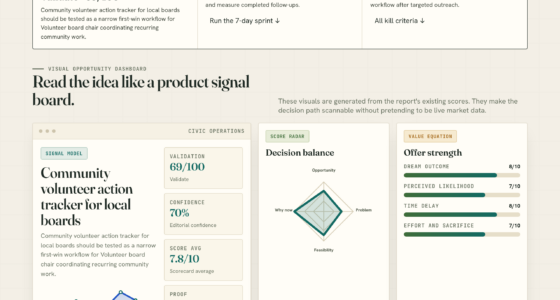

📊 Full opportunity report: The Next Generation Of AI: 9 Trends For 2026 on ThorstenMeyerAI.com — validation score, market gap, and execution plan.
TL;DR
This report identifies nine confirmed AI trends for 2026, including advancements in generative models, increased AI regulation, and expanded industry adoption. These developments are set to significantly influence technology and business landscapes, as detailed in the original analysis.
Nine key AI trends for 2026 have been confirmed by industry experts and research firms, signaling a transformative year for artificial intelligence. These developments include breakthroughs in generative AI, broader industry adoption, and new regulatory frameworks. The confirmation of these trends underscores their importance for technology, business, and policy sectors.
The nine trends identified for 2026 are based on recent industry reports, expert forecasts, and ongoing technological advances. For more on how to stay ahead, see how tracking AI trends can save your workflow. They include significant improvements in generative AI capabilities, increased focus on ethical AI and regulation, and wider deployment across sectors like healthcare, finance, and manufacturing.
Experts from leading AI research organizations and tech companies have confirmed these trends, emphasizing their expected impact on innovation and market dynamics. Learn more about the top solutions in Top AI & Automation Solutions For The Next Decade. For example, advancements in multimodal models and personalized AI assistants are already underway, with further progress anticipated this year.
Implications of 2026 AI Trends for Industry and Society
These confirmed AI trends are poised to reshape multiple sectors by enhancing productivity, enabling new applications, and prompting regulatory changes. Their adoption will influence economic growth, workforce dynamics, and ethical considerations, making them critical for policymakers, businesses, and consumers to monitor. The confirmation of these trends highlights the accelerating pace of AI innovation and its deepening integration into daily life.generative AI development tools
As an affiliate, we earn on qualifying purchases.
As an affiliate, we earn on qualifying purchases.
Recent Developments and Industry Forecasts for 2026
Over the past few years, AI has rapidly advanced, with notable breakthroughs in natural language processing, computer vision, and autonomous systems. Industry reports from organizations like OpenAI, Gartner, and McKinsey have forecasted continued growth and diversification of AI applications through 2026. These forecasts are now supported by recent expert confirmations, indicating that these trends are not speculative but imminent realities. The ongoing investments and policy discussions also suggest a strategic shift toward more regulated and ethical AI deployment.“The trends we see emerging in 2026 are not just incremental improvements but transformative shifts that will redefine how AI integrates into everyday life.”
— Dr. Lisa Chen, AI research director at TechInsights

Build Financial Software with Generative AI (From Scratch)
As an affiliate, we earn on qualifying purchases.
As an affiliate, we earn on qualifying purchases.
Unconfirmed Aspects and Potential Challenges for 2026
While the nine trends are confirmed by industry experts, specific details about their implementation timelines, regulatory responses, and societal impacts remain uncertain. The pace of technological development could accelerate or encounter unforeseen obstacles, such as ethical dilemmas or geopolitical tensions. Additionally, the degree to which regulatory frameworks will adapt to these innovations is still evolving, and their effectiveness remains to be seen.personalized AI assistant devices
As an affiliate, we earn on qualifying purchases.
As an affiliate, we earn on qualifying purchases.
Next Steps in Monitoring AI Developments for 2026
Industry leaders and policymakers will continue to monitor the rollout of these trends throughout 2026. Key milestones include the deployment of advanced multimodal AI systems, the introduction of comprehensive AI regulations in major markets, and the expansion of AI applications in critical sectors. Researchers and regulators will also focus on addressing ethical concerns and ensuring responsible AI use. Stakeholders should stay informed about these developments to adapt strategies accordingly.
multimodal AI model hardware
As an affiliate, we earn on qualifying purchases.
As an affiliate, we earn on qualifying purchases.
Key Questions
What are the most impactful AI trends expected in 2026?
The most impactful trends include advancements in generative AI, broader industry adoption, improved multimodal models, and stronger regulatory frameworks to ensure responsible development.
How will AI regulation evolve in 2026?
Regulatory efforts are expected to become more comprehensive, with major markets like the US, EU, and China introducing frameworks that address ethical concerns, safety, and transparency in AI deployment.
Which industries will be most affected by these AI trends?
Healthcare, finance, manufacturing, and customer service are among the sectors most likely to see significant transformation due to these AI developments.
Are these AI trends confirmed or still speculative?
The nine trends are confirmed by industry experts and recent reports, though specific implementation details and societal impacts are still developing.
What should businesses do to prepare for these AI trends?
Businesses should invest in AI research, develop ethical guidelines, and stay informed about regulatory changes to leverage AI advances responsibly and competitively.
Source: ThorstenMeyerAI.com