
📊 Full opportunity report: How Benefit Check Bots Improve Access To Medicaid, SNAP, And EITC on IdeaNavigator AI — validation score, market gap, and execution plan.
Open a free Amazon Business account
Business pricing, bulk buying and tax-exempt orders.
Create a free accountAs an affiliate, we earn on qualifying purchases.
TL;DR
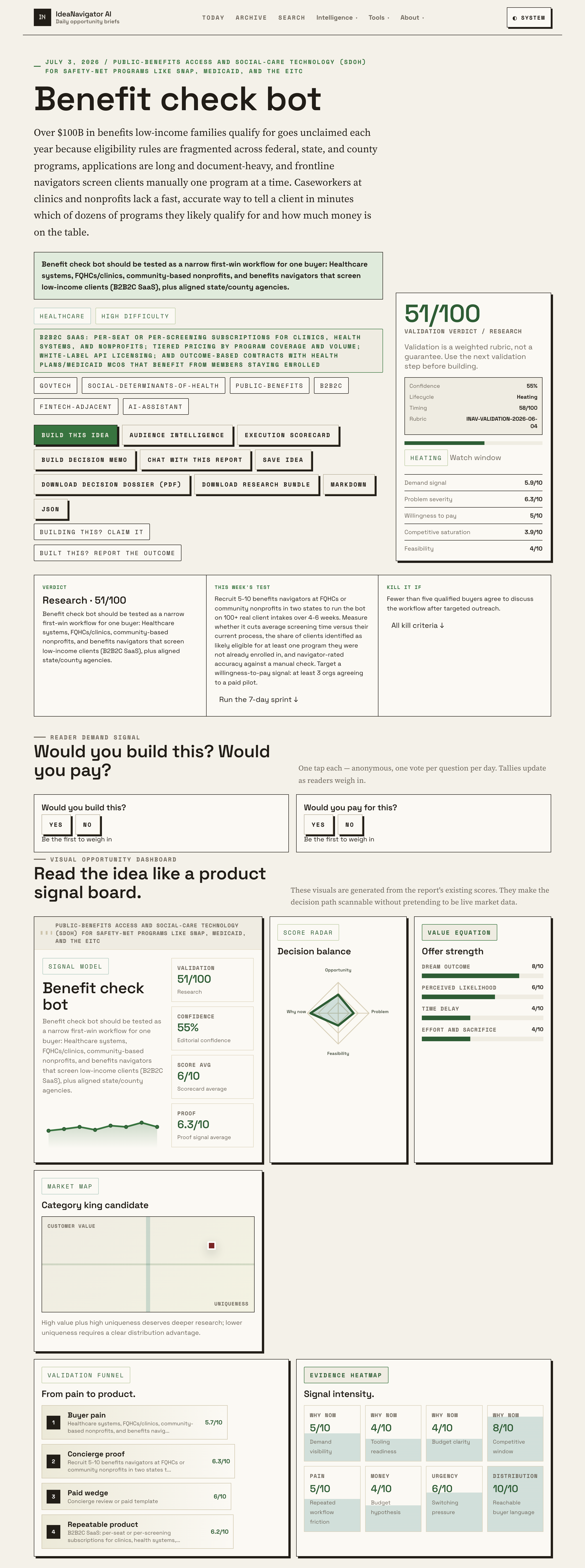
Benefit check bots are being tested as a new way for health systems and nonprofits to quickly identify low-income clients’ eligibility for programs like Medicaid, SNAP, and EITC. This technology aims to increase access, reduce manual screening time, and fill gaps left by traditional methods.
Benefit check bots are being piloted as a new tool to help clinics, health systems, and nonprofits quickly identify low-income clients’ eligibility for programs such as Medicaid, SNAP, and EITC. This development aims to address longstanding barriers to benefits access caused by complex eligibility rules, lengthy applications, and manual screening processes. The initiative is responding to a significant gap left by the shutdown of Benefits Data Trust in 2024, which previously provided outsourced benefits enrollment services across multiple states.
The benefit check bot is a white-label, conversational AI tool designed to be embedded on websites or used via SMS by frontline staff. It asks a series of yes/no and multiple-choice questions, then provides an estimated list of benefits for programs including Medicaid, SNAP, EITC, and others, along with application links and required documentation checklists. The initial pilot involves 5-10 benefits navigators across two states, aiming to evaluate whether the tool reduces screening time, improves benefit identification rates, and maintains accuracy. The bot is built to handle multilingual interactions and can be customized for different state rules, making it adaptable for various jurisdictions.
The model is a B2B2C SaaS offering, with clinics and nonprofits paying per user or screening, and additional revenue streams from API licensing and outcome-based contracts with Medicaid managed care organizations. The goal is to fill the capacity gap created by the closure of Benefits Data Trust and to leverage conversational AI to deliver near-zero marginal cost screening, especially during post-pandemic Medicaid redeterminations.
Impact on Benefits Access and System Efficiency
This technology could significantly increase the number of low-income families accessing benefits they qualify for, potentially recovering over $100 billion in unclaimed benefits annually. By automating screening, clinics and nonprofits can serve more clients efficiently, reduce administrative burdens, and improve accuracy. The shift toward AI-driven tools also addresses workforce shortages and reduces reliance on expensive call centers, making benefits navigation more scalable and accessible, especially in multilingual contexts.
Medicaid eligibility screening software
As an affiliate, we earn on qualifying purchases.
As an affiliate, we earn on qualifying purchases.
Addressing Fragmentation and Manual Screening Challenges
For years, eligibility for programs like Medicaid, SNAP, and EITC has been hampered by complex, overlapping rules spread across federal, state, and local agencies. Manual screening by caseworkers is time-consuming and prone to errors, often leaving millions of dollars in benefits unclaimed each year. The shutdown of Benefits Data Trust in 2024 removed a key outsourced capacity, intensifying the need for automated solutions. Recent policy shifts, including post-pandemic Medicaid redeterminations, have increased demand for efficient eligibility checks, highlighting the potential for conversational AI to streamline benefits access.
Early pilots and studies suggest that AI-powered screening can cut processing time and improve benefit capture, but widespread adoption remains in the testing phase. The technology’s success depends on validation of accuracy, user acceptance by frontline staff, and integration with existing systems.
SNAP benefits application assistance tools
As an affiliate, we earn on qualifying purchases.
As an affiliate, we earn on qualifying purchases.
Validation and Adoption Uncertainties
It is not yet clear how accurately the benefit check bot will perform across diverse populations and varying state rules once fully deployed. While initial pilots aim to measure screening time reduction and benefit capture rates, long-term effectiveness, user acceptance, and integration with existing case management systems remain to be proven at scale. Additionally, questions about data privacy, multilingual capabilities, and adaptability to policy changes are still under review.
EITC tax credit eligibility checker
As an affiliate, we earn on qualifying purchases.
As an affiliate, we earn on qualifying purchases.
Next Steps for Pilot Expansion and Validation
The pilot program will continue over the next 4-6 weeks, with participating clinics and nonprofits collecting data on screening efficiency, accuracy, and client outcomes. Success metrics include reduced time per screening, increased identification of eligible benefits, and positive navigator feedback. Pending favorable results, developers plan to expand the pilot to additional states, refine the AI’s accuracy, and prepare for broader commercialization. Stakeholders will also monitor policy developments and technological improvements to enhance the tool’s scalability and effectiveness.
As an affiliate, we earn on qualifying purchases.
Key Questions
How does the benefit check bot improve eligibility screening?
The bot automates the questioning process, quickly analyzing client responses to estimate likely program eligibility and benefits, reducing manual effort and errors.
Will this technology replace human benefits navigators?
No, it is designed to augment frontline staff by handling routine screening, allowing navigators to focus on complex cases and client support.
Is the benefit check bot available for all states?
Currently, the pilot is limited to 2-3 states with customized rules, but the platform is designed to be adaptable for additional jurisdictions.
What are the main challenges for widespread adoption?
Challenges include validating accuracy across diverse populations, ensuring data privacy, integrating with existing systems, and securing funding for broader deployment.
How soon could this technology impact benefits access at scale?
If pilot results are positive, wider adoption could occur within 1-2 years, contingent on validation, funding, and policy support.
Source: IdeaNavigator AI
Flea & tick season Picks
flea and tick prevention
As an affiliate, we earn on qualifying purchases.